

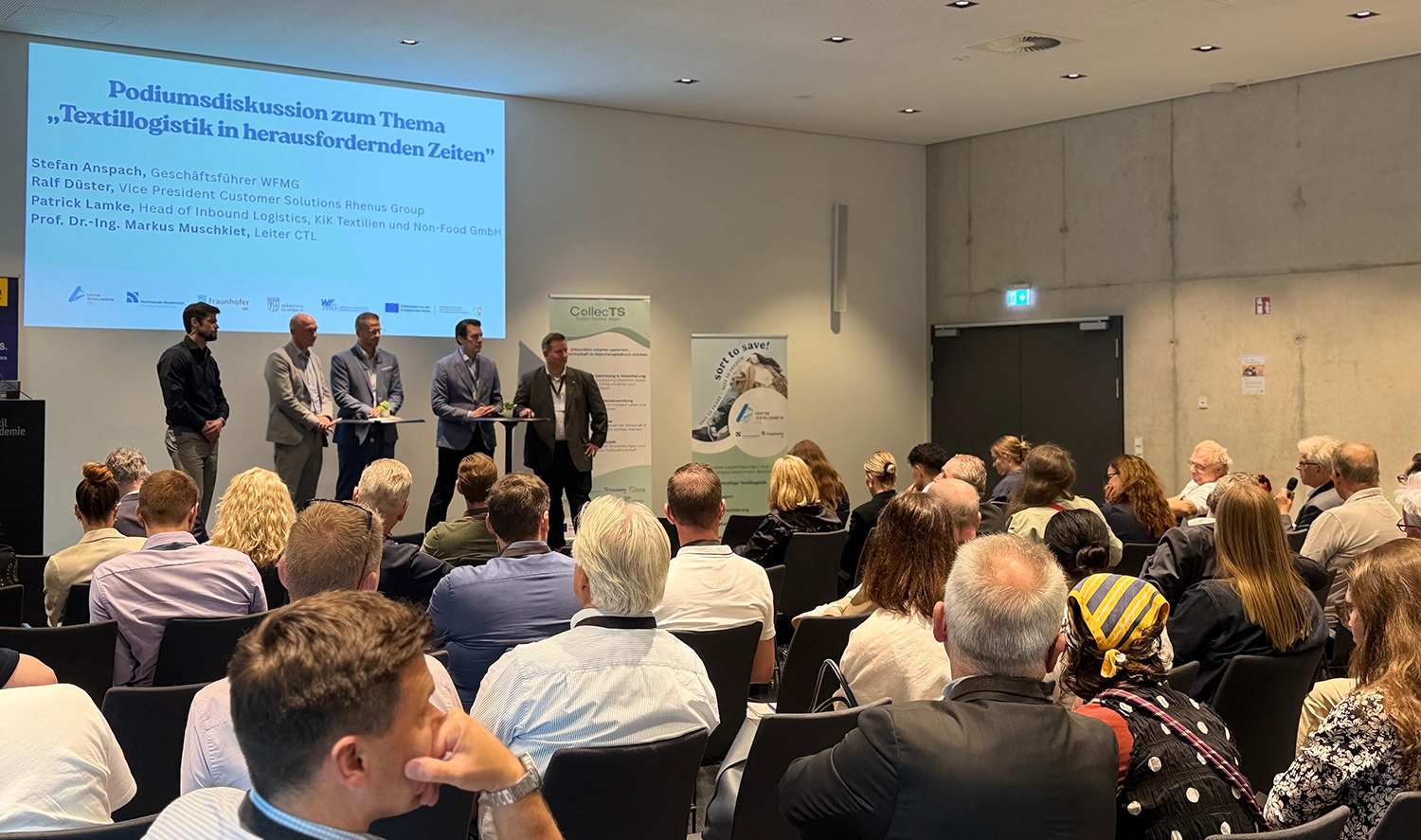
How can the textile industry be made fit for the future in the face of growing demands for sustainability, digitalisation and resource efficiency? This was the question addressed at the 8th Textile Logistics Forum on 8 July 2026 in Mönchengladbach. Under the theme ‘Textile Logistics in Challenging Times’, 75 representatives from academia, industry and practice came together to discuss current developments, innovative technologies and concrete solutions for the textile value chain.
The forum was organised by the Centre for Textile Logistics (CTL) at the Hochschule Niederrhein (HSNR) in collaboration with the Fraunhofer Institute for Material Flow and Logistics (IML) in Dortmund. The aim of this annual event is to strengthen the exchange between research and industry and to jointly develop perspectives for efficient and sustainable textile logistics.
“The challenges facing the textile industry can only be overcome by working together. In particular, the combination of scientific expertise, technological innovations and practical application is crucial for developing new solutions for the future of textile logistics,” emphasised Prof. Dr.-Ing. Markus Muschkiet, Head of the Centre for Textile Logistics at the HSNR and at the Fraunhofer IML.
This year’s programme covered the full spectrum of current issues: the focus was, amongst other things, on the development of a circular economy for textiles, the use of artificial intelligence in logistics processes, sustainable materials, recycling potential and smart solutions for the collection and recycling of end-of-life textiles.
Following the welcome address by Prof. Dr.-Ing. Markus Muschkiet and Prof. Dr.-Ing. Uwe Clausen (Director of the Fraunhofer IML and of the Institute for Transport Logistics at Dortmund Technical University), a varied programme of specialist presentations took place. Prof. Dr.-Ing. Robert Groten from HSNR presented research results on the integration of sustainability aspects relating to polymers in textile product development and highlighted the importance of product design for the subsequent reuse and recycling of textiles.
Dr Anna Missong, academic staff at HSNR, then presented findings from the project “Nachhal(l)tigkeit – Sustainable Skills Training for an Environmentally Friendly Textile and Clothing Industry”.
A key item on the agenda was the panel discussion ‘Textile Logistics in Challenging Times’. Prof. Dr.-Ing. Markus Muschkiet, together with Stefan Anspach (Managing Director of Mönchengladbach Economic Development Agency), Ralf Düster (Vice President of Customer Solutions at the Rhenus Group) and Patrick Lamke (Head of Inbound Logistics at KiK Textilien und Non-Food GmbH) on current market conditions, new demands on supply chains and the importance of resilient logistics structures.
“Textile logistics is facing a fundamental transformation. Issues such as the circular economy and digitalisation will have a significant impact on the sector in the coming years. To address this, we need new partnerships and innovative approaches across the entire value chain,” said Prof. Dr.-Ing. Markus Muschkiet.
The importance of Mönchengladbach as a textile hub was also highlighted. Felix Heinrichs, Lord Mayor of Mönchengladbach, emphasised in his opening remarks the role of the sector in the city’s economic development and the importance of research and innovation for the future of the location.
The subsequent start-up pitches offered insights into new business models. The company “nodes”, which emerged from the Centre for Textile Logistics and was represented by Sabrina Mauter and Lisa Gudehus, is developing a digital recycling management tool for the collection and distribution of textile offcuts and waste materials. The aim is to improve the tracking of textile materials and return them to recycling loops. The start-up “Baybi.O”, presented by Günther Winck, is taking a stand against textile overproduction with a waste-free, on-demand production model.
In addition, Janika Schüßler, an academic staff member at the CTL, presented the results of a consumer survey on perceptions of the obligation to separate waste textiles for collection in Germany. Another specialisation was the “CollecTS” (Collect Textiles Smart) research project, presented by Anna Engelpracht (Head of Environmental Management at mags Mönchengladbacher Abfall-, Grün- und Straßenbetriebe AöR) and Lisa Gudehus (CTL). The aim of the project is to develop smart solutions for the collection of used textiles, thereby laying the foundation for improved recycling processes.
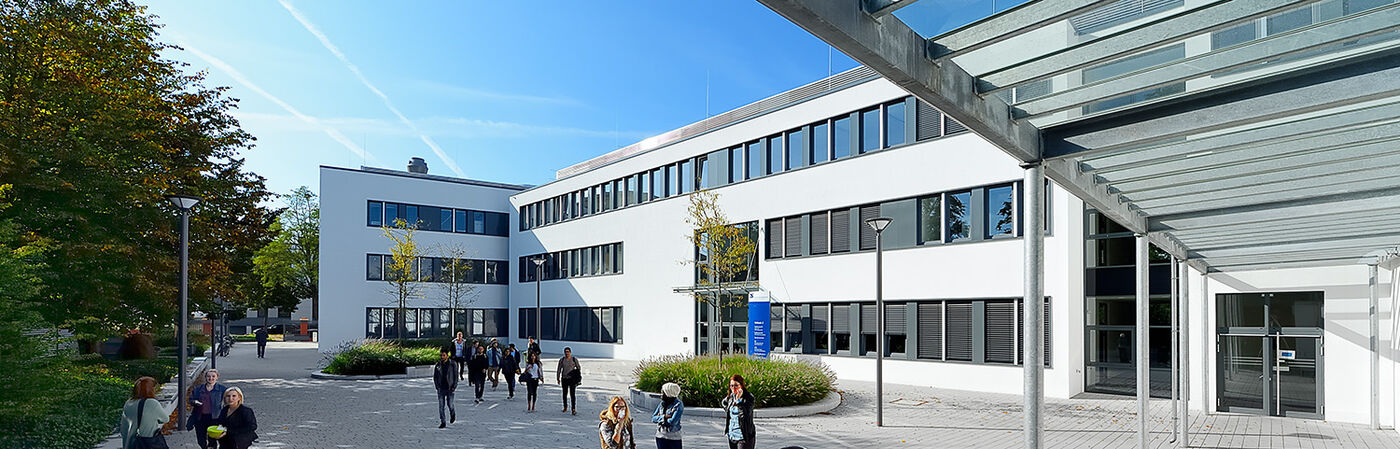
To round off the event, participants took part in workshops and were given guided tours of the laboratories and internships of the Faculty of Textile and Clothing Technology at the University of Applied Sciences Niederrhein (HSNR). There was also time for networking and professional exchange.
About the Centre for Textile Logistics (CTL): The Centre for Textile Logistics (CTL) is a joint venture between the Hochschule Niederrhein and the Fraunhofer Institute for Material Flow and Logistics (IML). At the Mönchengladbach and Dortmund sites, interdisciplinary teams work under the joint leadership of Prof. Dr Markus Muschkiet on practical research questions relating to the logistics of textile products. Under the guiding principle ‘Logistics for textiles – textiles for logistics’, the CTL combines scientific research with the requirements of industry and develops innovative solutions for sustainable and efficient textile logistics.