

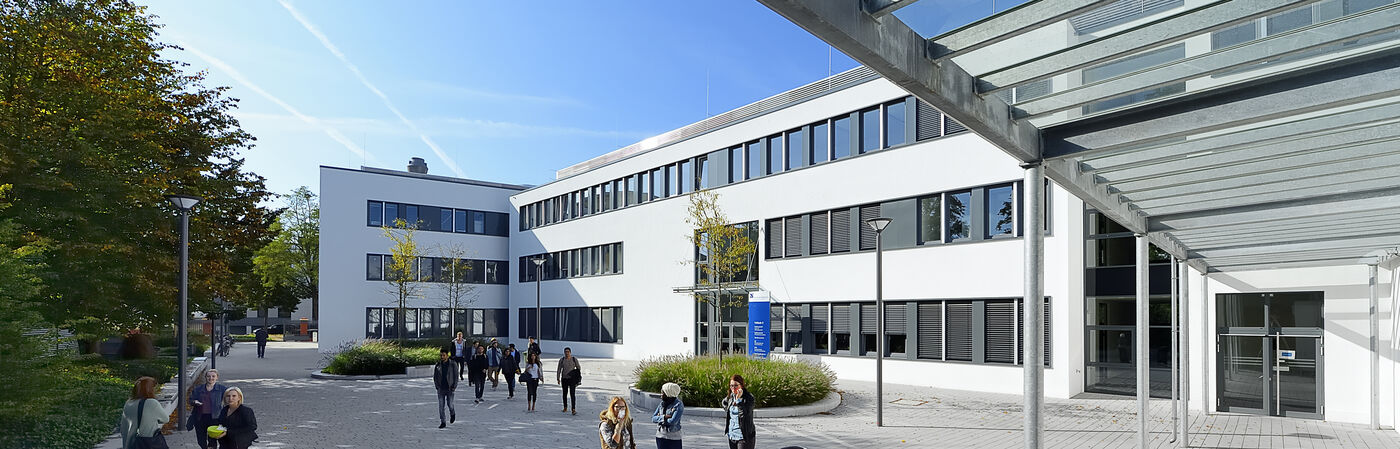
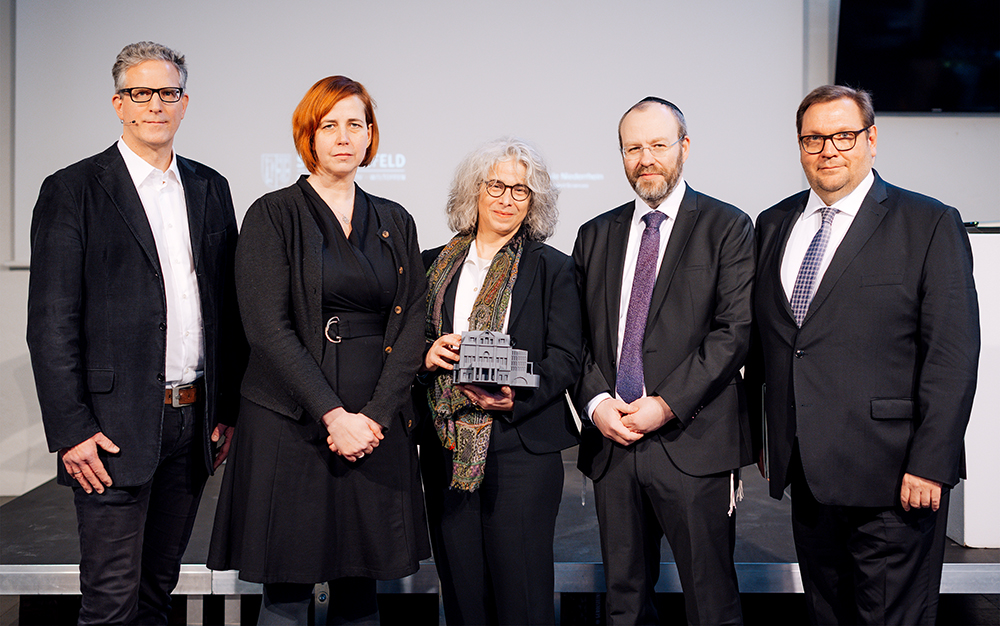
"I sat next to him every day, but one day he just wasn't there. He never came to class again." On the occasion of Holocaust Remembrance Day at The Hochschule Niederrhein, Lord Mayor Frank Meyer recalled the fate of Jews killed during the Nazi era and gave a speech that included reports from the perspective of contemporary witnesses. The Lord Mayor thus introduced a moving ceremony, which was characterised by diverse contributions from the university and poignant speeches from various actors. For the first time, the celebration of the "International Day of Commemoration in Memory of the Victims of the Holocaust" - held annually on 27 January to mark the liberation of the Auschwitz concentration camp in 1945 - did not take place at a Krefeld school, but at The Hochschule Niederrhein on Frankenring in Krefeld. This year's motto was "Everyone is a human being. Everyone is someone" by Michel Friedmann.
Addressing the students, Frank Meyer said: "You have great social power. You are the movers and shakers of tomorrow. With your decisions and your commitment, you are shaping the future. But you also have a special social responsibility. The fact that we are here at the university today is therefore also an important sign." Between the speeches, students from The Hochschule Niederrhein presented contributions that they had developed. The various faculties impressively demonstrated how they consider and implement memorial work in their subjects. Tabea Pollen, Jana Zaitz and Markus Gansel, for example, presented work on the book "Mein himmelblaues Akkordeon", which tells the life story of the Krefeld Auschwitz survivor Werner Heymann. While Tabea Pollen read from the biography, linocuts by Jana Zaitz were shown in large format. Afterwards, an impressive animated film by Markus Gansel was shown in large format, accompanied by the voice of Krefeld actor Matthias Oelrich.
In another contribution, students talked about a trip to a memorial site in Auschwitz and how the impressions they experienced there left a lasting impression on them. Matthias Hakes from the Catholic University Centre Lakum has been organising the trips since 2012. Ramona Theis showed students how remembrance work flows into the educational profession. She presented seminar papers from the fields of cultural education and social work and addressed, for example, the killing of people with disabilities, known as "euthanasia" in Nazi terminology, or the marginalisation of minorities. She was accompanied by university professor Andris Breitling, who teaches ethics, social philosophy and cultural theory, and led the event. "Human dignity is not an abstract concept, but the foundation course of democracy," he said, explaining his special commitment to the culture of remembrance. "'Resist the beginnings' must not just be a heading in a textbook."
University President Susanne Meyer also addressed the obligation of educational institutions to communicate the fundamental values of democracy in a sustainable way. She told the story of Rudolph S. Jacobs. The Jewish boy was a pupil at the Krefeld Weaving School, a predecessor of today's university. He managed to flee to America via Holland, but spent weeks in solitary confinement during his escape and lost his parents - they were murdered in a concentration camp. The university president was visibly moved as she read from a letter that Rudolph Jacobs wrote to Jasmin, a student from Krefeld, in the 1980s. Jacobs told her how he froze in fear when a new teaching education teacher in a black SS uniform entered the classroom. Despite the uniform, he turned out to be a fair instructor and Jacobs assured Jasmin: "I believe in the fundamental goodness of people". For Meyer, "a moment in which education briefly halted barbarism".
In his speech, Samuel Naydych, representing the Jewish community in Krefeld, made connections to the current global political situation. He praised his country, Germany, for its handling of the Nazi past: "We Germans should not have an eternal sense of guilt, but can be proud of the way we take responsibility. We should continue to face up to this responsibility.
Historian Sandra Franz, head of the Nazi documentation centre of the city of Krefeld, Villa Merländer, addressed the role of universities during the Nazi era. "The universities did not make any serious attempts to counter the interventions of the Nazi regime. On the contrary: numerous university lecturers were complicit in the years that followed," she explained, describing how students had undertaken downright hunts during the Nazi era. She contrasted this with the commitment of students today: "I personally place my hope in the next generation, who think critically, analyse with an open mind and hopefully learn from the mistakes of the past. It's a big task - but I believe it's in good hands."
The memorial service was accompanied by Erik Schmid, Dean of the Faculty of Design, who played pieces by Scarlatti on the grand piano, providing the musical backdrop to the two-and-a-half-hour event.