

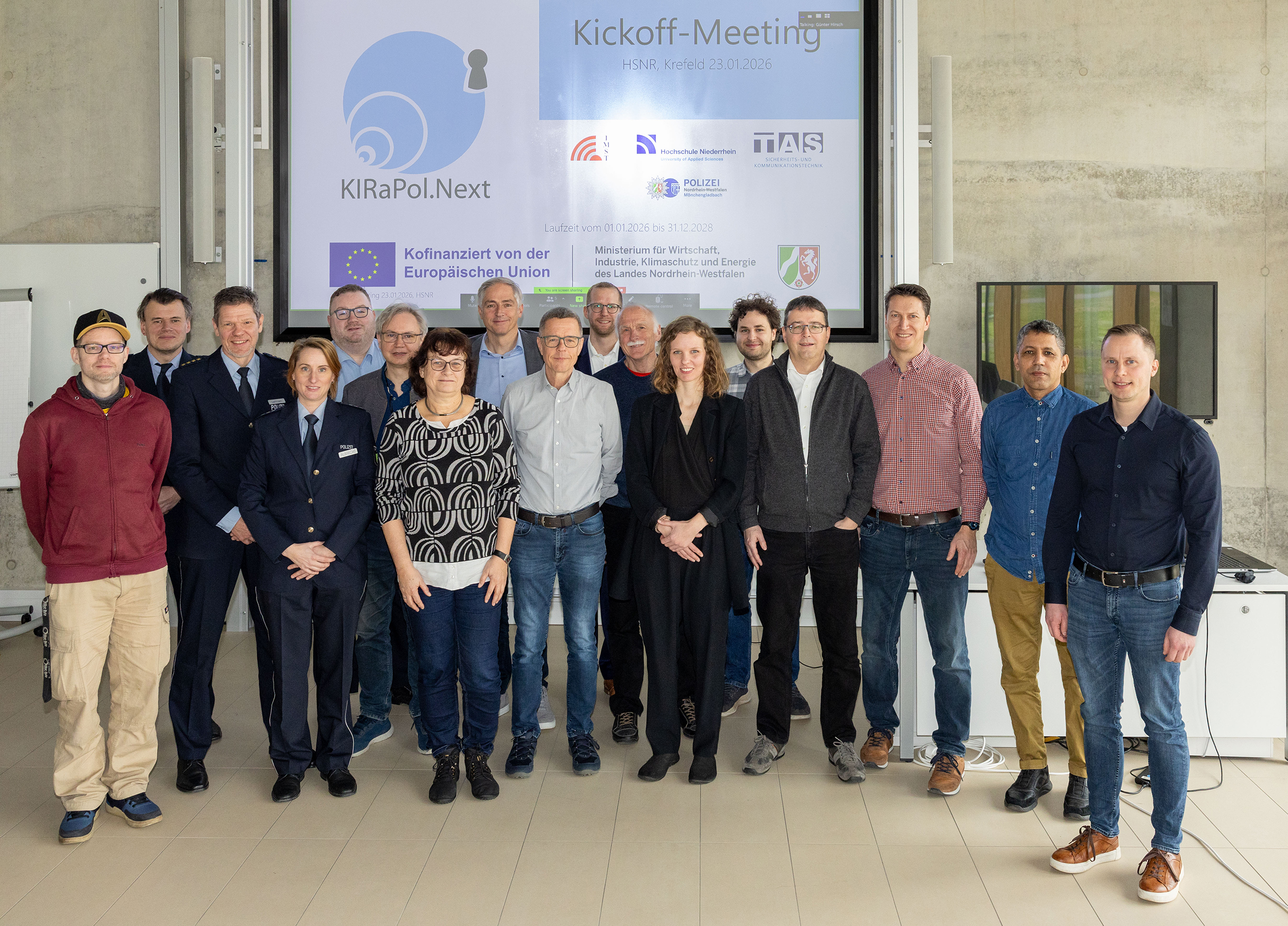
The launch of the "KIRaPol.Next" research project marks the next stage in the development of an intelligent assistance system for police operations. Building on the findings of the predecessor project KIRaPol.5G, the follow-up project aims to develop innovative, mobile radar systems to support police video surveillance in public spaces.
The Hochschule Niederrhein (HSNR) is participating in the project with the Institute of Pattern Recognition (iPattern) and the competence centres EthNa Competence Centre CSR (Ethics and Sustainability), ISA (Intelligent System Solutions Automation) and FAST (Intelligent Assistance Systems and Technologies). The project will run until 31 December 2028 and is being funded by the state of North Rhine-Westphalia and the European Union with around 1.7 million euros. HSNR will receive around 745,500 euros of this.
In addition to HSNR, IMST GmbH from Kamp-Lintfort, which is coordinating the project, and Telefonbau Arthur Schwabe GmbH & Co KG from Mönchengladbach are also involved in the project. The Mönchengladbach Police Headquarters, the Düsseldorf Police Headquarters, the Federal Police and the Bavarian State Office of Criminal Investigation are also involved as associated partners.
The aim of KIRaPol.Next is to develop a mobile police observation system that intelligently combines radar and video sensor technology. A particular focus is on the further development of the existing sensor technology: the radar technology is designed in such a way that persons are not identified via the radar signal. The artificial intelligence (AI) used analyses abstract movement patterns and should be able to differentiate between dangerous situations (punches, kicks, falling people) and harmless interactions such as hugs.
If the radar technology generates an alarm message, the situation is examined by the police using the video image. Only after the human assessment is a decision made as to whether further police action, such as the deployment of emergency services, is required. No radar or video analysis takes place outside of the core observation times. To ensure that the AI-supported radar technology works reliably, the required radar signals are recorded in collaboration with the partners under laboratory and realistic conditions and used to train the pattern recognition.
"As an institute for pattern recognition, our strength lies in the intelligent analysis of complex data. By using modern AI methods, we can precisely classify movement patterns and distinguish between harmless and potentially dangerous situations," says Professor Dr.-Ing. habil Regina Pohle-Fröhlich, Head of the iPattern Institute and Professor of Computer Science and Graphic Data Processing in the Faculty of Engineering and Computer Science at HSNR.
Georg Lehnen, police project manager: "Compared to radar-supported video surveillance using stationary systems, the mobile version not only allows the police to be more flexible in terms of location and time, but also enables video surveillance to be implemented in a resource-saving manner in the phases that are always busy."