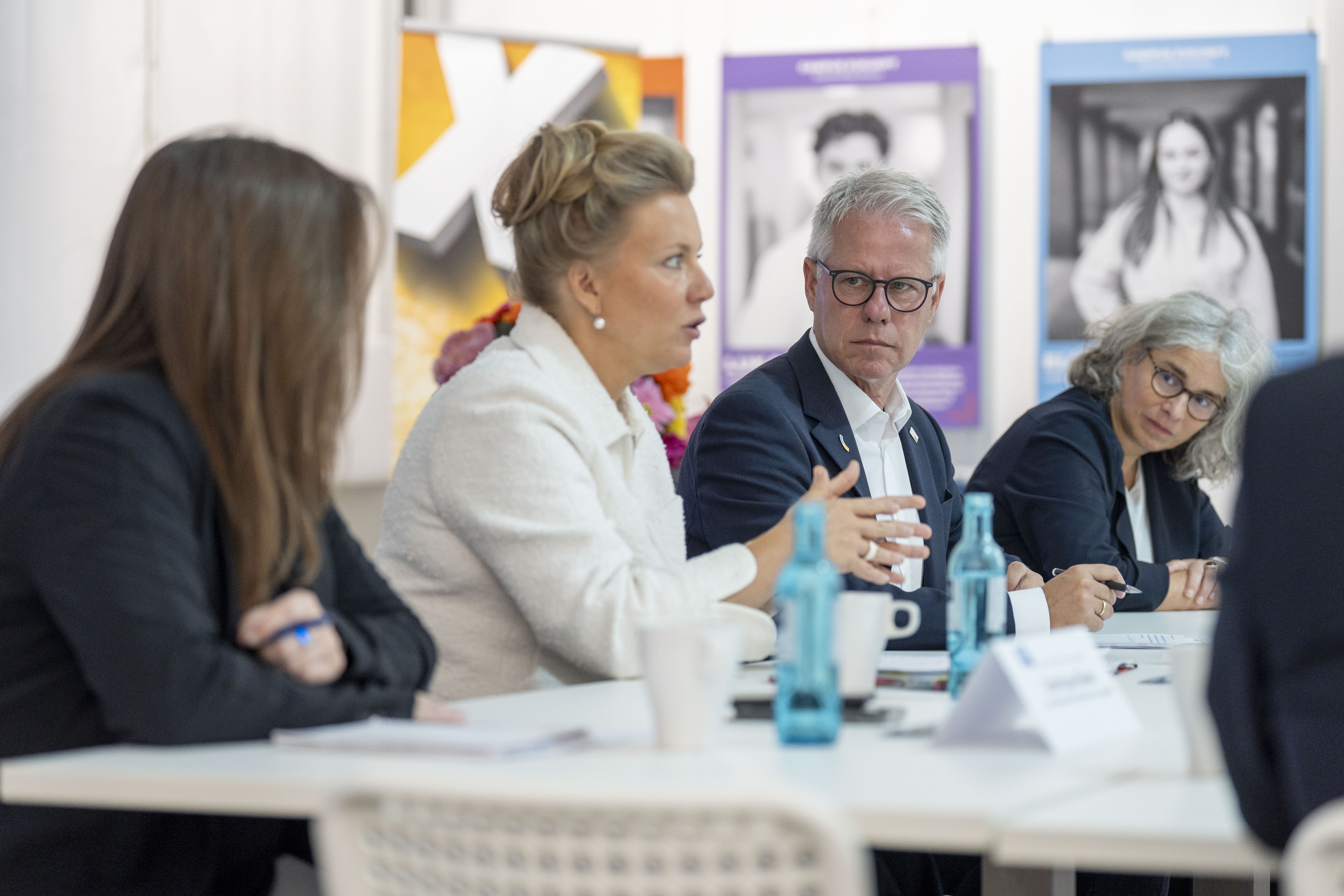


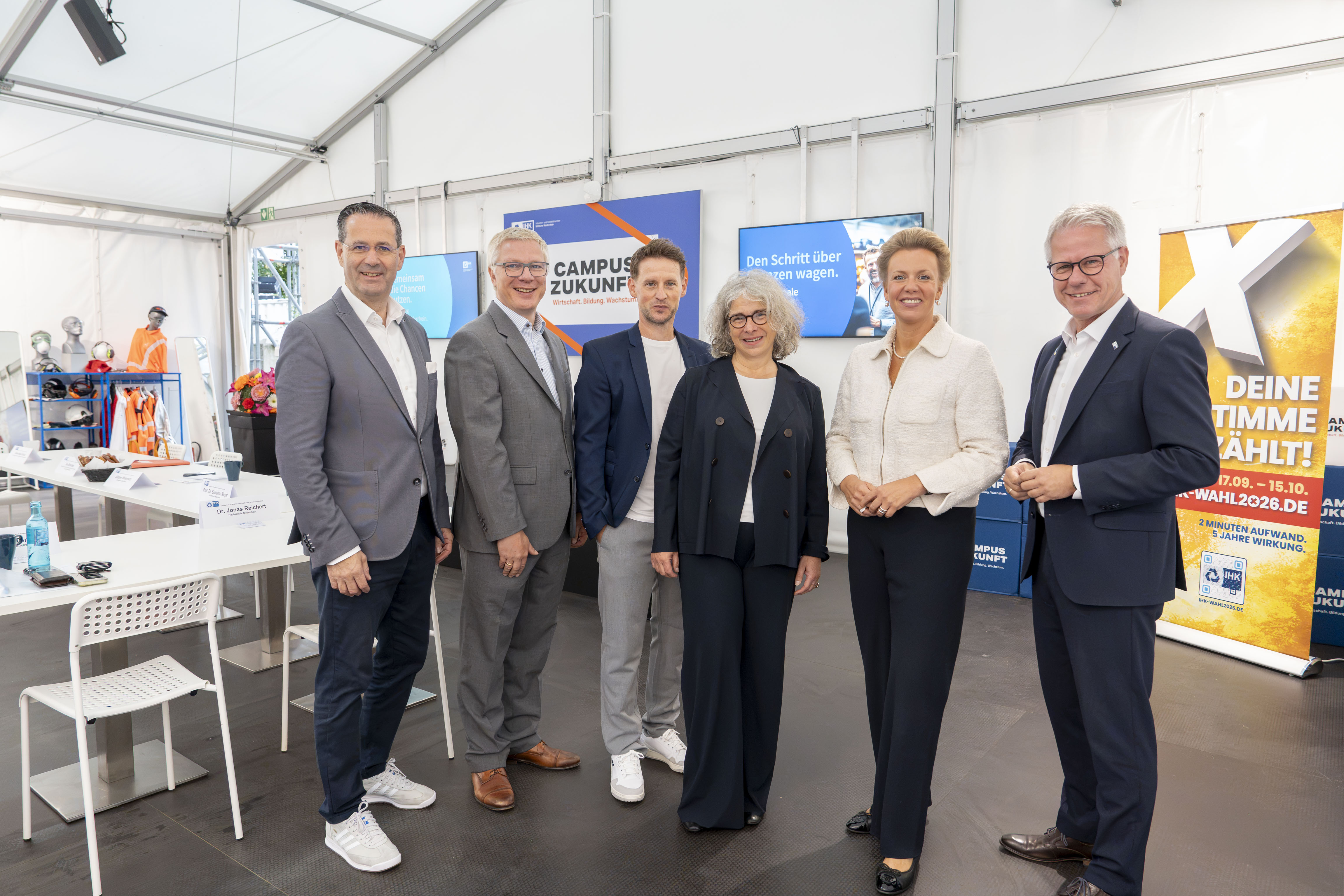
How are digitalisation, artificial intelligence and new innovation structures changing vocational education and training, apprenticeship-based professions and the regional supply of skilled workers? This question was the focus of a round-table discussion between Ina Brandes, Minister for Culture and Science of the State of North Rhine-Westphalia, the Chamber of Industry and Commerce (IHK) for the Middle Lower Rhine, the Hochschule Niederrhein and representatives from businesses. IHK Chief Executive Jürgen Steinmetz welcomed the guests to the IHK pavilion on Wendersplatz in Neuss: “Digitalisation and artificial intelligence are not just changing software, machines or individual business models. They are changing specific job roles, apprenticeship trades and skill sets. Knowledge becomes outdated more quickly, and new tools are emerging at ever shorter intervals. For our businesses, this creates major opportunities for productivity and innovation – but at the same time, it creates considerable pressure to act. In small and medium-sized enterprises in particular, the problem is often not a lack of interest, but a failure to apply ideas in a practical manner. Today, we want to explore how this can be achieved more effectively.”
In her keynote speech, the Minister explained that, in an age of demographic change, the economy is dependent on technological progress. Minister for Science Brandes: “AI, automation and, in particular, robotics will have to make up for part of the labour shortage. And that is why AI literacy must form part of everyone’s basic knowledge. So far, very few people have a solid understanding of what AI is, what it can do and what it cannot do.” At the same time, specialist knowledge is becoming even more important in the age of AI. Minister Brandes: “Only those who have a deep understanding of what AI can be used for will later be able to verify the results it produces.” Given the United States’ global dominance in generative AI models such as ChatGPT, Germany’s opportunity lies in developing industrial AI applications in smaller models for specialised uses.
Prof. Dr Susanne Meyer, President of the Hochschule Niederrhein, described AI as a dual driver of transformation for the university: on the one hand, artificial intelligence is changing the skills that need to be taught; on the other, it is also changing the way teaching education will need to function in the future. Meyer: “Understanding AI, using it effectively and being able to critically evaluate its results are key skills.” The university president sees great potential for collaboration with industry to solve specific problems faced by businesses through studies, research and final-year projects.
Dr Christian Temath, Managing Director of the AI.NRW competence platform, emphasised that AI has evolved from a niche topic into a mainstream issue for businesses. “The key transfer questions are: How do research results and available technologies find their way into small and medium-sized enterprises in particular, and how are businesses empowered to recognise and articulate their own needs?”
Markus Schmidt, Head of Apprenticeship and University Marketing at NEW AG in Mönchengladbach, added: “Companies need young talent who, in addition to specialist knowledge, bring with them, in particular, the ability to work in a team, openness, the ability to cope with uncertainty and practical AI skills. We let trainees test AI in practice and compare results with and without AI. This allows them to experience the opportunities and limitations of the technology first-hand.”
For Jürgen Germann, Head of Government Relations at 3M in Neuss, the benefits of AI lie primarily in the acceleration of research and development, as well as improved production and quality assurance processes. Germann called for better-structured and coordinated collaboration between stakeholders from schools, government, academia and industry in order to work more efficiently on the further development of AI in Germany.
At the conclusion of the round-table discussion, there was consensus among all participants: advancing digitalisation and artificial intelligence offer great opportunities. To make the most of these opportunities, universities, businesses, vocational schools, chambers of commerce and all stakeholders in the education system must work more closely together. “Vocational education and training and higher education complement one another in this regard,” emphasised Steinmetz. “We need everyone.”