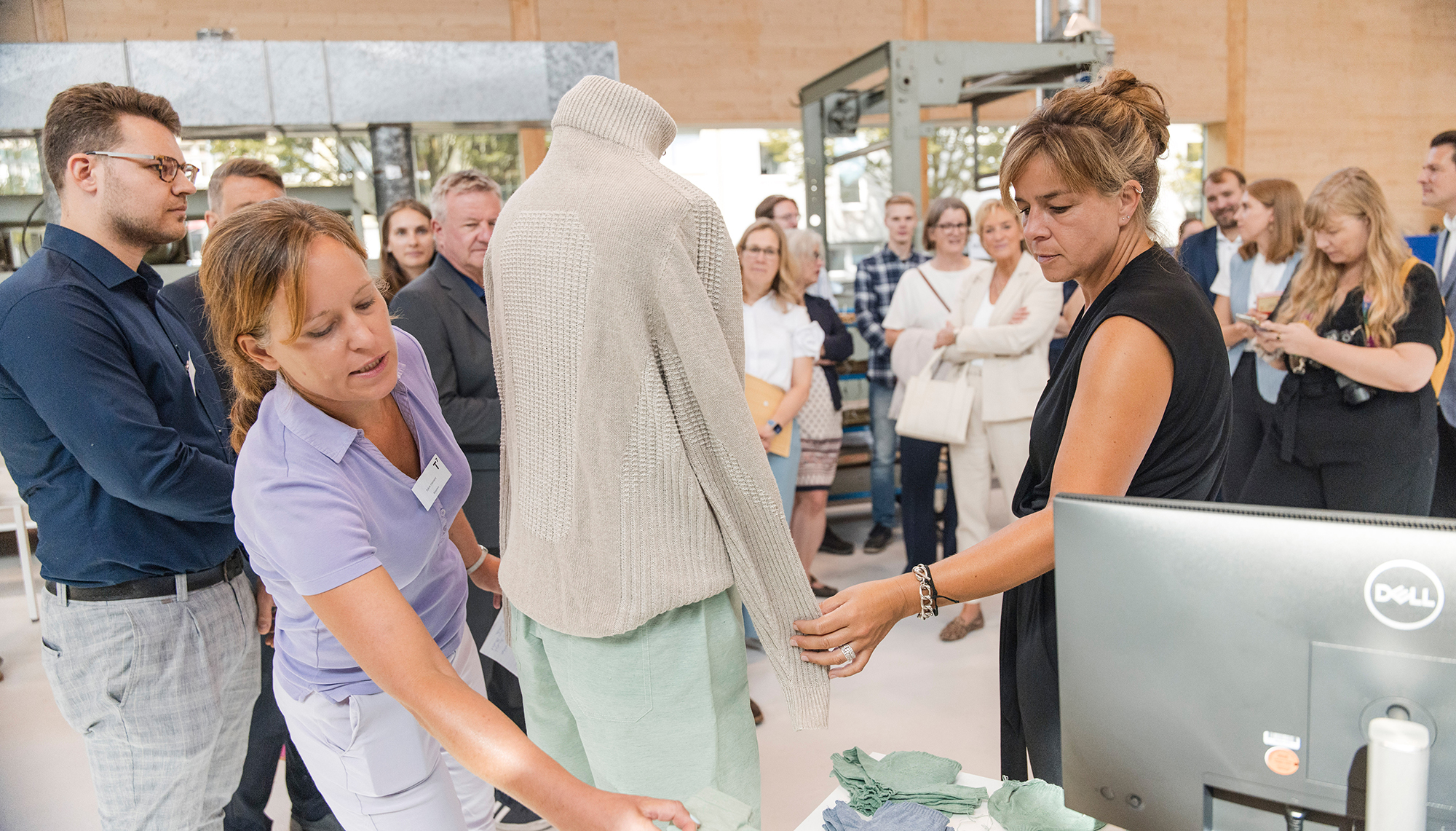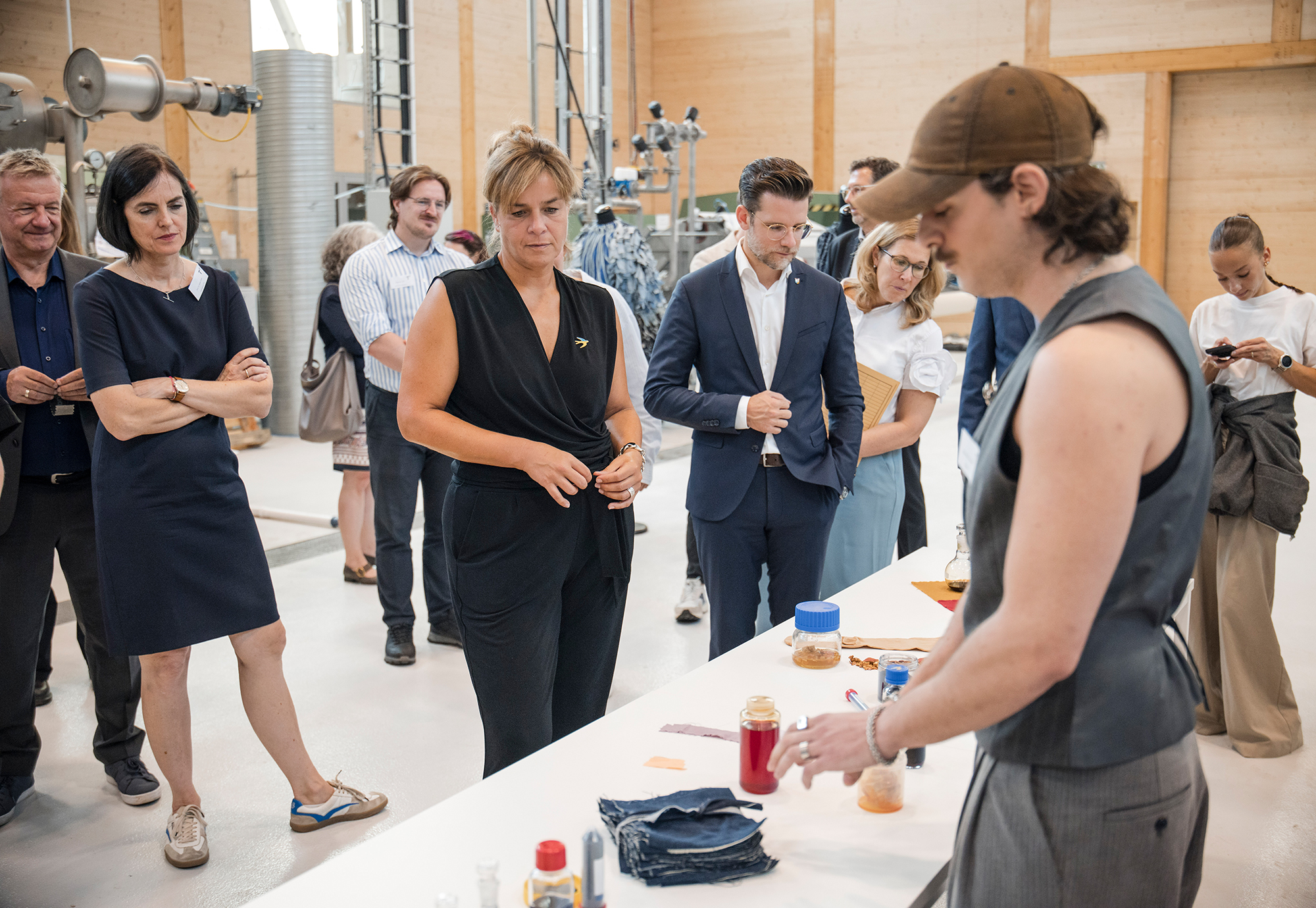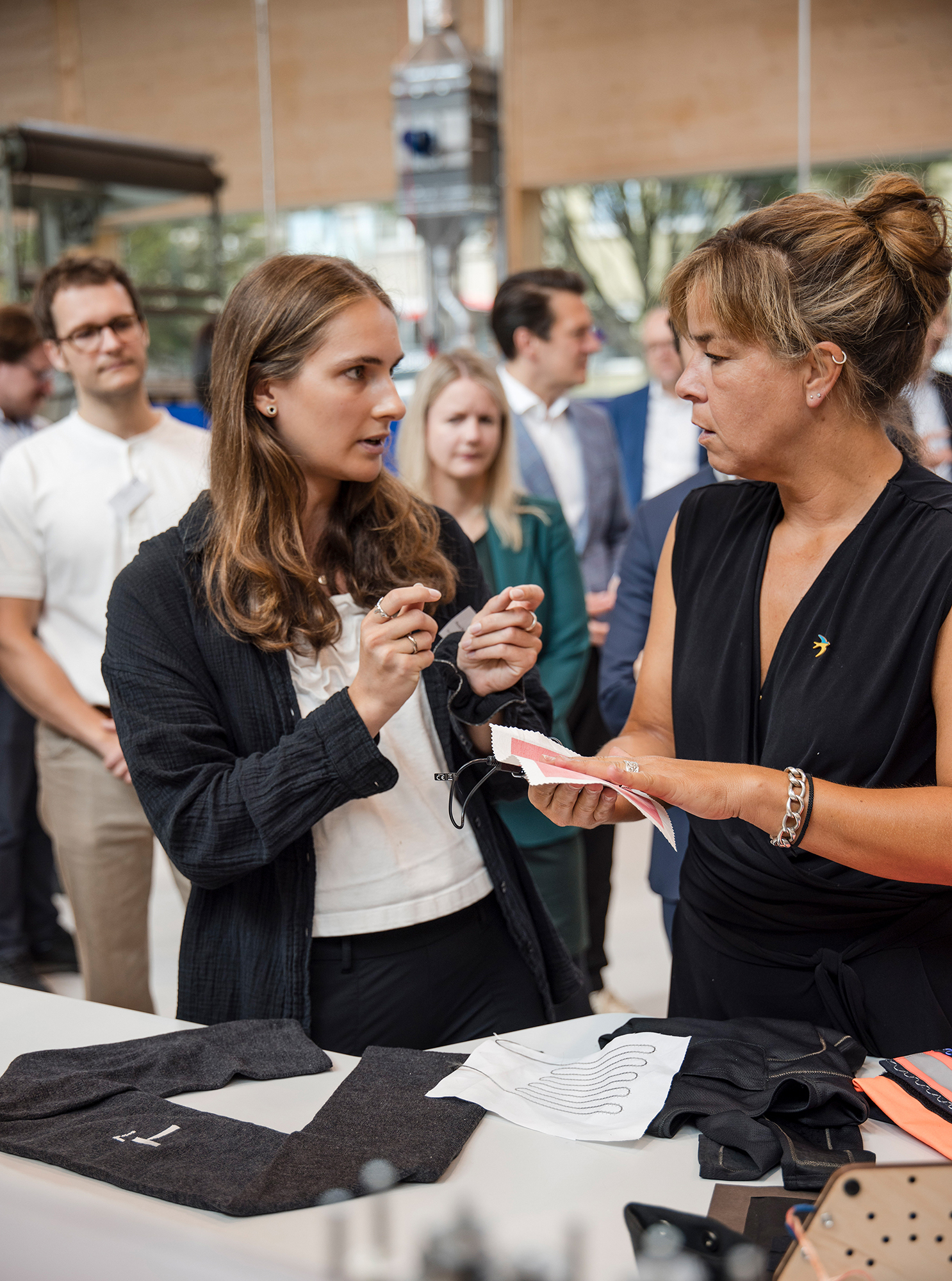


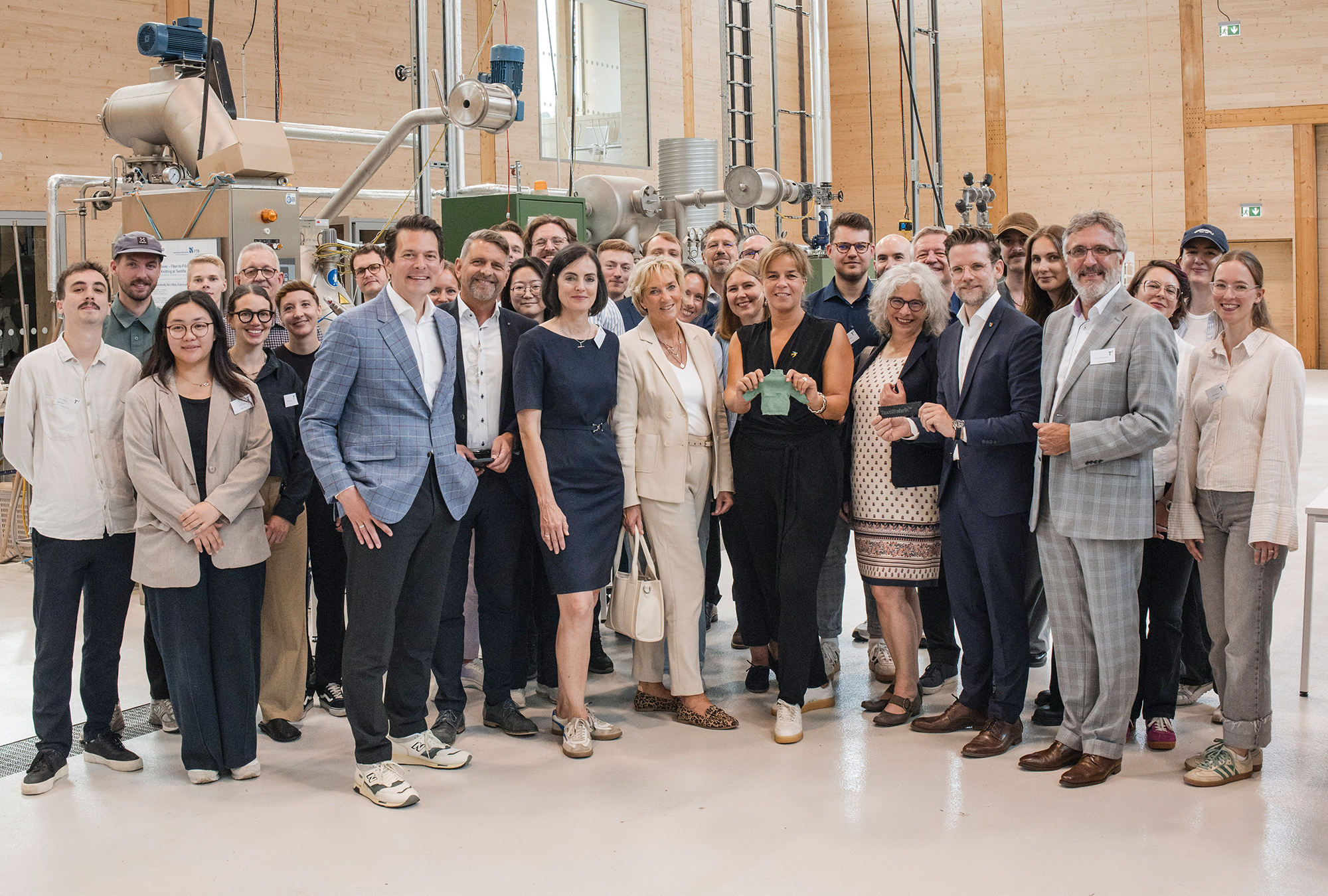
Smart textiles, AI-assisted fibre analysis and sustainable processes: During her summer tour, Mona Neubaur, Minister for Economic Affairs, Industry, Climate Protection and Energy for the State of North Rhine-Westphalia, visited the Technology Centre for Textile Finishing at the Hochschule Niederrhein (HSNR) to learn about the latest developments in sustainable textile production. The focus of the visit was the Textile Factory 7.0 (T7).
Staff from the Research Institute for Textile and Clothing (FTB) at the Hochschule Niederrhein (HSNR) and the project partner, the Institute for Textile Technology (ITA) at RWTH Aachen University, presented the latest research and development work not only in discussion but also directly in practical application, in the presence of the university’s president, Susanne Meyer, the Mayor of Mönchengladbach, Felix Heinrichs, and representatives of the state government, presented current research and development work not only through discussion but also directly in practical application. The visit centred on smart and clean technologies and processes that demonstrate how digitalisation and sustainability can be combined in textile production. The Minister was able to try out various applications herself and see for herself their potential for industrial practice.
With T7, a real-world laboratory is being established in the Monforts Quartier, where innovative technologies and production processes are developed, tested and further refined for industrial application under real-world conditions. The aim is to promote economically viable, carbon-neutral and circular textile production in the Rhineland mining region.
Smart: Textile production is becoming intelligent and digital
Smart textiles combine textile structures with sensors, actuators and electronics, thereby opening up new possibilities for application. Among other things, a demonstration on an embroidery machine showed how conductive yarn can be integrated into textile structures. Exhibits of smart textiles highlighted the new functions this can enable, such as the monitoring of body data or applications in the fields of health, fitness and climate adaptation.
A smart jacket was used to demonstrate exactly how such technologies feel and what possibilities they open up. Minister Neubaur was able to try out the technology herself and experience the tracking of her movements first-hand. The sensors integrated into the jacket record movement data in real time and transmit it via Bluetooth to an app. There, the movements are visualised on an avatar and analysed directly.
One possible application is in the health sector, for example: patients could use the jacket during physiotherapy exercises, whilst physiotherapists can digitally track the movement sequences and provide targeted feedback.
Mona Neubaur, Minister for Economic Affairs and Climate Protection: “The future is already being shaped in the Rhineland mining region – with innovative and sustainable solutions for local industry and people. Digital applications, artificial intelligence and sustainable processes are not only being demonstrated here, but also further developed and tested. For a product that is closely tailored to the user: when smart jackets made from intelligent textile fabrics measure vital signs, this helps people in very practical ways to stay healthy or recover. This not only helps people, it also creates concrete prospects for competitive yet sustainable textile production.”
Another smart innovation is a fibre analysis system based on artificial intelligence (AI), which also demonstrated how digital technologies can transform value creation in the textile sector. With the help of AI, natural fibres can be analysed and material compositions determined more quickly and precisely. Digital manufacturing processes such as laser printing could also be viewed first-hand on site. This approach opens up new possibilities for personalised and demand-driven production and can thus help to avoid overproduction.
Clean: Sustainable alternatives for textile processes
Alongside smart technologies, the focus was on sustainable alternatives to established textile processes. After all, a sustainable textile industry requires not only new technologies but also solutions that conserve resources and reduce the use of fossil-based or environmentally harmful raw materials.
Approaches were presented in which natural dyes – derived, for example, from tea or pomegranate skins – can be extracted and used for dyeing textiles. Alternative processes are also being developed for the decolourisation and bleaching of textiles. Demonstrations showed how a pair of jeans can be decolourised using laser technology or even fungal cultures. This process produces a substance which, in turn, can be used as a raw material for vegan leather alternatives. This approach thus combines the development of new processes with the concept of the circular economy: materials should be kept within the recycling loop for as long as possible and reused as extensively as possible. Visitors were also able to view the test rig for determining fibrous microplastics in wastewater from washing machines.
From research approach to industrial application
This is precisely where Textile Factory 7.0 comes into play. A real-world laboratory is being established in the Monforts Quarter, where innovative technologies and production processes are developed, tested and further refined for industrial application under conditions that are as close to real-world scenarios as possible.
“Textile Factory 7.0 impressively demonstrates what applied research can achieve when academia and industry work together on concrete solutions. At the same time, it exemplifies the high level of innovation and performance of our Faculty of Textile and Clothing Technology, which closely integrates research, teaching education and knowledge transfer. As the Hochschule Niederrhein, we aim not only to research innovation but also to put it into practice, thereby actively helping to shape the transformation of the textile industry. T7 combines our comprehensive textile expertise with digitalisation, sustainability and the circular economy, thereby strengthening the future viability of the location and the entire region,” says Professor Dr Susanne Meyer, President of the Hochschule Niederrhein.
With its four core areas – on-demand manufacturing, MicroFactory Engineering, Digital Textiles and Biosphere – T7 combines technological innovation with sustainability, thereby creating a platform for the textile production of tomorrow. At the heart of this is a common question: how can textile production become smarter, more sustainable and economically viable all at once?
“Today’s tour has impressively demonstrated just how much textile expertise and innovative strength there is in Mönchengladbach and the region. Even today, a wide variety of technologies and applications can be experienced in practice here. This demonstrates the potential that lies in the collaboration between science, industry and Mönchengladbach – a city with a rich textile heritage – and the opportunities this presents for sustainable growth and prosperity in the future,” summarised Mayor Felix Heinrichs.
Prof. Dr Rabe (HSNR) and Prof. Dr Gries (RWTH) emphasised to the Minister: The motto ‘smart and clean’ is not an abstract vision, but can already be experienced and tested in practice today; it is ready for application.
About Textile Factory 7.0 (T7):
T7 is a joint project between the Research Institute for Textile and Clothing (FTB) at HSNR, the Institute for Textile Technology (ITA) at RWTH Aachen, the Association of the North-West German Textile and Clothing Industry, the Association of the Rhenish Textile and Clothing Industry, the Textile Academy NRW and the Mönchengladbach Economic Development Agency.
The project is funded by the Federal Ministry for Economic Affairs and Energy (BMWE) under the ‘STARK’ funding scheme aimed at strengthening the dynamics of transformation and renewal in the mining regions and at coal-fired power station sites; by the State of North Rhine-Westphalia under the remit of the Ministry for Economic Affairs, Industry, Climate Protection and Energy (MWIKE) of the State of North Rhine-Westphalia in accordance with the Framework Guideline for the Implementation of the Investment Act for Coal-Mining Regions (InvKG) North Rhine-Westphalia (RRL), and by the Federal Ministry for Research, Technology and Space (BMFTR). We would like to thank the funding bodies for their trust.