

The Faculty of Health Care at the Hochschule Niederrhein (HSNR) has launched the first adaptation course for midwives from non-EU countries in cooperation with the Simulation Centre and the Academy for Multidisciplinary Emergency Training (SAM) in Mönchengladbach. The Hochschule Niederrhein is currently the only university in North Rhine-Westphalia to offer such a course.
"Together with SAM, we have developed a competence-oriented and evidence-based recognition course that systematically takes up the existing qualifications of midwives from non-EU countries and specifically links them to the requirements of the German healthcare system," explains Professor Therese Werner-Bierwisch.
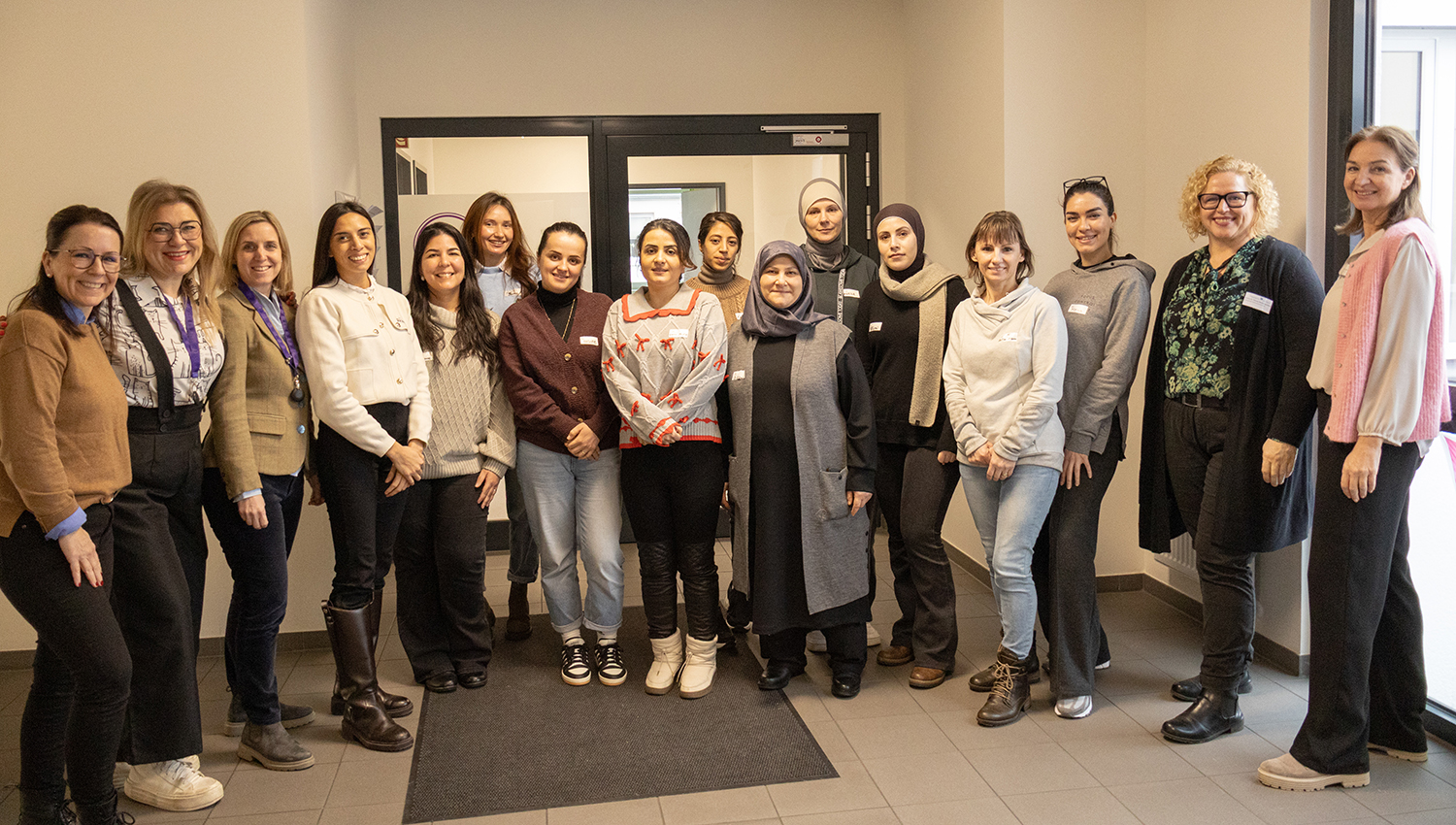
The 18-month course is currently preparing twelve internationally trained midwives specifically for professional recognition in Germany. For many of them, this recognition is the central prerequisite for being allowed to work as a midwife in Germany. The participants come from countries including North Africa, Ukraine, Turkey and Brazil.
Targeted response to the shortage of skilled labour in NRW
North Rhine-Westphalia faces considerable challenges in the provision of obstetric care. The HebAB.NRW study points to existing access barriers and excess demand, while the current report on the assessment of demand for outpatient midwifery care describes a partial shortage of care and a lack of management instruments. Both studies make it clear that additional personnel capacities are required in order to ensure needs-orientated care. The new recognition course therefore makes an important contribution to securing skilled labour: midwives from non-EU countries bring valuable professional experience with them and can be integrated into care quickly after successful recognition. The programme therefore not only strengthens individual facilities, but also the obstetric infrastructure in North Rhine-Westphalia as a whole.
Contribution to health equity
Internationally trained midwives also promote health equity. Specialists with their own migration or refugee experience can accompany expectant mothers at eye level, break down language barriers and facilitate access to the healthcare system. Especially for women who do not (yet) speak sufficient German, this can make a decisive difference in terms of self-determination and safety. "Health equity does not begin with the claim, but with access to care. Midwives with specific cultural skills can play a key role here," emphasises Professor Therese Werner-Bierwisch.
Theory and practice closely interlinked
The theoretical apprenticeship takes place in several modules as block courses at the SAM site in Mönchengladbach. "Our modern, practical teaching methods, such as skills and simulation training, ensure a high level of confidence among participants," explains Julia Scholz, Head of Simulation Obstetrics and Examinations at SAM. Each theoretical phase is self-contained, ends with a performance review and documents the individual learning progress of the midwives.
The participants are closely supervised by qualified instructors during the practical assignments. This ensures that the theoretical content can be safely transferred into practical application. "A particular challenge is to find suitable practice partners, as a lack of refinancing, centralisation processes and the collapse of staffing systems are significantly reducing the number of available practice places. Health Care facilities in North Rhine-Westphalia are therefore invited to get involved as cooperation partners and thus actively contribute to securing skilled labour in obstetrics," says Scholz, herself a qualified midwife.
Target group and admission requirements
The course is aimed at immigrant midwives with a notice of assessment in which significant differences to the German apprenticeship have been identified. Prerequisites for participation are a valid residence permit, a work permit and German language skills at level B2. In individual cases, an adaptation course is still possible until December 2027 in accordance with the Apprenticeship and Examination Ordinance for Midwives.
Further information can be found at:
https://www.hs-niederrhein.de/gesundheitswesen/studieninteressierte/b-sc-angewandte-hebammenwissenschaft/anpassungslehrgang/
For questions and further information on enrolment, please contact Christin Roosen, Coordinator for the Qualification of International Midwives at the Faculty of Health Care at HSNR, by email at christinroosen(at)hs-niederrhein.de or by telephone at 02151822-3735.