

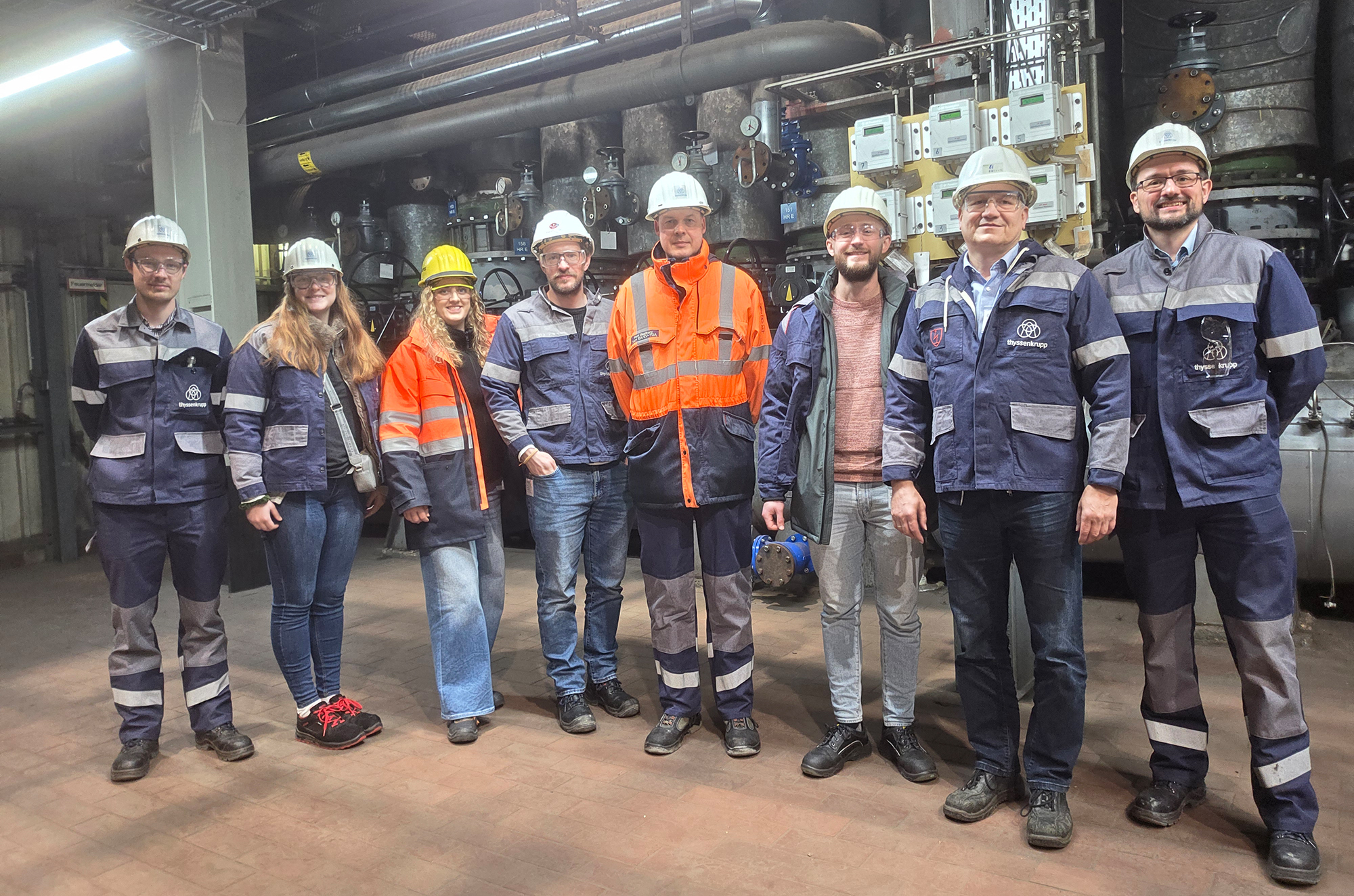
How can industrial heating networks be operated in a more flexible, energy-efficient and climate-friendly way? The Hochschule Niederrhein's (HSNR) new research project "FlexHeatNet" is dedicated to this question. Together with its partners thyssenkrupp Steel Europe (tkSE) and heatbeat nrw GmbH, the HSNR is developing an innovative modelling and optimisation tool to accelerate the transformation process of industrial heat supply systems. The goal: intelligent, data-based network operation that saves energy, reduces costs and makes an important contribution to climate neutrality. The project started on 1 October 2025; the first modelling results are expected in 2026. The project is funded by the state government of North Rhine-Westphalia. "FlexHeatNet" is co-financed by the European Union.
"The transformation to a climate-neutral and energy-efficient industry is necessary for a competitive and sustainable industry," says Lisa Schmitt, Research Associate at the SWK E² - Institute of Energy Technology and Energy Management at HSNR. Almost two thirds of the energy used in industry is required to provide process heat. A relevant proportion of this process heat is then channelled from heat generation to consumers with the help of heating networks. "However, in order for the energy transition to succeed, industrial heating networks must also be decarbonised."
How this can be achieved is being researched using a specific practical example: the project is creating a digital twin of the industrial heating network at thyssenkrupp Steel Europe in Duisburg-Hamborn. It combines a network model that describes the flow and temperatures in the heating network with an optimisation model that calculates how heat, cooling and electrical energy can be generated most efficiently. This coupled modelling enables a realistic simulation of all energy and flow processes in the network for the first time. In scenario analyses, the research team investigates which flexibilisation measures are particularly suitable - such as the use of centralised and decentralised heat storage systems, the integration of heat pumps, the use of additional waste heat sources or the adjustment of flow and return temperatures. "The operating tests at thyssenkrupp Steel provide valuable data on which flexibility options are particularly effective in practical application and how they can be implemented economically," says Prof Dr Jörg Meyer, Head of SWK E².
According to the research team, the advantages of flexible operation are manifold: energy consumption and costs can be significantly reduced, CO₂ emissions can be cut sustainably and renewable energies can be better integrated. At the same time, flexible network operation increases the security of supply and enables more efficient utilisation of existing infrastructure without the need for immediate high investments. "Flexibilised heating grids strengthen the competitiveness of energy-intensive companies and make a key contribution to the industrial transformation," says Jörg Meyer.
The knowledge gained in the project should also have an impact beyond the Duisburg site. An analysis is planned to determine the extent to which the modelling and optimisation tool developed can be transferred to other industrial heating networks in North Rhine-Westphalia, Germany and Europe. The project team is also looking forward to exchanging ideas with other players from industry and with providers of innovative technologies for making heating networks more flexible.