

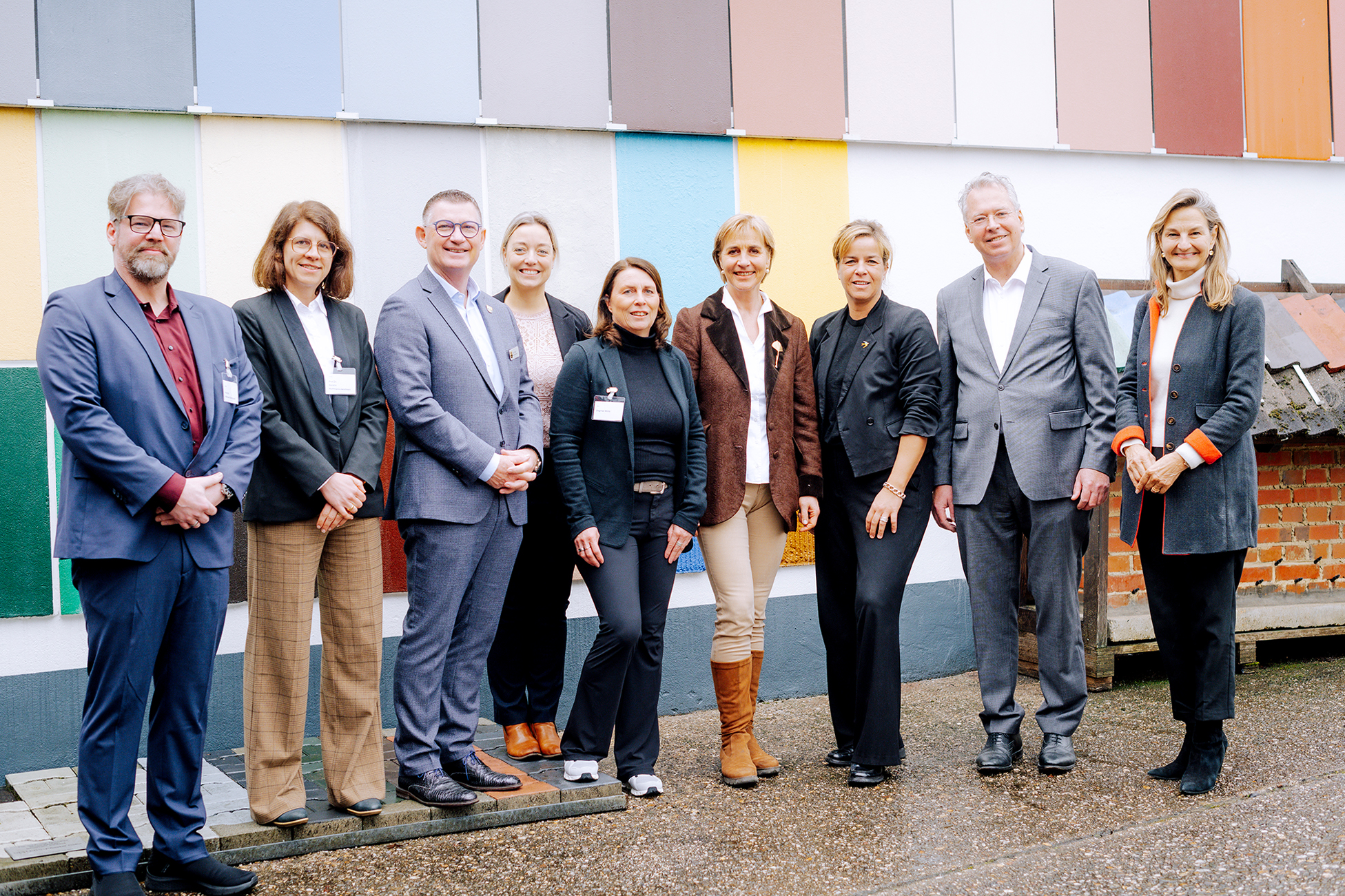
How can structural change in the Rhenish mining area be achieved in concrete terms? This question was the focus of a visit by Mona Neubaur, Minister for Economic Affairs, Industry, Climate Protection and Energy of the state of North Rhine-Westphalia, to the Oellers paint factory in Aldenhoven. As part of the NRW Innovation Tour, the Minister gained an insight into a joint project between Oellers, The Hochschule Niederrhein (HSNR) and technology partner 3Win. The project is an example of how applied research can produce marketable industrial solutions.
The "P-REx" project, funded by the state of North Rhine-Westphalia and the federal government, uses biotechnological processes to transform agricultural wastewater into an industrially usable raw material - for the coatings industry, among others. A substance that was previously considered an environmental problem thus becomes a valuable resource and contributes to the circular economy. In the "BioPhosCoat" project, the partners are developing a phytic acid-based binder for corrosion protection. The phytic acid required for this is obtained from agricultural residues, including pig manure. Research results from the laboratory are thus transferred directly into industrial applications. The Hochschule Niederrhein's professors Dr Kerstin Hoffmann-Jacobsen and Dr Michael Dornbusch are responsible for the scientific processing of the projects. The research work also gives rise to industrial property rights as part of the innovation2business.nrw transfer programme. For Oellers, close collaboration with science and technology partners is a key success factor. "For us, cooperation with the university is crucial in order to really bring innovations into practical application," explains Managing Director Paul Oellers. The combination of research, industrial experience and technological expertise results in solutions that are both ecologically and economically convincing.
Mona Neubaur, Deputy Prime Minister and Minister of Economic Affairs: "Especially in economically challenging times, we need people and companies who dare to break new ground. Every day, clever people are working in laboratories, factories and offices on concrete solutions to the challenges of our time. Genuine openness to technology, clever ideas and strong partnerships ensure that inventions become marketable solutions - and that these solutions lead to prosperity and good jobs. This is the future that is created locally - and from which everyone benefits."
The HSNR also sees its role as specifically transferring research into application. "We bring research to where it has an impact - to SMEs and regional industry. Collaborations like the one with Farbenfabrik Oellers are key for us. As a university of applied sciences, we work together with companies to find solutions to real challenges and thus contribute to strengthening North Rhine-Westphalia as a centre of innovation," says Professor Dr Kathleen Diener, Vice President for Research and Innovation.
The visit to Farbenfabrik Oellers is part of the NRW Innovation Tour, with which Minister Neubaur is seeking a direct exchange with companies, employees and science. A central aspect of the tour is the promotion of research, development and innovation as well as the improvement of location conditions for future-oriented companies in North Rhine-Westphalia.
Farbenfabrik Oellers, a family business since 1949, develops and produces paints, varnishes and floor coatings for industrial and commercial companies as well as skilled trades companies and end consumers at the company site. Owner Paul Oellers attaches particular importance to continuously improving the environmental friendliness of his products. For years now, he has been successfully using renewable raw materials from regional suppliers, such as alkyd resins or fatty acids from vegetable oils, for paints. The P-REx research project is also a consistent advanced course of this commitment.