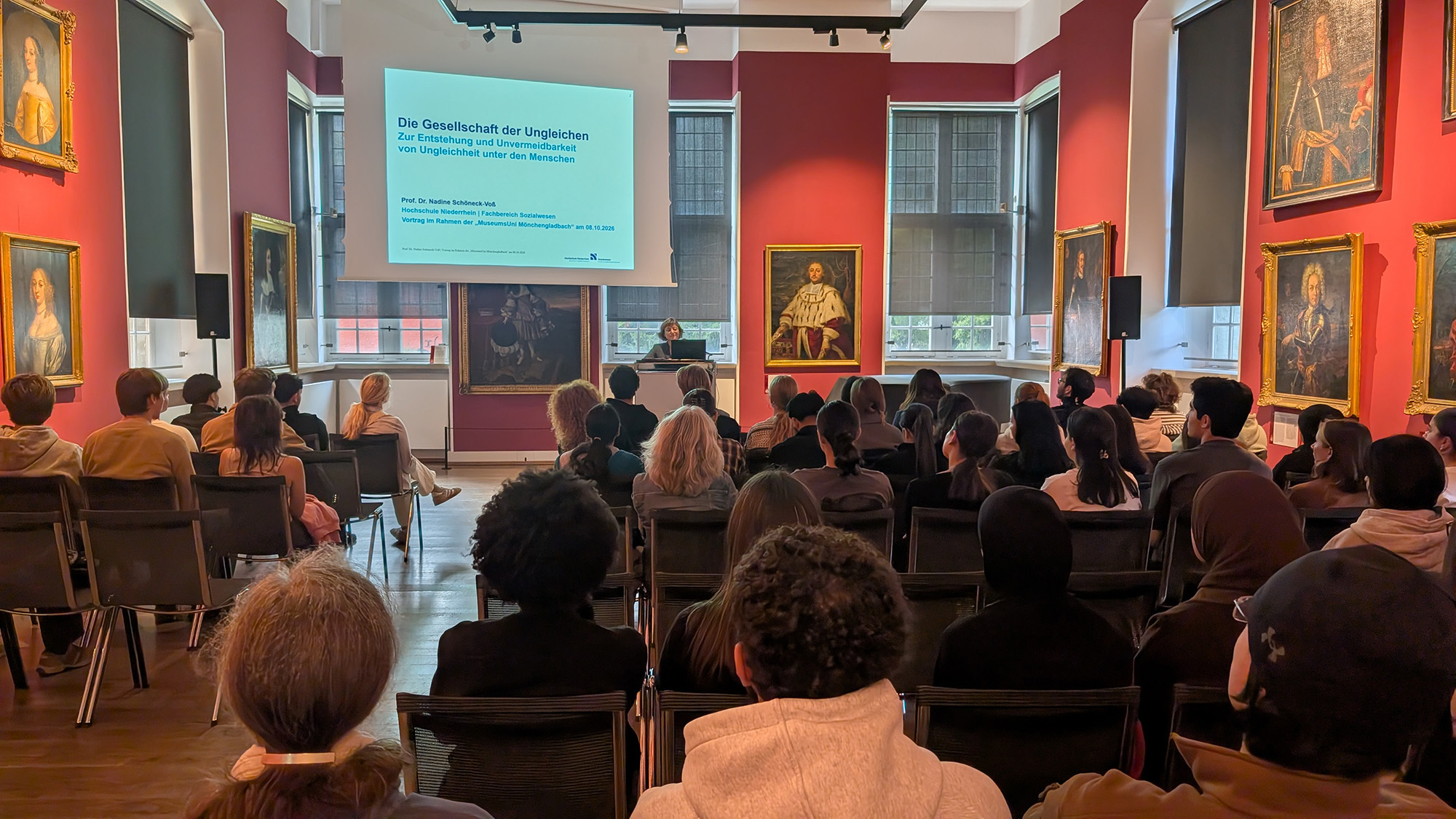
When is inequality unfair? This was the question explored by 81 sixth-form pupils at the MuseumsUni Mönchengladbach. In the Knights’ Hall of the Schloss Rheydt Museum, professor Dr Nadine Schöneck-Voss from the Faculty of Applied Social Sciences at the Hochschule Niederrhein (HSNR) explained how social inequality arises and which factors influence people’s life trajectories. Pupils from the Volksgarten Comprehensive School, the Rudolph Steiner School, the Espenstraße Comprehensive School and the Hugo-Junkers Grammar School took part in the event.
The young people were able to share their views through several polls using QR codes. This revealed that the majority of participants regarded any form of inequality as unjust. Schöneck-Voss picked up on this view and explained the difference between inequality and injustice. She identified social background, genetic predispositions, personal decisions and actions, as well as fate and chance, as possible factors influencing unequal living conditions and outcomes.
Using fictional characters, the speaker illustrated how different starting points and personal circumstances can shape people’s life paths. Among other things, she discussed the influence of the family home, resources and individual talents. These factors influence a person’s opportunities, but do not necessarily determine success or failure.
“Museums are not just places where history is preserved and communicated. They also provide a space to address current social issues and gain an understanding of different perspectives. Through the MuseumsUni, we would like to invite young people to engage with such topics and experience the museum as a vibrant place of learning,” says Dr Karlheiz Wiegmann, Director of the Städtisches Museum Schloss Rheydt.
The event was part of the joint educational series “MuseumsUni Mönchengladbach” organised by the Schloss Rheydt Museum, the HSNR and the Mönchengladbach Mathematics and Natural Sciences Grammar School. The programme began with a lecture by Prof. Dr.-Ing. Jörg Meyer from the HSNR on the energy supply of the future. Other talks covered topics including the war in Iran, alternative proteins and plant-based drinks, and the impact of fast fashion. The series links scientific topics to the everyday lives of young people, provides insights into various specialist fields and brings the museum to life as a place of education and culture. The lectures are aimed at pupils from various year groups.