

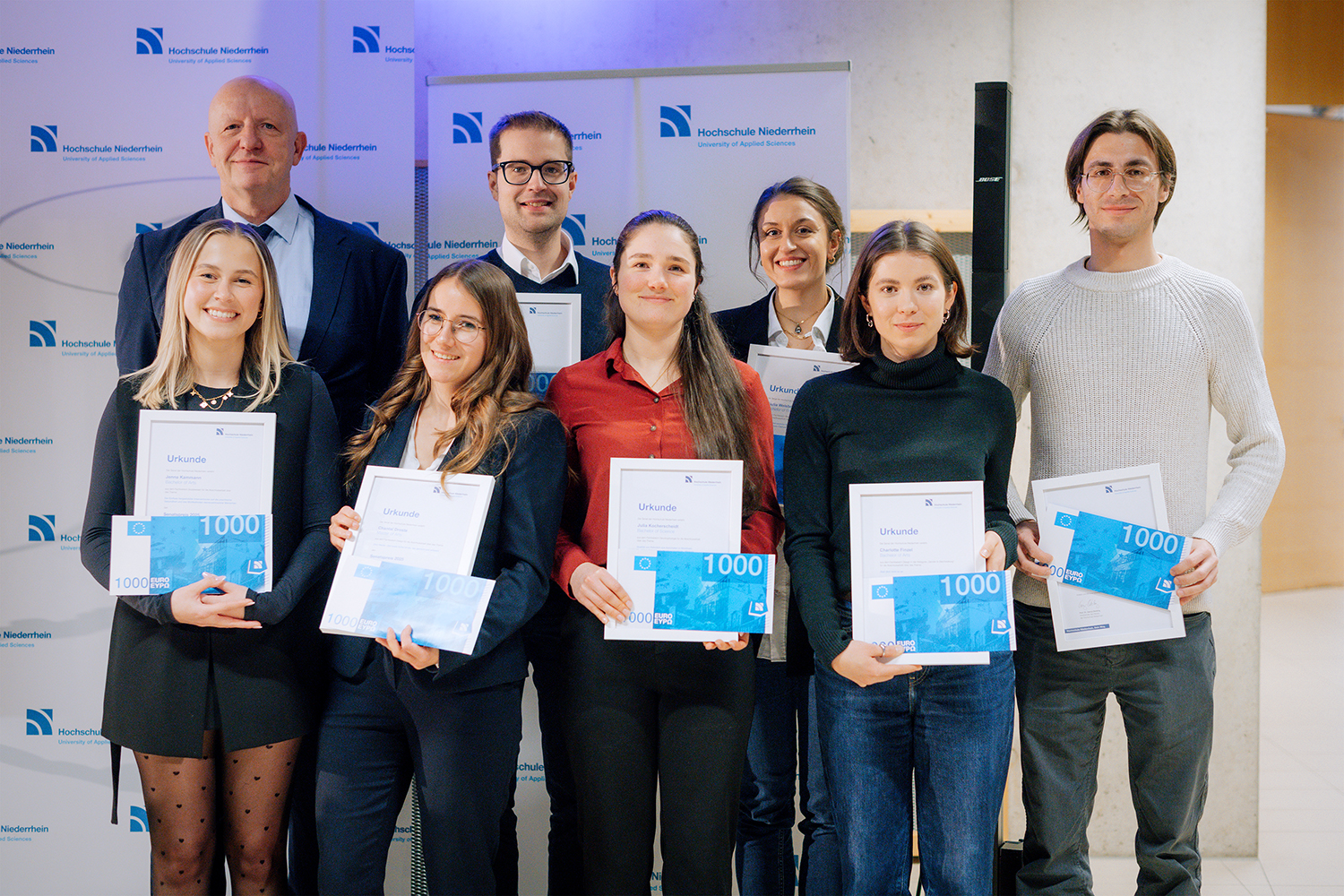
The Hochschule Niederrhein (HSNR) has awarded the Senate Prize 2025 in a festive setting. Nine students were honoured by the University Senate for their excellent bachelor's and master's theses. The prize is endowed with 1,000 euros each.
In the "Gender and Equality" category, Charlotte Finzel (Bachelor of Communication Design) received the distinction for her fictional campaign "Stell dich nicht so an". In it, she thematises everyday sexism. "The provocative title picks up on a socially internalised defensive reaction and makes visible how the experiences of those affected are often relativised or silenced despite clear figures, studies and realities," explains Finzel. In addition to posters and social media posts, she developed an accompanying website with advanced course information.
Chantal Droste (Master Design) from Issum was honoured for her work on sustainability. With her "zero" app, she designed a digital motivation tool for a zero-waste lifestyle suitable for everyday use. Personalised recommendations, challenges, an overview of sustainable places and a reward system help users to act more resource-efficiently step by step.
Bianca Hilden (Nutrition Sciences (B.Sc.)) analysed nine different daily nutrition plans based on the recommendations of the German Nutrition Society (DGE) and the Planetary Health Diet (PHD). To this end, she designed energy-equivalent or energy- and macronutrient-equivalent plans to enable a direct comparison of the daily plans in the first place. With the help of comprehensive life cycle assessments, she analysed the environmental impact along the entire food value chain. Her findings: none of the recommendations analysed are automatically within climate-friendly per capita emission limits. Rather, the decisive factor is the conscious selection of individual foods. Among other things, she developed a "nutrient ecology speedometer" and a performance index for evaluation purposes.
Julia Kocherscheidt (B.Sc. Nutrition Sciences) examined 32 raw milk samples from North Rhine-Westphalia for antibiotic residues, the mould toxin aflatoxin M1 and their microbiological composition. While no antibiotic residues were detected, individual samples showed elevated hygiene parameters and in two cases potentially pathogenic germs. "It is therefore important to always boil raw milk before consumption," emphasises Kocherscheidt.
Giulia Weisbender (Bachelor of Process Engineering) dedicated her thesis to the topic of carbon capture in the chemical industry. As part of a techno-economic analysis, she evaluated both the technical foundation courses and the economic impact of the corresponding processes. The aim was to answer the central question: What costs are incurred if climate protection is implemented consistently?
Christof Groschke (Master of Computer Science) worked on waste optimisation in the production of printed circuit boards. Using mathematical optimisation methods, in particular the column generation method, he developed efficient production plans to reduce material consumption. He presented his research results at the "International Conference on Operations Research 2025".
Michael Sojka (Master Cyber Security Management) from Krefeld developed a serious game for the practical orientation of IT security knowledge. In a realistic virtual environment, users train in the defence against cyber attacks. A specially programmed "feedback channel" analyses technical input in real time and enables immediate feedback within the game.
Jenna Kammann (Bachelor of Social Work) from Brüggen investigated the influence of animal-assisted interventions on the well-being of people with dementia. The results show that contact with animals can reduce anxiety and restlessness and promote social interaction - albeit to varying degrees depending on the individual. At the same time, the study points to a need for further research.
Martina Boller (Master Textile Products) from Mönchengladbach analysed the extent to which cellulose-based fibres can be efficiently dewatered by mechanical squeezing in order to save energy in industrial drying processes. The results demonstrate considerable sustainability potential for the textile industry, but also highlight challenges with regard to material quality.
The event was accompanied musically by singer Lina Nüchter, a student at the Faculty of Applied Social Sciences.
A direct application for the Senate Prize is not possible: the respective examiner proposes outstanding work to the faculty's Examinations Board, which forwards the recommendations to the Senate. A Senate jury then selects the award winners.