

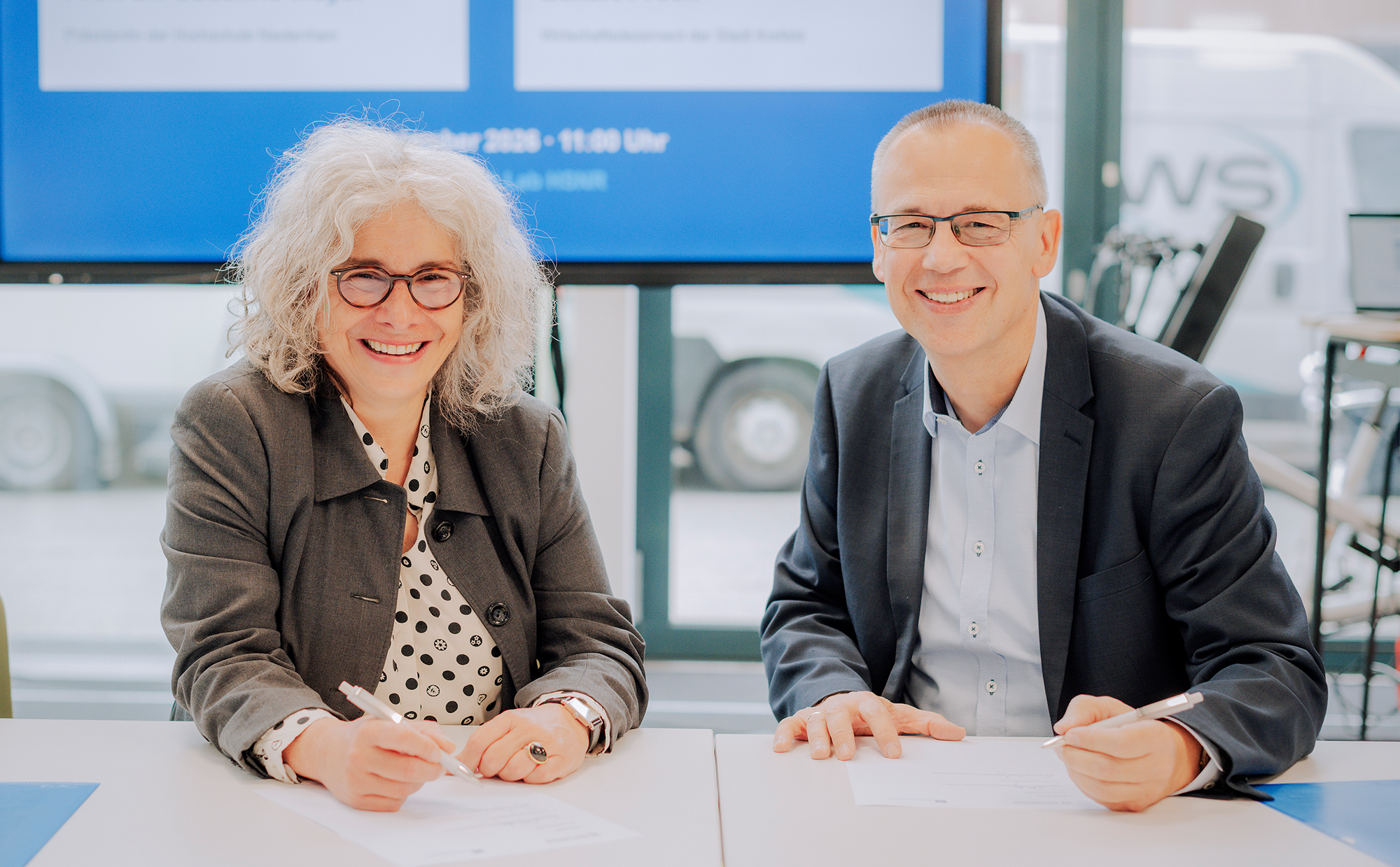
Whether through exchanges with international partners or through innovation and educational initiatives, the Hochschule Niederrhein (HSNR) and the City of Krefeld have been working closely together for many years to develop new approaches to addressing challenges facing the city as a whole. The direct – though, as yet, often rather informal – exchanges between the city administration, lecturers and students have already given rise to many concrete ideas and projects for Krefeld. This successful collaboration is now to be systematically expanded and firmly established. Under the name ‘CityChallenges’, the city and the university are creating a new joint framework for this purpose. As part of the ‘Smart City Day’ on 19 September, the university’s President, Prof. Dr Susanne Meyer, and Eckart Preen, Head of the Department for Economic Affairs, Digitalisation and International Affairs (WDI) at the City of Krefeld, signed an agreement on structured collaboration.
The principle behind ‘CityChallenges’ is as follows: the city passes on real-world issues and challenges arising from its day-to-day work to the HSNR. Professors at the university can select suitable topics and integrate them into their teaching programmes. Students then tackle these as part of projects, seminars or theses. Ultimately, the results are fed back to the city. This may result, for example, in analyses, concepts, technical prototypes or initial workable solutions. A specialist contact from the city acts as the ‘project owner’ for each challenge and ensures that the students maintain the necessary practical relevance. Initially, the ‘CityChallenges’ will focus on digitalisation topics. In the future, the model is set to be expanded to cover further topics and as many faculties at the university as possible.
“A fantastic win-win situation: the collaboration combines highly project-based learning with a practical emphasis at the university, along with tangible benefits for the city as a partner. This will undoubtedly yield exciting and important ideas and solutions. We are already looking forward to the first tasks,” says University President Prof. Dr Susanne Meyer. For the city, too, the agreement represents a further step towards linking innovation more closely with the practice of the local authority. In the latest Smart City Index published by the digital association Bitkom, Krefeld shared first place with Nuremberg in the ‘Administration’ category, achieving the maximum score of 100 points – a good starting point for continuing to drive innovation and digital services. “With the Hochschule Niederrhein, we have a strong innovation partner right here in our city. In the past, many good projects have already emerged from individual contacts. With the ‘CityChallenges’, we are now turning this into a reliable process and continuing to breathe life into the idea of a smart city,” says Eckart Preen.
Several joint projects have already demonstrated that this approach can work. For example, students are exploring how existing public infrastructure can be intelligently retrofitted using ‘retrofit’ solutions. A current example is the further development of the existing dynamic parking guidance system: rather than completely replacing the existing infrastructure, the aim is to continue using existing components and enhance them digitally through sensor technology, networking and new technical solutions. Other projects also illustrate the broad scope of the collaboration. Together with Netzgesellschaft Niederrhein (NGN), for instance, the Hochschule Niederrhein investigated the effects of artificial light from street lighting on insects. The project combines technical infrastructure with issues of environmental protection and species conservation.
The city has deliberately placed this cooperation within the Division for Economic Affairs, Digitalisation and International Relations. The division acts as a key interface between the administration and the wider community, bringing together stakeholders from business, academia and international partners. This approach also shapes Krefeld’s smart city strategy: new solutions for the city should not be devised in isolation within the administration, but developed jointly with the people and institutions that can contribute knowledge, ideas and diverse perspectives. The ‘CityChallenges’ initiative is now translating this approach into a long-term collaboration with The Hochschule Niederrhein.
The agreement will initially begin with a one-year pilot phase. Afterwards, the city and the university will jointly review the results and further develop the programme on the foundation course.