

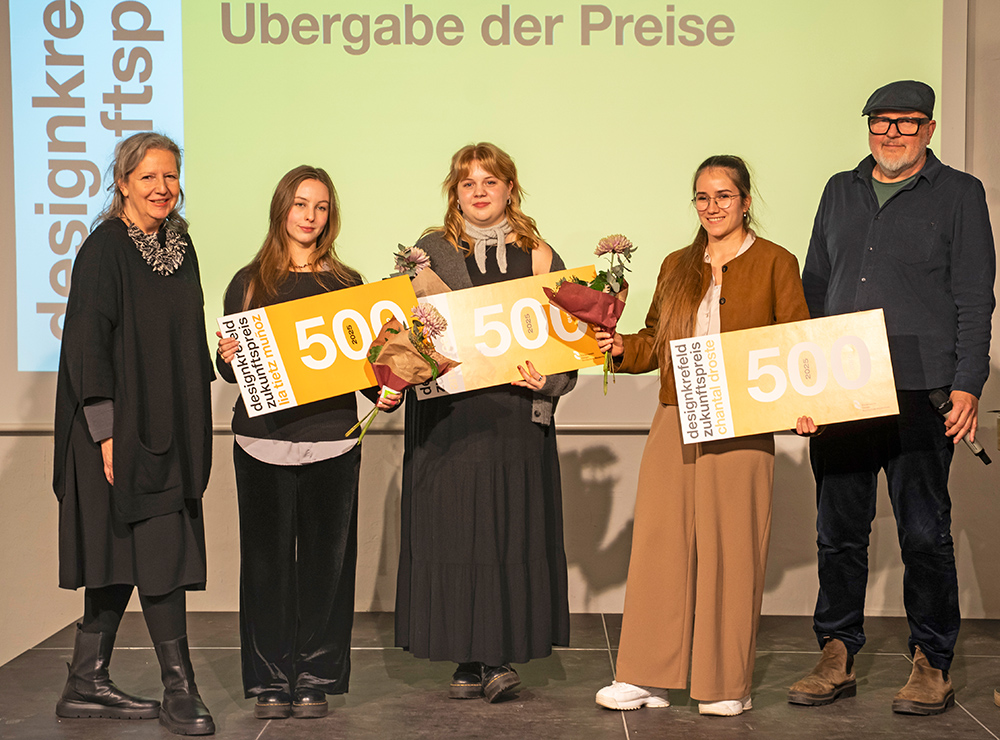
This year, three students were honoured with the Future Prize of the support association of the Faculty of Design at Hochschule Niederrhein (HSNR). The prize was awarded for the second time for three Bachelor's and Master's theses that focus on aesthetic values for a world with more justice, sustainability and confidence.
Eleven design students submitted their theses. These were assessed by the jury - consisting of Katia Baudin (Director of the Kunstmuseen Krefeld), Reinhard Henke (Managing Director of the advertising agency BUTTER.) and Mone Schliephack (Professor of Illustration at Düsseldorf University of Applied Sciences). "When selecting the jury members, we deliberately chose representatives from the fields of culture, business and design studies," says Professor Dr Erik Schmid, Dean of the Faculty of Design and Chairman of the support association. The distinctions were awarded to Anika Oelke (Communication Design degree programme) for her work "Mir geht es einsam", Lia Tietz Muñoz (Product and Object Design degree programme) and her work "MEKI KIT", and Master's graduate Chantal Droste for her thesis "Zero". The winners each received prize money of 500 euros from the support association.
The prize in the field of communication design went to Anika Oelke for her work "Mir geht es einsam" (I'm lonely), which impressed the jury due to its highly relevant social theme and media presentation as an exhibition. Because: "Mir geht es einsam" is an exhibition that aims to contribute to the normalisation of the topic of loneliness.
"In today's world, where social media creates pressure to perform and individualise, the feeling of isolation is growing. The aim is to make loneliness an emotional experience and bring it into the social dialogue," says Anika Oelke. The exhibition therefore focuses on all kinds of very personal human reactions to loneliness and forms a bridge between one's own loneliness and the community. The exhibition shows 156 sentences, always beginning with "I was lonely, so I ...". These sentences form the core and give the viewer a sense of belonging. "The theme of loneliness was a personal concern of mine, which is why the distinction means so much to me. It shows that you are not alone with your loneliness and that the topic plays an important role in our everyday lives. I am delighted that the work can reach even more people in this way," says Anika Oelke.
The prize for product and object design went to Lia Tietz Muñoz, who designed "MEKI KIT", a fermentation kit for everyday, mobile and domestic use. MEKI KIT makes the process of lactofermentation tangible and visible by accompanying all phases: Preparation, kitchen work, observation, waiting and storage. It is aimed at anyone who has not yet dared to ferment vegetables, for example, and thus makes it easier to get started with a sustainable and culturally significant form of food preservation.
"The distinction shows me that a topic that is so close to my heart has been able to reach and touch other people. Receiving recognition for this is an overwhelming feeling - not only for the topic, but also for the realisation, because there is always a piece of yourself in the design," says Lia Tietz Muñoz.
The prize for the best master's thesis went to Chantal Droste, whose work "zero" was recognised as an outstanding example of successful user experience design (UX design). She developed a practical and clearly designed app on the topic of waste avoidance. The "zero" app helps users to find their way into a zero waste life - in a structured, personalised and motivating way. The centrepiece of the app is the challenge function with categories such as kitchen, bathroom or garden. Here you can discover sustainable product alternatives and DIY ideas - and are rewarded with points for every task you complete. The knowledge section provides compact, verified information about zero waste. A map shows sustainable locations nearby, such as unpackaged shops or second-hand shops. With "zero", sustainability becomes suitable for everyday use, digital and motivating.
"For me, the Future Prize is confirmation that the topic of zero waste is not only socially relevant, but that my work can also make a real contribution," says Chantal Droste. "Several people have already told me that they would also like to use the app when it comes onto the market. One nice lady told me straight after the award ceremony that she felt very inspired and motivated to get more involved with zero waste. That particularly touched me." It shows that the intensive focus on sustainable solutions has paid off - and that innovative ideas, even from studies, can have an impact, says Droste.