

The research project "XR Environmental Education in the Mönchengladbach City Forest" by the MXR Lab at the GEMIT Institute of Business Process Management and IT (GEMIT) at Hochschule Niederrhein (HSNR) shows how digital technologies can get young people excited about environmental and nature conservation. Together with Mönchengladbach's waste, green and road services (mags), an innovative educational programme is being created that combines real experiences of nature with virtual game elements.
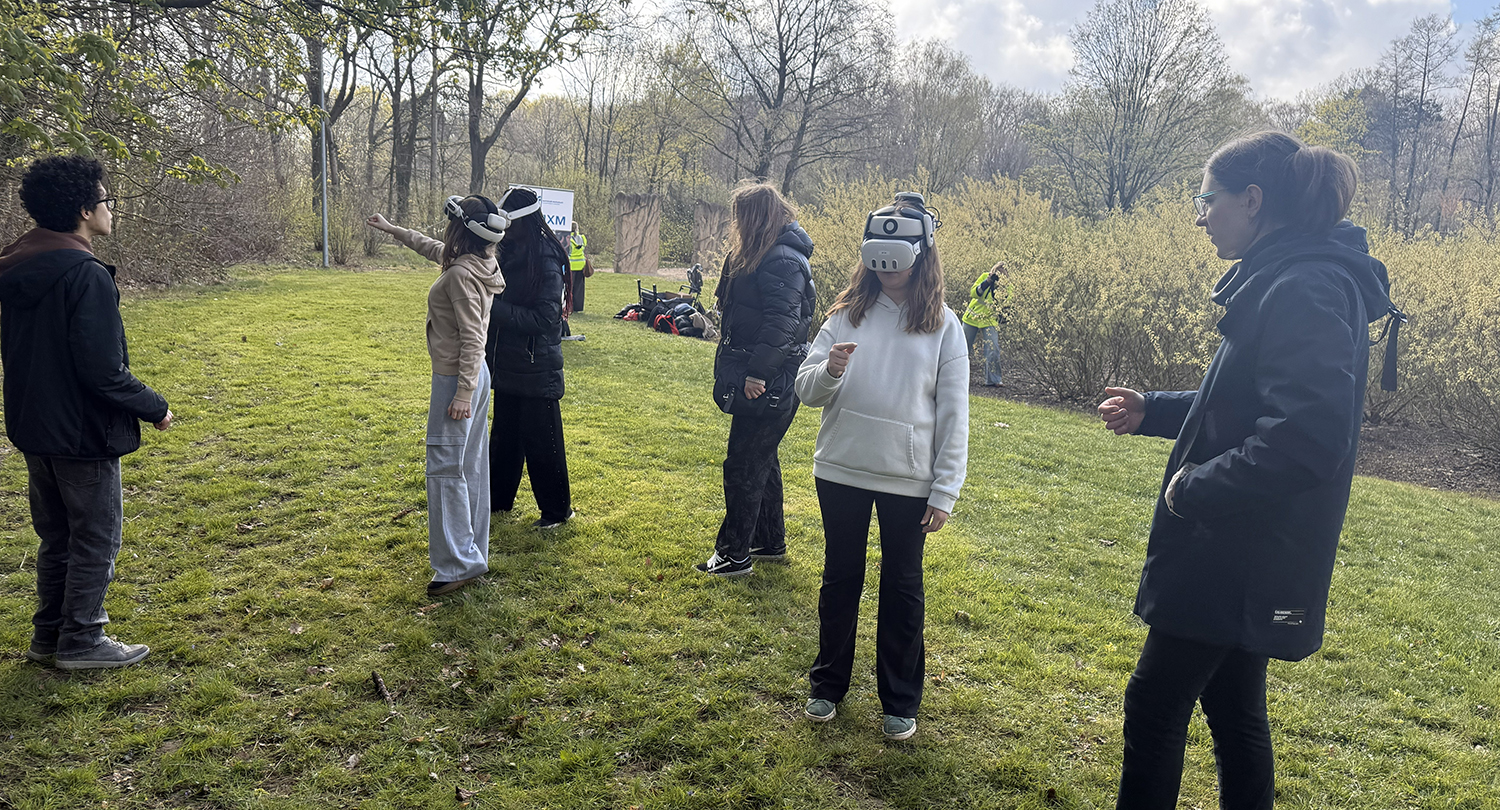
The project focuses on an interactive extended reality (XR) serious game that conveys environmental knowledge in a playful way and promotes sustainable behaviour. The game is played using Meta Quest glasses, which augment virtual objects such as rubbish, animals or plants into the real environment. A 6th grade class from the Realschule an der Niers recently completed a first practical test in the Rheydt city forest. Together with the character "Max the Bee", the pupils played various sequences in which they had to collect rubbish virtually and separate it correctly. They received points and virtual rewards for successfully completing the tasks. Parallel to the digital learning experience, some of the class took part in a real rubbish collection campaign in the city forest. In this way, virtual learning was directly linked to practical environmental protection.
"We want to make environmental education motivating, low-threshold and sustainable. We focus on playful content in a non-playful context. The combination of a real environment and digital content creates an immersive learning experience that appeals to children and young people emotionally and motivates them to act in an environmentally conscious way," explains Dr Lennart Hofeditz, project manager and scientific director of the MXR Lab at HSNR.
"XR" stands for Extended Reality and describes technologies that merge real and virtual worlds. Together with student employees Kate Kaufmann, Alessandro Carrillo, Mohamed Ahabbal and Nicole Maier, Dr Hofeditz is continuously developing the application. The pupils' feedback from the practical test will be incorporated into the next development phase and a possible follow-up project.
Further functions are already planned for the future: These include AI-based plant recognition and a multiplayer mode to make the application even more interactive and collaborative.
The project is part of the smart city strategy of the city of Mönchengladbach and is supported by the Federal Ministry of the Interior and Homeland (BMI) as part of the Mönchengladbach Smart City programme. The GEMIT Institute at the Faculty of Business Administration and Economics at HSNR received funding totalling 65,433 euros for the project.
The project is also part of Dr Lennart Hofeditz's work as part of the Tandem Niederrhein programme, which supports young academics on their way to professorship and supports application-oriented research in cooperation with regional partners.
The project runs from 1 June 2025 to 31 May 2026 and is aimed at children and young people aged 12 to 18, schools, educational institutions and visitors to the Mönchengladbach city forest.