profile
Hochschule Niederrhein

Hochschule Niederrhein. Your way.

Hochschule Niederrhein

The Hochschule Niederrhein is one of the largest and most successful universities of applied sciences in Germany. We open up new horizons: through a forward-looking academic apprenticeship and research that is problem- and application-oriented , we lay the foundations for our graduates to be in demand on the labour market.

We are a renowned centre of education and research within the German higher education landscape. With nine faculties, campuses in Krefeld and Mönchengladbach, and 13,363 students, we are a key contact for regional businesses when it comes to research and knowledge transfer.

Our 78 Bachelor’s and 34 Master’s degree programmes cover a broad spectrum of subjects and are tailored to the region’s needs. The faculties of Engineering and Computer Science, Faculty of Industrial Engineering, and Faculty of Health Care are based at the Krefeld South Campus. The faculties of Chemistry and Design are based at the Krefeld West campus. And in Mönchengladbach, alongside the university’s largest faculty – Business Administration and Economics – the faculties of Food and Nutrition Sciences, Applied Social Sciences, and Textile and Clothing Technology are also based there.

We stand for guidance and optimism

In a complex and rapidly changing world, we need institutions that can provide guidance through their experience, strength and capabilities. We are one of these – one of Germany’s largest and most high-performing universities of applied sciences. Drawing on our knowledge of our region, the Lower Rhine, and our expertise in teaching education, research and knowledge transfer, we open up new prospects for individuals and organisations and play our part in ensuring that our society is well prepared to tackle future challenges.

We form a strong community and instil confidence and trust in our students’ own abilities. Through a future-proof academic apprenticeship and research that is problem- and transfer-oriented, we lay the foundations to ensure that our graduates are in demand on the labour market.

Those who study with us forge their own path.

Grown in the region

In 2019, the universities of applied sciences – which are now known as ‘Hochschulen für Angewandte Wissenschaften’ – are celebrating their 50th anniversary. The first institutions of this new type were established in Schleswig-Holstein in 1969. In North Rhine-Westphalia, the University of Applied Sciences Act of 29 July 1969 and the Act on the Establishment of Universities of Applied Sciences of 8 June 1971 laid the foundations for the establishment of the first universities of applied sciences. Among these was the then Niederrhein University of Applied Sciences, which has been known as the Hochschule Niederrhein since 2001. On 1 August 2021, the Hochschule Niederrhein will mark its 50th anniversary.

However, the history of the Hochschule Niederrhein stretches back much further, namely to the year 1855. It was then that the Crefeld Higher Weaving School was founded, from which the Dyeing and Finishing School and the School of Textile Engineering later emerged – the two predecessor institutions of today’s faculties of Chemistry and Textile and Clothing Technology. Key dates in our fascinating history are set out below.

1855: Crefeld Advanced Weaving School

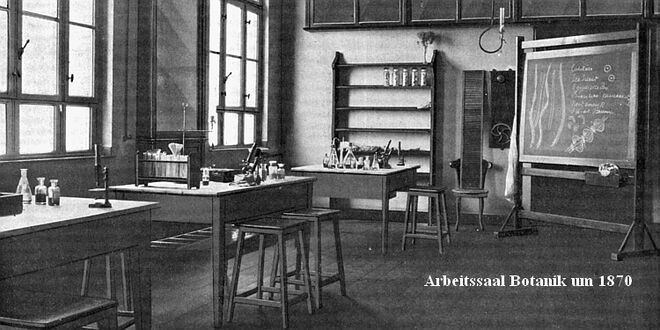
Botany Study Room

Textile technology also formed the basis of industrial development in the 19th century in the Lower Rhine region on the left bank. Initially, this was underpinned by the ‘Verlegersystem’ (contracting system), under which textiles produced by weavers working from home were marketed by contractors.

Mechanisation and automation brought about a radical transformation in the middle of the century. Within a few years, the system of home-based work was phased out and replaced by automated looms in large factory halls. These changes – despite the Prussian monopoly on velvet and silk for Krefeld – made it urgently necessary for employees in the textile industry to acquire further qualifications, as many Krefeld manufacturers were sending their young successors to Lyon, their main competitor, for an apprenticeship.

In response to this local educational crisis, the ‘Höhere Webschule Krefeld’ (Krefeld Higher Weaving School) was founded in 1855 on the initiative of the Krefeld Chamber of Commerce, becoming the first higher education institution in the Lower Rhine region. This marked the birth of the Hochschule Niederrhein.

1883: Royal School of Weaving, Dyeing and Fin

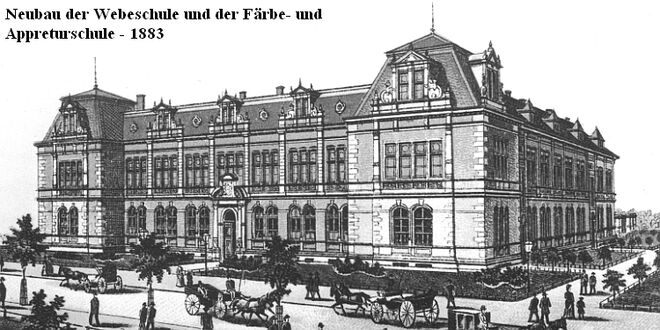
New building for the Krefeld Weaving School

In 1878, it was once again Krefeld’s industrial sector that was concerned about the long-term viability of the ‘old’ silk industry. It seemed necessary to capitalise on the possibilities and opportunities offered by the new, emerging dyestuff and chemical industries.

The Chamber of Commerce called for a fundamental reorganisation of the ‘Municipal Weaving School’ modelled on renowned foreign institutions, such as those in Lyon.

Thanks to the considerable personal and financial commitment of wealthy silk manufacturers, the Krefeld Chamber of Commerce and the Prussian state, the ‘Royal School of Weaving, Dyeing and Finishing’ opened in 1883 – to international acclaim – in a magnificent building. All branches of textile technology and chemistry were incorporated, including modern dyeing and finishing processes.

Under the leadership of the dye chemist Prof. Dr Heinrich Lange, who took over as head of the school from BASF, the institution developed into an educational establishment of world renown. Indeed, in its first 25 years, 80 students from all over the world had already been awarded doctorates. They had previously studied at other universities under leading figures in their field, such as Justus von Liebig, and were now embarking on second studies with a practical emphasis at the “Royal School of Weaving, Dyeing and Finishing”.

In 1904, during the ‘boom’ years of the dyestuff industry, this predecessor institution was chosen to represent the German Empire’s apprenticeship in this field at the World’s Fair in St Louis, USA.


By 1895, the building had already become too small. The buildings on Adlerstraße, which still stand today, became the new home of the spun-off School of Dyeing and Finishing.

The broad, application-oriented and practical orientation fostered the development of further specialist areas within the school. In close collaboration with industry, fibre finishing, synthetic fibres, paints and varnishes, as well as cleaning and hygiene, became new fields of applied research and teaching education.

1901: Prussian Higher Technical College

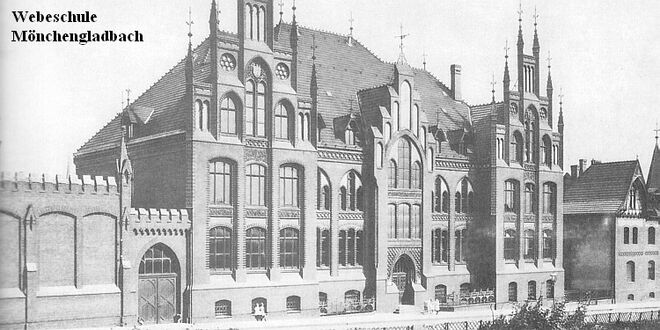
Mönchengladbach Higher School of Weaving

In the second half of the 19th century, the Mönchengladbach-Rheydt industrial area developed into the ‘Rhenish Manchester’ – one of the most important centres of textile processing in Germany – as the industry shifted from flax and linen to cotton.

In response to the industry’s needs, the Prussian state established, in addition to the ‘weaving schools’ which offered an apprenticeship for foremen, ‘advanced weaving schools’ to provide preliminary training for ‘manufacturers and factory managers’. On the initiative of a special commission comprising the Chamber of Commerce, local authorities from the Mönchengladbach commercial district, the District President in Düsseldorf and the Ministry of Trade in Berlin, the‘Prussian Higher Technical College for the Textile Industry in München-Gladbach’ was founded in 1901 to provide an apprenticeship for managers.

1904: School of Trades and Applied Arts

Krefeld University of Art and Design

However, textile art and colour theory also play an important role here in relation to another predecessor institution, the “Crefeld School of Applied Arts”.

‘Design means giving shape to one’s surroundings’ – this was the credo of the founders of the ‘Handwerker- und Kunstgewerbeschule’ (School of Crafts and Applied Arts), established on 1 October 1904, from which the ‘Crefelder Werkkunstschule’ emerged.

It became a significant institution for the applied arts. Painting, graphic art, stained glass, textile design, ceramics and architecture were key fields of teaching at this institution.

Heinrich Campendonk, Helmut Macke, Henry van der Velde, Jan Thorn Pricker, August Biebricher, Fritz Winter and Peter Lindbergh are just a few examples of famous artists who were associated with the Werkkunstschule as university teachers / lecturers or students. Some of them have had a lasting influence on art history.

1932: Higher School of Fashion Design

Researchers in the Lower Rhine region

Close cooperation with industry led, in 1932, to the re-establishment and incorporation of the “Higher School of Clothing” and, ultimately, in 1936, to the “School of Textile Engineering”.

Three higher state institutions, the core of what would later become the Hochschule Niederrhein, began their journey into the 20th century. They grew out of the region and their influence extends far beyond it.

1933: School for Master Craftspeople in the G

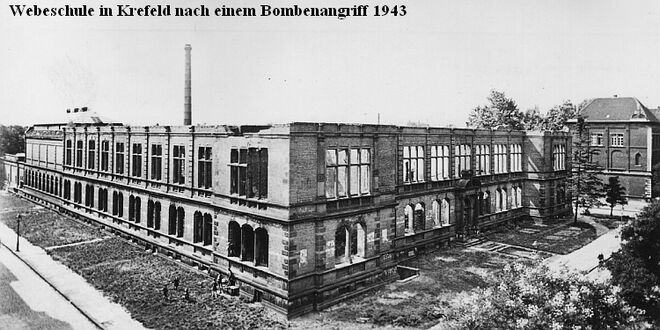
The destroyed weaving school in Krefeld

In 1933, the National Socialists’ seizure of power led to the standardisation of all state institutions, particularly educational establishments. Above all, the fine arts were subjected to unprecedented suppression and discrediting. The ‘School of Applied Arts’ was renamed the ‘School for Master Craftspeople’. The architecture, sculpture and ceramics departments were closed in 1934. Five out of seven ‘art teachers’ were dismissed; only the craft departments remained.

In 1932, the ‘Higher Technical College for Textile Surface Art’ was fortunate enough to be affiliated with the Krefeld Weaving School. The employees there were able to conceal their abstract ambitions partly behind the textiles, whilst also putting them to use.

The National Socialists recognised textile production – ideally without raw materials from abroad – and the associated research and apprenticeship as a crucial factor for the economy and armaments. Few technical restrictions or adjustments were imposed. In Mönchengladbach, work involving cotton – a raw material considered foreign – was restricted. In Clothing Technology, uniforms played a greater role. In Krefeld, research into chemical fibre production was stepped up. Professors are dismissed if they have not “at all times unreservedly championed the national state”.

The ‘National Socialist German Students’ League’ is founded. Its members are obliged to serve in the SA and thus to undergo military-style training. Other student associations are banned.

The result is war, death and chaos: in June 1943, the Higher School of Weaving in Krefeld is the first to be affected. The apprenticeship continues in the equally badly damaged building of the ‘School of Dyeing and Finishing’ on Adlerstraße. One day later, the School of Applied Arts on Peterstraße in Krefeld is struck. The apprenticeship continues in the manor house at Linn Castle.

The building of the Mönchengladbach School of Textile Engineering and its facilities were almost completely destroyed during the 1944/45 winter semester. The apprenticeship was relocated to Münchberg (Upper Franconia) at the end of 1944.

1945: The post-war years

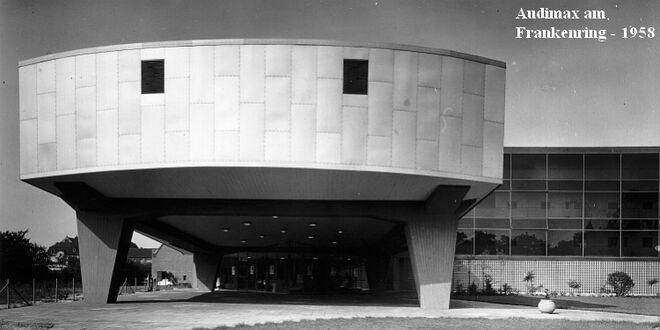
New building for the Krefeld School of Textile Engineering

The tyranny and the war destroyed much, but not everything. The three schools survived and got back on their feet. In 1955, the long-established Krefeld School of Textile Engineering was given a modern, award-winning new building on Frankenring, featuring an impressive glass façade. It represents an early work by the architects Lohrscheidt and Pfau, who became famous for projects including the Düsseldorf Schauspielhaus.

The Werkkunstschule was rebuilt on Peterstraße. In Mönchengladbach, the buildings of the School of Textile Engineering rose from the ruins on Webschulstraße.

1958: State College of Engineering for Mechan

School of Engineering

On 1 April 1958, the“State School of Mechanical Engineering” was founded. The Krefeld Chamber of Industry and Commerce contributed one million German marks (DM) towards its funding through a special contribution scheme. The City of Krefeld donated a further one million DM, the building plot on Reinarzstraße – where today’s Krefeld South Campus is located – and the extension site in the allotment garden area.

All of Krefeld’s metal and electrical engineering firms made a contribution, as did the chemical industry and the Post Office, which was the operator of the communications networks at the time. The departments of Mechanical and Process Engineering, and later, Process Engineering and Electronics are established. The university’s faculties of ‘Mechanical and Process Engineering’ and ‘Electrical Engineering and Computer Science’ develop.

1962: State Higher School of Economics

The “State Higher School of Economics” was officially opened on 2 October 1962 in the Balkonsaal of the Kaiser-Friedrich-Halle in Mönchengladbach. The “Faculty of Business Administration and Economics” was established. The guest list included the patrons of this founding: Minister-President Franz Meiers, a native of Mönchengladbach; Chamber President Prof. Dr Viktor Achter; and City Director Dr Elbers. It was not until 1970 that the college was able to move into its new building on Webschulstraße. The “Mönchengladbach campus” is gradually taking shape.

1971: Niederrhein University of Applied Scien

Foundation of the Hochschule Niederrhein

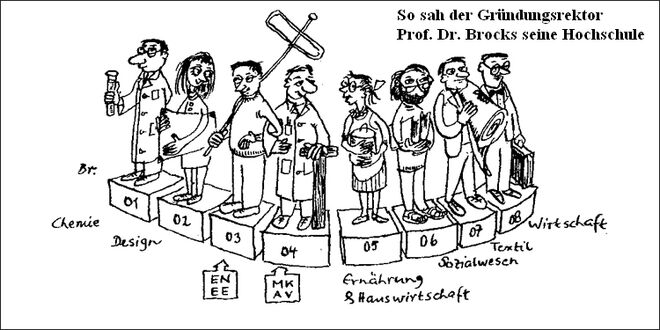
On 1 August 1971, the “Niederrhein University of Applied Sciences” was founded. Its six faculties were built upon a foundation of 13 “state universities of applied sciences”, which brought with them a long tradition and a strong track record of academic excellence. Academic and geographical links already existed in a variety of forms; these were reorganised and strengthened. Two new faculties were added when the university of applied sciences was founded: the Faculty of Applied Social Sciences and the Faculty of Food and Nutrition Sciences. These subjects had previously been taught at technical colleges and were now adapted to meet society’s increased demands. Food and nutrition had by then become important economic sectors in the Lower Rhine region. The ‘Mönchengladbach Campus’ was completed by the addition of these two faculties.

Also in 1971, a section of the ‘State School of Engineering for Textiles in Krefeld’ was merged with the ‘State School of Engineering for Textiles in Mönchengladbach’. This gave rise to the Faculty of Textile and Clothing Technology at the Hochschule Niederrhein, with a range of specialisms unique in Europe, spanning from fibres to finished products in the fields of clothing and materials for technical textiles.

The interdisciplinary range of courses was expanded, initially to include “Industrial Engineering” and subsequently – by which time the institution was already known as the Hochschule Niederrhein ( since 9 July 2001) – “Health Care”. From the 2010/11 winter semester, The Hochschule Niederrhein offers a range of educational and research programmes across ten faculties.

Practical universities in Germany

The Hochschule Niederrhein is a founding member of the new university consortium, the University Alliance for Small and Medium-sized Enterprises (HAfM). The Alliance aims to raise awareness nationwide of the potential of universities of applied sciences. It promotes the idea of studies that are closely aligned with the needs of the SME sector, as well as application-oriented research that develops solutions to key technological and societal issues.

Universities and small and medium-sized enterprises are ideal partners: together, they offer apprenticeships to young people, thereby strengthening the region, and collaborate in a solution-oriented manner in research and development. The universities also work in partnership with SMEs in structurally weak regions to prevent the exodus of young talent. As regional development centres, they play a unifying role and act as an effective safeguard against demographic-driven structural change. They also make a crucial contribution to the integration of migrants and their children into the academic world.

Prof. Dr Hans-Hennig von Grünberg, President of the Hochschule Niederrhein until the end of February 2020, was a co-founder and, for five years, Chairman of the University Alliance for SMEs.

Website of the University Alliance for SMEs

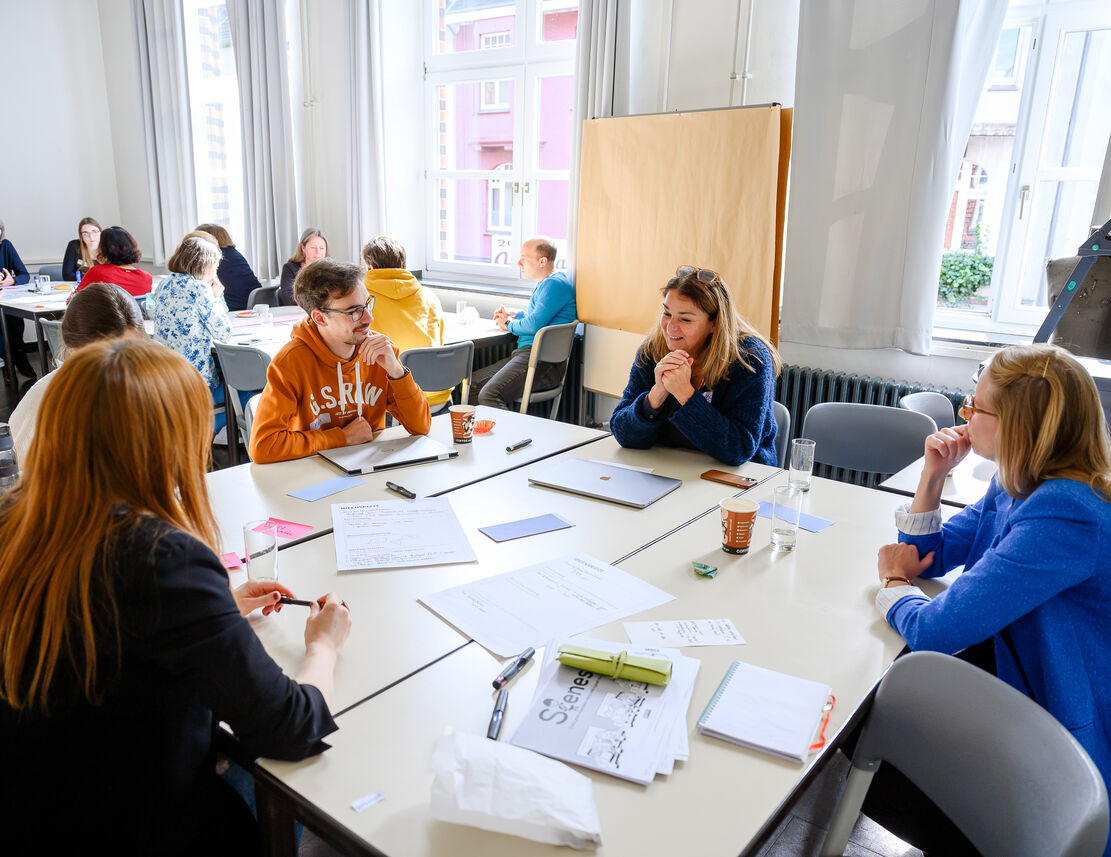
Workshop – A Vision for Teaching and Learning
Position paper

On the use of generative AI in studies and teaching education

On 11 May 2026, the Senate adopted the position paper on the use of generative AI in studies and teaching education at the Hochschule Niederrhein. It was developed through a participatory process involving the ‘Generative AI in Studies and Teaching Education’ think tank, the ‘AI in Teaching, Learning and Assessment’ project, and with the participation of numerous members of the university community.
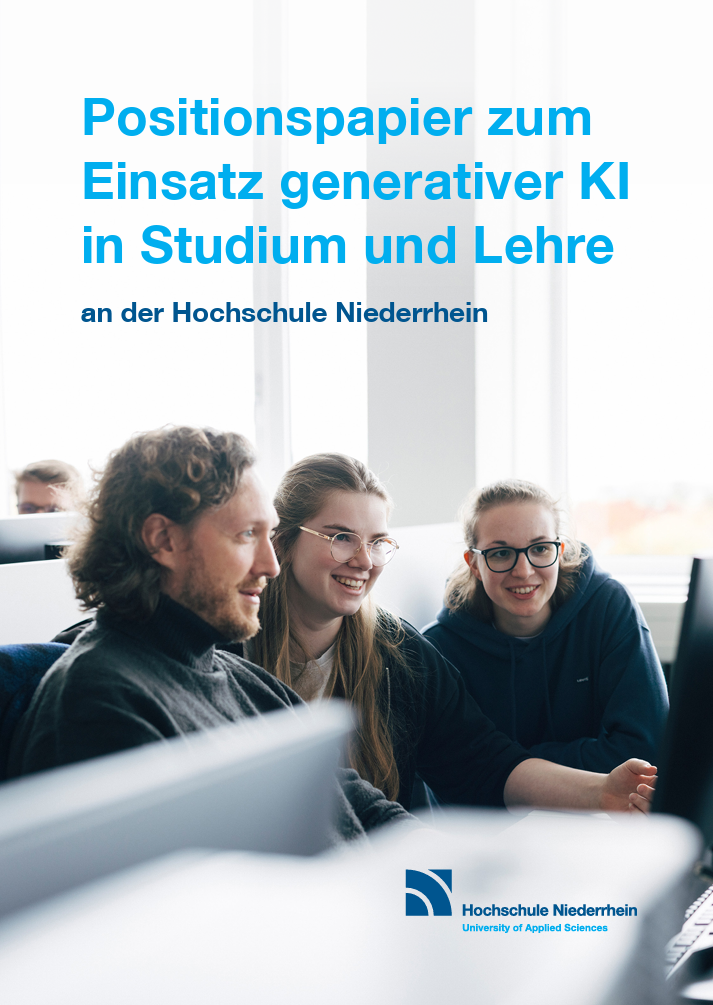
With this position paper, The Hochschule Niederrhein takes a clear stance: it advocates the responsible use of generative AI in studies and teaching education in line with the university’s values framework. It views AI as an opportunity to jointly shape new approaches to teaching education, learning and assessment, thereby preparing students for a life and working world increasingly shaped by AI.

What makes our position paper special is that it is deliberately not a collection of guidelines or prohibitions. Rather, it sets out a shared stance and provides a framework for the responsible use of generative AI. It invites us to harness the potential of AI together, to monitor developments critically and to play an active and creative role in shaping its use.

It is now up to all of us to bring this stance to life. Lecturers, students and staff from support services, administration and other areas are invited to work together to further develop the responsible use of generative AI.

Consulting
Accessibility

HSNR Chatbot