




In order to use artificial intelligence profitably in business and society, well-trained specialists are needed who can actively and positively shape technological and social change across various disciplines and areas of application. On the other hand, a fundamental social understanding of the mechanisms of action and implications of AI is also required.
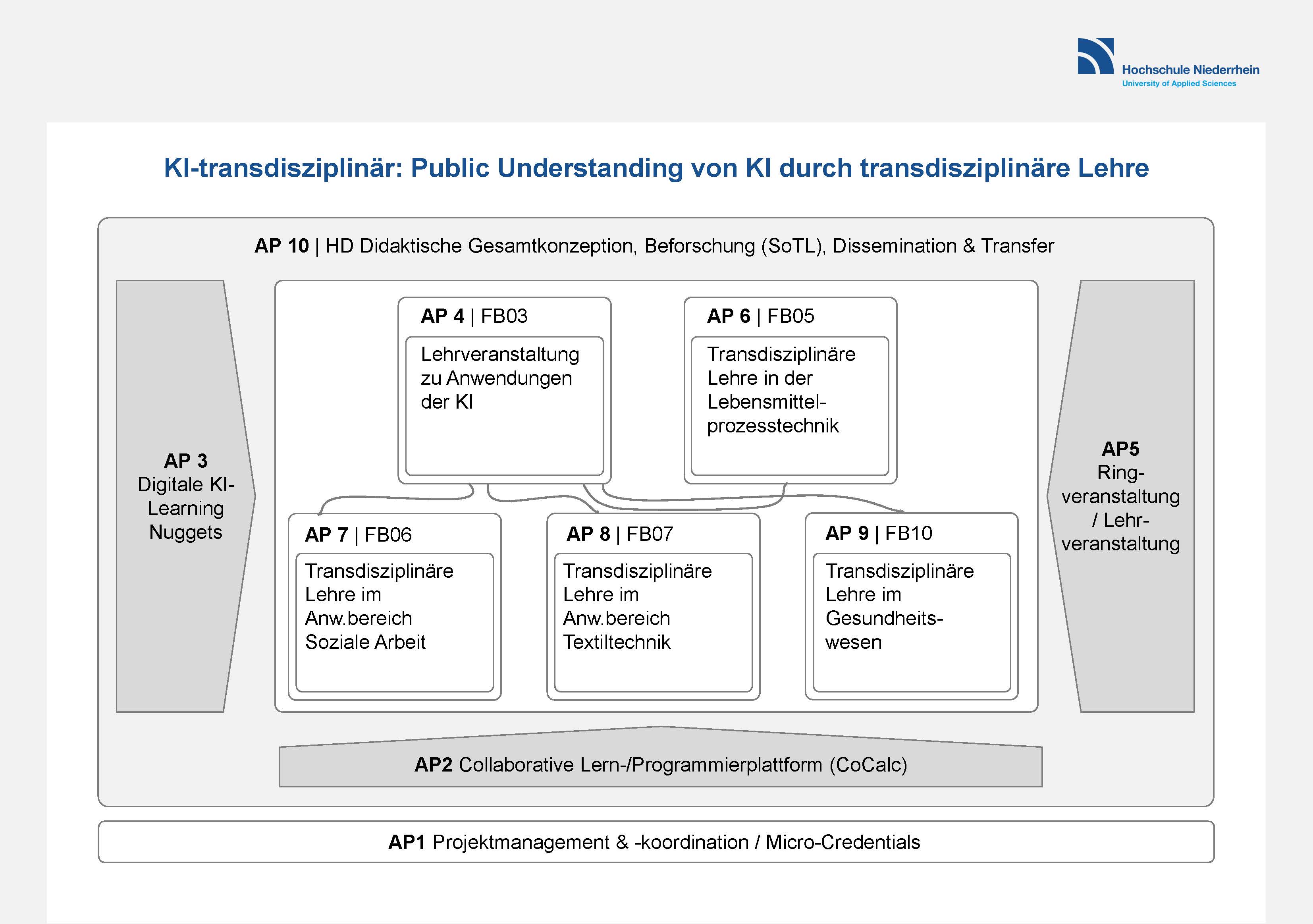
The project presented here aims to impart application-oriented AI skills to a broad base of students. In doing so, this project does not use the classic formats of a so-called Studium Generale, in which conventional computer science courses are opened up to students from the application areas, as these do not do justice to either the students' prior knowledge or their motivation. Instead, the central element is transdisciplinary projects in which students from culturally heterogeneous degree programmes work together to use AI to solve a given practical problem. These projects are flanked by demand-oriented learning nuggets, expert lectures and a software infrastructure to be developed that enables students from the application areas to work with AI topics at a low threshold.
Computer Science degree programme students learn to assess the benefits of AI in practical application contexts and to develop solution concepts together with users. Complementary to this, students of the application areas learn to describe application scenarios for AI methods in their field and to use AI methods. Together, both groups also learn to reflect on the use of AI and the processing of data from an ethical perspective.
With its interdisciplinary, transdisciplinary approach, the project is also designed to create sustainable structures in the field of AI teaching education at the HSNR.
Funding
The project "Public Understanding of AI through transdisciplinary teaching education" (KI-transdisziplinär) is funded by the BMFTR as part of the federal-state funding initiative "Artificial Intelligence in Higher Education".




 Ring Event