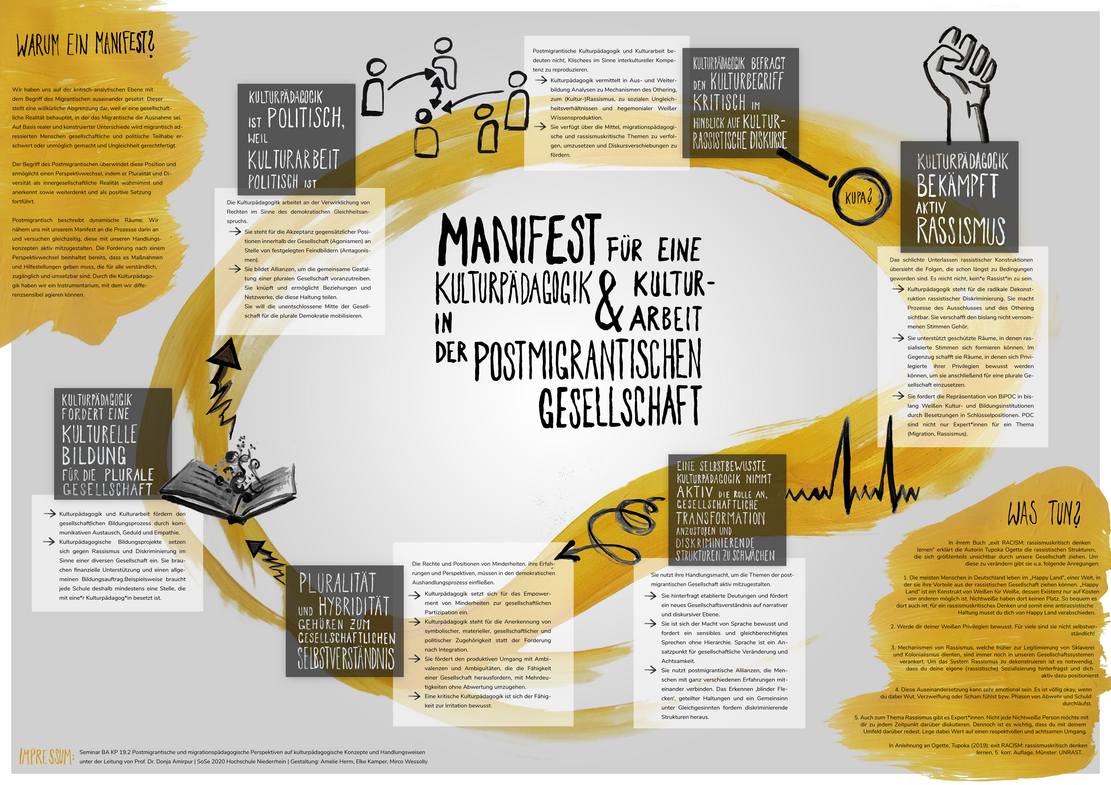
We have analysed the concept of the migrant on a critical-analytical level. This represents an arbitrary demarcation because it asserts a social reality in which the migrant is the exception.
On the basis of real and constructed differences, social and political participation is made difficult or impossible for people addressed as migrants and inequality is justified.
The concept of the post-migrant overcomes this position and enables a change of perspective by perceiving and recognising plurality and diversity as a reality within society, as well as thinking it through and advancing it as a positive setting.
Postmigrant describes dynamic spaces. With our manifesto, we are approaching the processes within these spaces and at the same time trying to actively shape them with our concepts for action.
The demand for a change of perspective already implies that there must be measures and assistance that are understandable, accessible and realisable for everyone. Cultural education provides us with a set of tools with which we can act in a way that is sensitive to differences.
- Cultural education is political because cultural work is political.
- Cultural education critically scrutinises the concept of culture with regard to cultural racist discourses.
- Cultural education actively combats racism.
- Self-confident cultural education actively takes on the role of initiating social transformation and weakening discriminatory structures.
- Plurality and hybridity are part of society's self-image.
- Cultural education calls for cultural education for a pluralistic society.