Competence centre
Resource-orientated age(ing) research

Hochschule Niederrhein. Your way.

The REAL competence centre

The Competence Centre for Resource-Oriented Age(ing) Research (REAL) was founded in 1993 by Professor Dr Engelbert Kerkhoff as the core research areas "Competence in old age between routine and new beginnings" at The Hochschule Niederrhein.

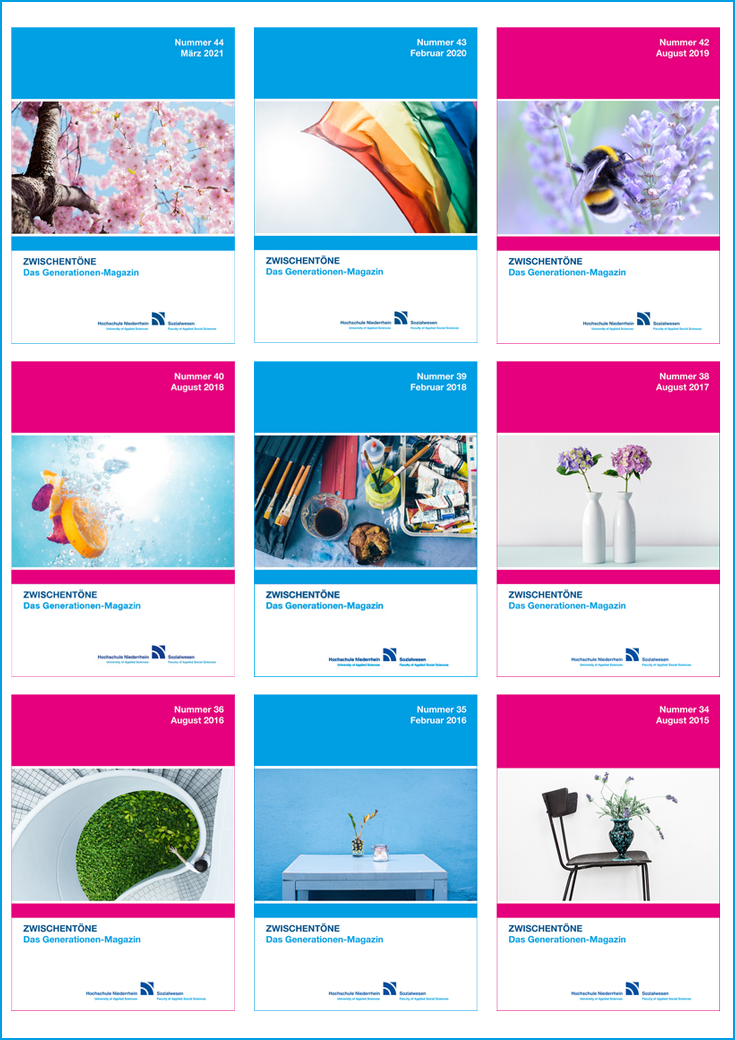
Today, we conduct basic and application-oriented research on issues relating to ageing and old age, carry out practical projects and incorporate gerontological, i.e. age(ing) science topics into the teaching education of the Social Work and Education degree programme. We are responsible for the FAUST guest student programme and publish the generation magazine Zwischentöne.

We cooperate with the various faculties of the university and external regional and national partners.

Our goals, topics and areas of expertise

Objectives

  • Promoting social participation of the heterogeneous group of older people, in particular lifelong learning
  • Strengthening dialogue between the generations
  • Raising awareness of the diversity (heterogeneity) of age(ing) and reducing age discrimination
  • Gaining knowledge through research on age(ing) issues
  • Strengthening the exchange between science and society / practice / politics
  • Preparing students for social work with older and very old people and their relatives

Topics and areas of expertise

  • Education, leisure and culture in old age
  • Pension transitions
  • Informal care
  • Digital participation in old age
  • Participatory technology development with older people
  • Neighbourhood work
  • Ageism, age discrimination
  • Methods of empirical social research

BA thesis distinguished

18.02.2026

Jenna Kammann's Bachelor's thesis, for which Moritz Heß was first supervisor, was honoured with the HSNR 2025 Senate Prize!

Congratulations, Jenna Kammann! We are delighted to have our work on the influence of animal-assisted interventions on the well-being of people with dementia recognised. The study shows that animal contact can reduce anxiety and restlessness and support social interactions - although the effect varies from person to person. Congratulations also to the other award winners!


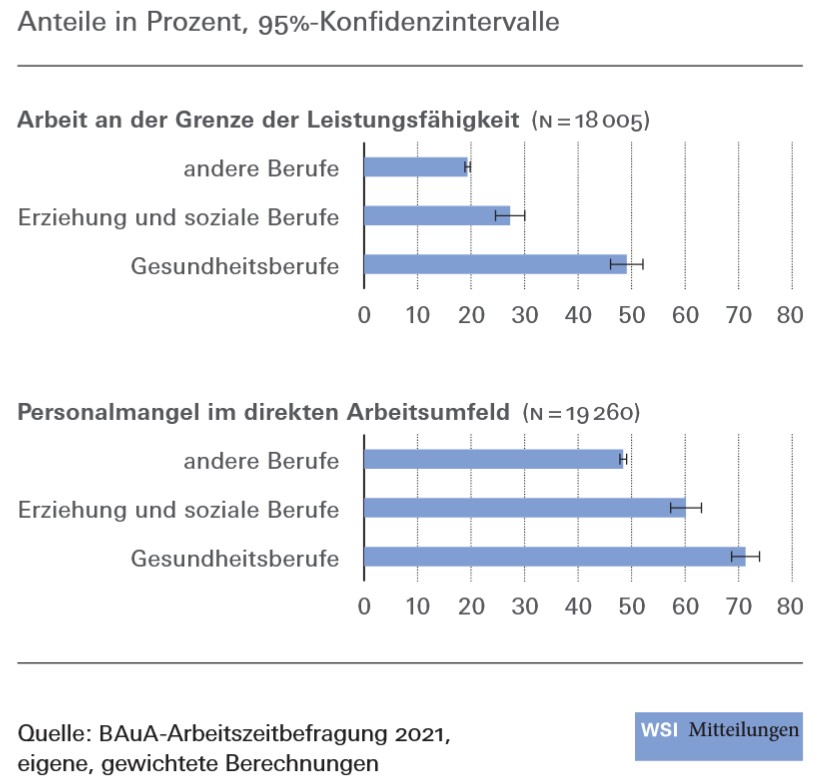
Figure Work at the limits of performance and lack of personnel in the immediate working environment by occupational group
New publication in WSI-Mitteilungen

31.01.2026

Moritz Heß publishes an article in the WSI-Mitteilungen on social and healthcare professions in the Covid-19 pandemic

Together with Silke Tophoven from Düsseldorf University of Applied Sciences and Anita Tisch from the BAuA, Moritz Heß analyses how employees in social and health professions perceived their workload during the pandemic. They used data from the BAuA working time survey. As a result, they found a high workload in these professions.

The article is open access and therefore freely accessible.

What are baby boomers planning for retir
Article in ZWISCHENTÖNE magazine

12.02.2026

Melanie Oeben and Ann-Marie Krewer from the SO.CON institute, together with Moritz Heß, have analysed the needs and ideas of baby boomers with regard to their post-employment phase.

They present the initial results of their study in the 53rd expenditure of the generation magazine ZWISCHENTÖNE. The study shows, among other things, that the ideas of a "good retirement" vary, but for most of them an active and self-determined lifestyle as well as social contacts and social participation play an important role.

The intergenerational magazine ZWISCHENTÖNE is published by the REAL competence centre in collaboration with volunteer editors and contains a wide range of articles. The magazine is available to download free of charge and will be available to pick up at various university locations, bookshops and libraries from the end of February 2026.

Publication in Sex Roles
New publication on "Cat Calling"

14.04.2026

Further publication by the REAL team

Moritz Heß, together with researchers from the Faculty of Health Care at HSNR and the University of Bonn, has published a study on the topic of "cat calling".

The study examines whether attitudes towards other groups and the perceived origin of the catcalling person influence how people perceive such behaviour.

New publication
Article published in InterCare

09.04.2026

New publication on student carers

Joy Pirig and Moritz Heß, together with Anna Wanka, have published the article "Who are student caregivers? Reconciling studying and caregiving in Germany" in the International Journal of Inclusive Education.

The article is based on an analysis of the data from the student survey and the results show that 11% of students state that they care for family members or friends. Older students and those from non-academic families are significantly more likely to take on caring responsibilities.


New book chapter
Publication in manual

31.03.2026

New publication in international handbook

Moritz Heß, together with Laura Naegele and Philipp Stiemke, has published the book chapter "Ageing and the Multilevel Structure of Society" in the renowned Research Handbook on the Sociology of Ageing. In it, they discuss how demographic ageing affects different levels of society.


Moritz Heß at PK NRW

14.03.2026

Moritz Heß has been accepted at the doctoral college NRW

We are delighted that our director Moritz Heß has been accepted as a professorial member of the Doctoral College NRW in the Department of Social and Health Sciences. The Promotionskolleg NRW is building structures and processes to create the conditions for doctorates at HAW in NRW.


The team

Research Associate, Managing Director Competence Centre for Resource-Oriented Age(ing) Research (REAL)

Gerontology Head of the competence centre REAL

Nicole Klösges, Social worker (B.A.)
Competence Centre for Resource-Oriented Age(ing) Research (REAL) Coordination FAUST program

Research assistant in the InterCare project

Student employees

Finn Convent B.A. (research intern in the InterCare and PUSH projects)

Maria Fletschinger B.A. (offers at the Belting-Treff community centre, support in the FAUST guest auditor programme)

Vanessa Müller B.A. (support for events and research activities, editorial work in the magazine "Zwischentöne")

Lana Popovic (support with the FAUST guest auditor programme and research projects)

Marie Wagner (semester intern Bachelor Cultural Education)

InterCare: Challenges and potential for reconciling education and care in ageing knowledge societies

InterCare stands for intergenerational caring relationships. The project focuses on young carers and the people they care for (e.g. parents or grandparents). Why? Young carers often have to combine caring for their relatives with other tasks, such as their education, training or employment. This can be accompanied by challenges in terms of health and education. Support for this target group is lacking or can be improved. InterCare is therefore investigating the challenges, but also the potential, of reconciling education and care. In addition to expanding the knowledge base, InterCare also aims to raise awareness of the issue of young carers in education and training. Furthermore, a European research network will be initiated, especially for young researchers. The project partners are Anglia Ruskin University in England, Goethe University Frankfurt and Jagiellonian University in Poland. The Hochschule Niederrhein is responsible for the implementation of a quantitative online survey within the framework of InterCare, which will be conducted in the three participating countries. Other methods include interviews, a Delphi panel and innovation labs. The project is funded by the Volkswagen Foundation.

Key data

Project duration: 2024 to 2028

Project partners: The Hochschule Niederrhein, Goethe University Frankfurt, Anglia Ruskin University England, Jagiellonian University Poland

Funding: Volkswagen Foundation


Contact persons

Joy Pirig: joy.pirig(at)hs-niederrhein.de

Professor Dr Moritz Heß: moritz.hess(at)hs-niederrhein.de

Online-Umfrage

Leitende Einrichtung: Hochschule Niederrhein, Deutschland 
Methode: Fragebogen für junge Menschen zwischen 18 und 30 Jahren im Bildungssystem 
Ziel: Analyse der Auswirkungen der Pflege während der (Aus-)Bildung auf verschiedene Lebensbereiche wie Bildung und Gesundheit. 

Interviews

Lead institution: Anglia Ruskin University, England
Method: Dyadic interviews with young carers in (further) education and the people they care for and audio diary
Aim: To capture the experiences from both perspectives in terms of intergenerational relationships, challenges and potentials.

Delphi panel

Lead institution: Goethe University Frankfurt am Main, Germany
Method: Delphi panel survey with national and local policy makers, specialists and practitioners in the education and care sector
Aim: To investigate the awareness and attitudes of actors in educational institutions, practitioners in NGOs and counselling centres as well as local, national and transnational policy makers in the field of care and education.

Innovationlabs

Leading institution: Jagiellonian University, Poland
Method: Intergenerational innovation labs with young carers in (further) education and older people in need of care
Objective: To develop practical and effective support structures that meet the individual needs of the groups in a participatory manner. The aim is to develop solutions that can be recommended at various political levels.

Between education and care
Creative workshop series to join in


As part of the InterCare project, we organise intergenerational workshops with the aim of raising awareness of the issue of caring for relatives and developing practical support structures.


We are looking for

Young people

  • in education (studies, apprenticeship, etc.)
  • who support or care for an older person, e.g. (grand)parents

as well as people who are cared for by younger people

What you can expect:

  • Exchange with others in a similar life situation
  • Creative work (e.g. photos, writing, theatre, podcast)


Why it's worth taking part:

  • You can be creative and learn new techniques with artists
  • You create visibility for the topic of care and support
  • You will receive €25 compensation per workshop


When and where:

  • Online workshops via Zoom
  • Tuesday, 19.05.2026, 16:00-17:30 hrs
  • Wednesday, 24.06.2026, 16:00-17:30 hrs


Please register by email to Anna Wanka: wanka(at)em.uni-frankfurt.de

Logo InterCare

The complete call (incl. new dates) is available for download here:

Call for participation

PUSH: Caring students - invisible university members

For the first time, data from the 22nd student survey shows that more students are caring for older relatives than for children. For at least 280,000 students, this represents their living situation, which is more than one in ten of those surveyed. Nevertheless, there is still little knowledge in the research landscape about this population of caring students or about institutional support options, such as those available for studies and raising children. They are invisible members of the university community. This is where the PUSH project comes in with its mixed-methods design. The three-year project aims to identify the compatibility of care and studies, the resulting challenges for students, but also the potential for support from universities. In addition to its own qualitative and quantitative surveys, the data from the aforementioned 22nd student survey will also be used. The PUSH project therefore not only closes a research gap, but also offers perspectives for reducing social inequality and the shortage of skilled labour. The HS Niederrhein is responsible for analysing the quantitative data, while the Goethe University Frankfurt will conduct the qualitative research. The PUSH project is funded by the Federal Ministry of Education and Research.

Key data

Project duration: 2025 to 2028

Project partners: The Hochschule Niederrhein & Goethe University Frankfurt

Funding: Federal Ministry of Education and Research

WeCare - HSNR

According to data from the German Centre for Higher Education Research (DZHW), around one in ten students provides care for relatives. This dual role can become a burden. On the university side, there are often only a few measures in place to support students who are caring for relatives and to promote compatibility. The Hochschule Niederrhein sees itself as a family-friendly university and aims to continuously improve the compatibility of studies and family. With the "WeCare - HSNR" project, it wants to explicitly focus on the group of students who are carers. The project pursues three goals: 1. to gain a deeper understanding of the situation, challenges and resources of students with caring responsibilities at HSNR, 2. to raise awareness and 3. to (further) develop measures to reconcile studies and care and integrate them into the existing structures of HSNR.

Project duration: 2026


Contact persons

Marc Kellert: marc.kellert(at)hs-niederrhein.de

Joy Pirig: joy.pirig(at)hs-niederrhein.de

Completed projects (selection)

Projects between 2016 and 2022

2022
"Stolpern - Erinnern - Erzählen" - Entwicklung gestalterischer Projekte zur Erinnerung an die Mönchengladbacher Opfer des Nationalsozialismus . Interdisciplinary project on social and cultural research in cooperation with the Hans-Jonas-Gesamtschule Mönchengladbach. Professor Dr Andris Breitling, Dipl.-Geront. Sigrid Verleysdonk-Simons.

2021
Caring students: Problems and support options for students with caring responsibilities"
The project is investigating the challenges students experience when they are caring at home in addition to their studies. The project partner is Dr Anna Wanka from Goethe University Frankfurt. The project is funded by the Equal Opportunities Office and the Faculty of Education at Goethe University Frankfurt. A systematic literature research and evaluation and qualitative interviews with ten students who are carers are being conducted.

2021
The voluntary nature of retirement: a European cohort comparison with data from SHARE
The project analyses factors that lead to a voluntary, involuntary or neutral retirement transition at European level. Retirements that are perceived as involuntary in particular are associated with negative consequences for individuals and society, so it is important to learn more about the reasons.
Project management: Professor Moritz Heß / Project implementation: Philipp Stiemke, M.A.

2020
FAUST akut
Redesign of the FAUST guest lecturer programme under the conditions of the corona pandemic into an online offer.

2019
Evaluation project: Dementia Inclusive - Networked Culture of Remembrance
Accompanying evaluation research of the model project "Dementia Inclusive - Networked Culture of Remembrance in the Monforts Quartier". The practical implementation of the project was the responsibility of Sozial-Holding der Stadt Mönchengladbach GmbH. The project was a pilot project designed to strengthen the service and support structures for people with significantly limited everyday skills (especially dementia) and their relatives.
Funding: Ministry of Labour, Health and Social Affairs of the State of North Rhine-Westphalia, State Representation of the Association of Substitute Health Insurance Funds (VDEK) in North Rhine-Westphalia

2019
Cultural salon for people with dementia. Stimulating the senses and the mind with music, poetry and art.
Development of a concept for the above cultural model programme for people with dementia at the Augustinus Group's Memory Centre in Neuss by musicologist and music mediator Elisabeth von Leliwa and social pedagogue Manfred Steiner from the Memory Centre in Neuss. The model offer was financially sponsored by the Sparkassen Stiftung Neuss.
For the purpose of evaluation and professional exchange, a cooperation was entered into with the Competence Centre for Resource-Oriented Age(ing) Research (REAL) represented by the nursing scientist Arthur Drewniok M.Sc. and the SO.CON Institute (Social Concepts - Institute for Research and Development in Social Work) represented by the sociologist Flavia Nebauer.

2019
Project development Topic: Cultural bridges - cultural participation, cultural exchange for residents of retirement centres and pupils from different types of schools.
Objectives: Increasing the well-being of both target groups, biographical learning for all participants, sustainable networking of relevant stakeholders. Cooperation project with retirement centres, artists, cultural institutions and schools in Mönchengladbach and the surrounding area with the involvement of the association "Das Mönchengladbacher Erzählcafé e.V."

2018
Social participation of older people with disabilities or everyday restrictions through target group-specific offers from museums in NRW - empirical survey of implementation practice and potential for needs-orientation and sustainability (DeMuT)
Documentation of activities of museums in NRW for the target group of (older) people with disabilities. Identification and presentation of good practice examples.

2017
Evaluation of the pilot project "Demenz Inklusive - Vernetzte Erinnerungskultur im Monforts Quartier"
Strengthening service and support structures for people with significantly impaired everyday skills (especially dementia) and their relatives.

2016
Inventory of storytelling café concepts in NRW, Germany, regionally and nationally. Networking of best practice models, promotion of a culture of exchange, implementation of a round table on biographical storytelling, part II. Update in preparation for the 20th anniversary of the Mönchengladbach storytelling café in 2017.

2016
FAUST study 2014 - 2016
Improving quality and promoting skills and resources in the FAUST guided guest student programme.

Projects before 2016

2011
Cooperation project with the Competence Centre for Intelligent Assistance Systems and Technologies (FAST ). Representative quantitative study on acceptance factors of ambient assistive systems. Survey among FAUST guest students.

2010
Cooperation project with the Competence Centre: Women and Cars. Conducting focus groups in the Belting-Treff community centre on the topic: Rethinking mobility: offers in the neighbourhood using electric mobility.

2010
Cooperation project with the Faculty of Textile and Clothing Technology, Professor Dr Detering and students from the SenioVita team on the topic: Development of occasion wear for bedridden older people.

2009
Cooperation project with the competence centre FAST (Research for Ambient Assistance Systems and Technologies). Survey on the topic: Ambient Assisted Living (AAL) with the participation of FAUST guest students.

2009
"Geborgenheit in Balance - Entwicklung eines Präventionsmodells zur Verbesserung der Lebens- und Wohnqualität im Alter"
Opening of the new Belting-Treff in Mönchengladbach-Beltinghoven. Co-operation project with GWSG Mönchengladbach and other co-operation partners.

2008
"Culture-oriented social work in the neighbourhood" - cooperation project with GWSG Mönchengladbach.

2008
"Stories telling - pictures taking" - co-operation project with the Finnish university Laurea Polytechnic, Finland. Biographical study involving Finnish and German students on the subject of security. Presented at the XIII European Symposium for Social Work in Hyvinkää, Finland.

2008
"Social Space Design - Places for Young and Old - Space for Identity" under the auspices of the Faculty of Design.

2008
Competence Centre: Women and Cars. Further sub-project: Emotional component of ergonomics/pre-project proprioception.

2008
"Weg-Weisungen. On dealing with closeness and distance" - interdisciplinary book and photo project

2008
Inventory of storytelling café concepts in NRW, Germany, regionally, nationally, networking of "best practice" models, promotion of a culture of exchange, implementation of a "biographical storytelling" round table.

2005
"Furniture and shower cubicles suitable for the elderly in nursing homes" - interdisciplinary project in cooperation with the Faculty of Design.

2004
"School project NASE - Afternoons: Adventure - School - Experience"
As part of the open all-day primary school, students and older guest students offer culture-orientated afternoon activities for schoolchildren.

2003
"SOS-IDA - Social Consultation Hours at the Doctor's Practice"
Networking of counselling psycho-social work with medical-therapeutic medical activity

2003
Interdisciplinary project: Women and cars: quality of life and mobility of older people. Studies on the needs-based car, car-related services, mobility and living conditions of older women.

2002
Improving the current apprenticeship and staffing situation in outpatient and inpatient care facilities. Study commissioned by the city of Krefeld.

Current programme

FAUST programme summer semester 2026


Download (6,4 MB)

FAUST programme summer semester 2026

Registration: 02.03. to 20.03.2026
online (recommended) / in writing / in person on site (from 09.03.2026)


Optimum screen display in Adobe Acrobat Reader: Two-page view
Display ► Page display ► Activate "Two-page view" and "Show cover sheet in two-page view".


FAUST is the guest student programme of The Hochschule Niederrhein and is coordinated by the REAL competence centre. It is open to anyone who is interested in education - not just people with university experience, but in particular anyone who enjoys learning and discussing in a community.

Title page of the lecture series
Lecture series Mönchengladbach

The tension between fear and trust - interdisciplinary considerations

Whether in partnerships, in everyday care or in politics, the topics of fear and trust are omnipresent in many areas of society and in people's lives. Fear and trust fundamentally characterise our attitudes, our actions and our relationships. They not only influence individual behaviour, but also social interaction.

We will incorporate various perspectives and disciplines - from philosophy to medicine, nursing science, psychology and sociology. The experts' contributions will encourage us to understand the interplay between fear and trust and explore the possibilities that can help us build stable relationships and strong trust at both an individual and societal level.

Time and place

Thursdays | 14:15 - 15:45
09.10. | 30.10. | 13.11. | 20.11. | 04.12. | 11.12.2025 | 08.01. | 15.01.2026
Richard-Wagner-Str. 101
41065 Mönchengladbach
Room S 301 and online

Participation

for enrolled students, guest students and employees of The Hochschule Niederrhein

Registration form

faust@hs-niederrhein.de

Past lecture series

Health and well-being in old age (WS 24)

Spaces, places and regions (WS 2023/24)

On the art of letting go... (WS 2022/23)

.

On the art of letting go and the beauty of quitting

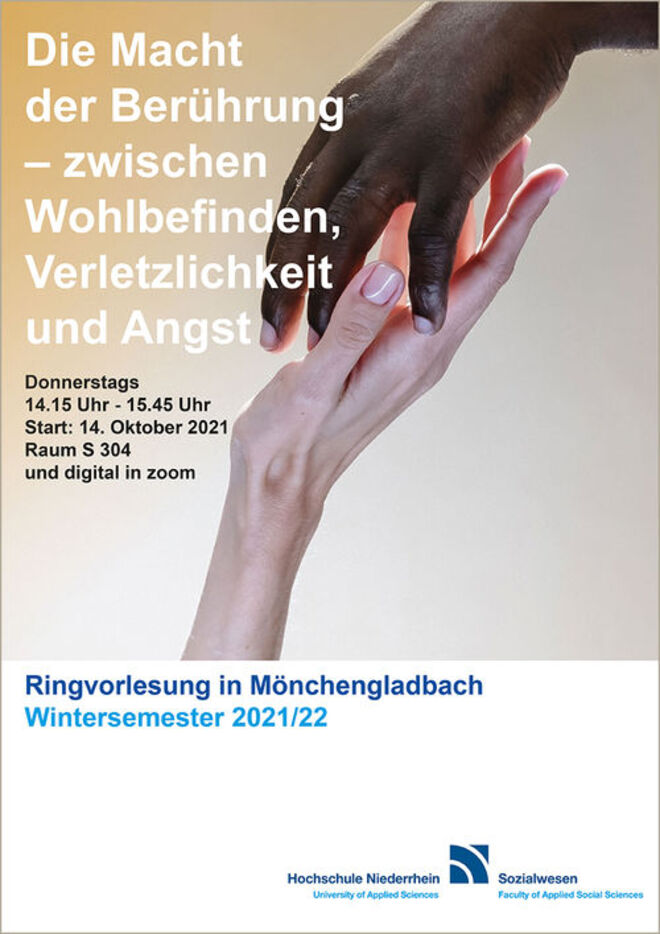
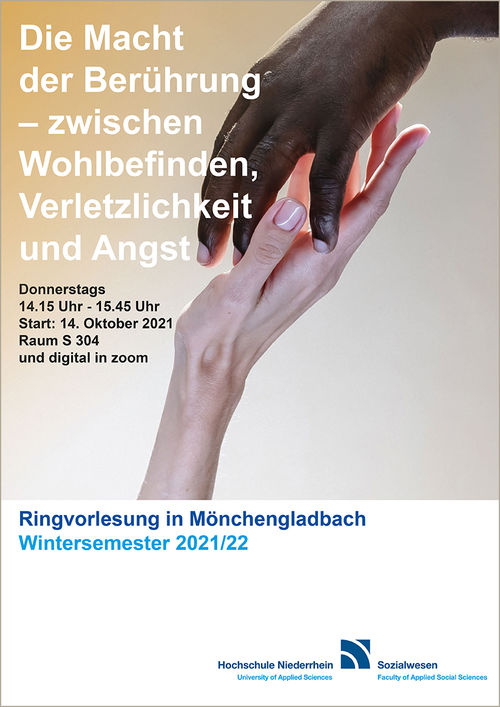
The power of touch (WS 2021/22)

The power of touch - between well-being, vulnerability and fear

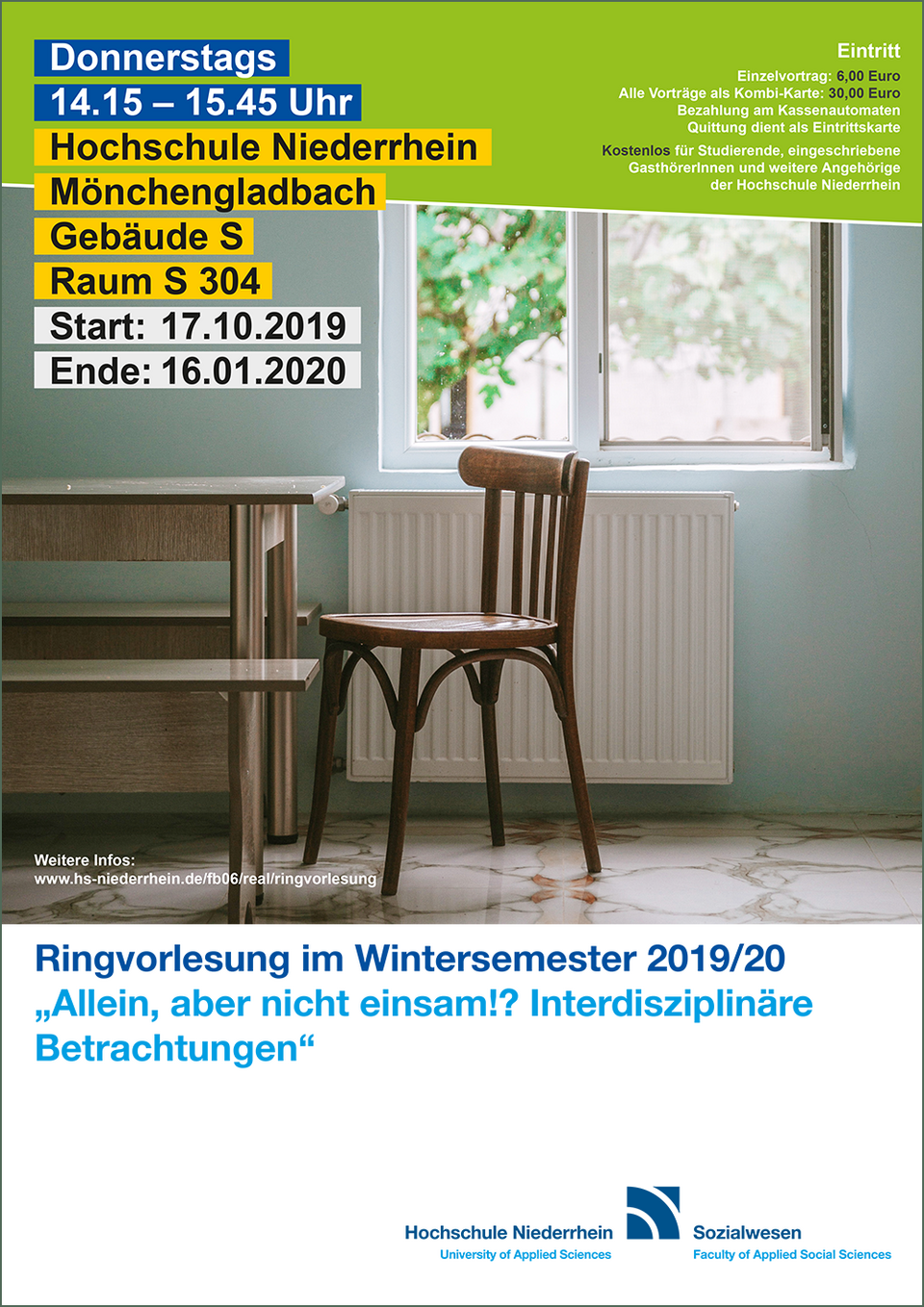
Alone, but not lonely! (WS 2019/20)

Alone, but not lonely?
Interdisciplinary reflections

Can you be alone or do you feel lonely when you are not socialising? And is it enough to advise lonely people to socialise more?

Being alone, as a voluntary decision to calm down, gain distance, recharge one's batteries or even as self-chosen independence, can be seen as an invaluable resource for coping with the demands of everyday life.

Involuntary loneliness, on the other hand, which is not just temporary but permanent, causes people to suffer, not only mentally but also physically. Lonely people sleep worse, experience more pain, have a weaker immune system and a lower life expectancy.

In a recent extrapolation of the German Ageing Survey to the total population in Germany, it was estimated that more than 3.5 million (9%) in the 40 to 84 age group were affected by loneliness in 2017.

Being connected with others and maintaining good relationships is an innate need for all people. However, the feeling of loneliness is a painful experience for many people and is associated with considerable health risks.

Dealing with this issue is highly topical. "Loneliness is not a private matter, but also the result of precarious developments in our society," wrote the Rheinische Post in May 2019. Loneliness is therefore not just an individual problem, but also a social one.

In the lecture series in the 2019/2020 winter semester, we will take a look at different perspectives on the tension between being alone and loneliness and enter into an exciting discourse with academics and representatives from the field.


Thursdays, 14.15 - 15.45
Start: 17.10.2019

Download FLYER
Download PLAKAT


Thu, 17.10.2019 // 14.15 - 15.45 // S 304
The silent topic of loneliness: current research and practical implications
Susanne Bücker, M.Sc.
Ruhr-Universität Bochum, psychologist, Faculty of Psychology, Psychological Methodology

Loneliness has become a major issue of our time. But how widespread is loneliness really? What do we know about the causes and consequences of loneliness? And what can society and politics do to combat loneliness? Susanne Bücker, a psychologist at Ruhr University Bochum, researches loneliness and its development over the course of a lifetime. In an introduction to her lecture, she will provide information on the current state of research and the resulting practical implications.


Thu, 24 October 2019 // 2.15 - 3.45 pm // S 304
Loneliness - from a psychological perspective
Prof. Dr Dieter Wälte
Hochschule Niederrhein, Faculty of Applied Social Sciences, Clinical Psychology and Personality Psychology

From a psychological perspective, loneliness mainly describes the feeling of discrepancy between desired and actual social relationships (in terms of trust, common goals, commitment and quality of the relationship). This feeling also explains the apparent paradox that people still feel lonely despite having multiple social relationships. This lecture will focus on clarifying three questions: 1. how do people become lonely? 2. is loneliness dangerous? 3. what leads psychologically out of the feeling of loneliness?


Thu, 31 October 2019 // 2.15 - 3.45 pm // S 304
"I think the sheep likes me ..." - Loneliness as an issue in nature- and animal-assisted counselling and process support
Dr Dipl.-Pädagogin Nicole Justen
Specialist for animal-assisted interventions, "Waldraum" - nature- and animal-assisted systemic counselling and process support

Some people, regardless of their age, experience personal crises in the course of their lives in which they feel deeply lonely and alienated from other people. Some have lost trust in other people or have already had negative experiences with educational or therapeutic support services. Others are consciously looking for alternative ways to deal with their issues and challenges and find new paths for themselves. In such cases, animal-assisted interventions can be helpful in (re)engaging with relationships and issues through access to the animal. "I think the sheep likes me, can I come to you more often now?" (Statement of a 9-year-old boy with attributed ADHD and refusal of therapy).


Thu, 07.11.2019 // 14.15 - 15.45 /// S 304
Lonely? As a couple? Together! - Ideas and practical examples for overcoming loneliness in old age
Silke Leicht
Sociologist, Head of the International Elderly Policy Office of the Federal Association of Senior Citizens' Organisations (BAGSO)

Together with the Federal Ministry for Family Affairs, Senior Citizens, Women and Youth (BMFSFJ), the Federal Association of Senior Citizens' Organisations (BAGSO) organised the competition "Lonely? Together? Together!" competition at the end of 2018 and was looking for innovative and compelling initiatives that combat social isolation and promote the social participation of older people. The 600 or so projects submitted impressed with their wide variety of ideas. The lecture presents selected practical examples of how to prevent and reduce loneliness in old age and looks beyond the horizon: What can we learn from other countries? And what can politicians do?


Thu, 14.11.2019 // 2.15 - 3.45 pm // S 304
Recognising and overcoming loneliness
Thomas Hax-Schoppenhorst
Non-fiction author and educator at the LVR Clinic in Düren

The phenomenon of loneliness and social isolation is becoming increasingly common in our times, which are characterised by selfishness and excessive individualisation. The elderly are particularly affected, but people between the ages of 20 and 30 also complain about this. There are many reasons for this.
The speaker will provide a detailed insight and show ways in which an exacerbation can and should be counteracted and how healthcare professionals can understand, support and integrate lonely people.


Thu, 21 Nov 2019 // 2.15 - 3.45 pm /// S 304
Does loneliness lead to mental illness?
Priv.-Doz. Dr Hanns Jürgen Kunert
Qualified psychologist, Median Klinik am Waldsee

Loneliness has different meanings in everyday language, both negative (e.g. a state of undesired social isolation) and positive (e.g. as a conscious strategy to withdraw from social relationships for certain purposes). If we now consider loneliness under the negative aspect of social seclusion or isolation, this can be seen as a generally chronic psychological crisis and stress situation. This condition in turn is associated with neurobiological reactions that can lead to the development of illnesses. In extreme cases, for example, this can lead to serious mental illnesses such as psychotic conditions, depression or suicide under solitary confinement conditions. The lecture will take a closer look at these connections, focussing on the fact that the brain is a "social organ" and its functioning is dependent on positive and development-promoting interpersonal contact, even in old age. Therefore, overcoming "loneliness" also has a health-promoting character.


Thu, 28.11.2019 // 2.15 - 3.45 pm // S 304
Nobody is alone in old age without a reason
Erich Schützendorf
Qualified educationalist, expert on ageing and geriatric care, author

People do not become difficult in old age, but a difficult person grows old and remains difficult. Dominant, opinionated, exclusionary, argumentative, mean-spirited, envious, selfish, complaining, dissatisfied people soon find themselves alone in old age. They have alienated friends, acquaintances, well-wishers and even family members over the years and feel left alone when they need help in old age. But even then, they reject well-meaning visitors and carers or insist on having their way.
The speaker poses the question of how to deal decently with these people who are difficult to live with and whether they can be left alone if their basic needs are met.


Thu, 05.12.2019 // 2.15 - 3.45 pm /// S 304
Living alone in old age - facts and figures, life courses and design potential
Arthur Drewniok, M.Sc.
Hochschule Niederrhein, Faculty of Applied Social Sciences, nursing scientist

Living alone in old age has a clearly negative connotation in social discourse. It is associated with a state that must be prevented at all costs! "Man is a social being, being alone contradicts his nature" - this is the common argument. In this presentation, I would like to introduce you to different approaches to the phenomenon of living alone (in old age). Firstly, I will define living alone. Statistics differentiate here, for example, between people living alone and single people, between single, widowed and divorced people, etc. In the second step, we will take a look at the ways of living alone and the effects of being alone on people's lives (in old age). Is there such a thing as the typical person living alone? What characteristics do we actually associate with people who live alone and how do people who live alone actually see themselves? Are they very lonely and do they suffer from it? In the last part, I would like to discuss with you the potential for shaping a needs-orientated, self-determined and dignified life alone in old age (despite the need for care and dementia, for example).


Thu, 12 Dec 2019 // 2.15 - 3.45 pm // S 304
Aloneness as a resource
Prof. Dr Michael Borg Laufs
The Hochschule Niederrhein, Faculty of Applied Social Sciences, Theory and Practice of Psychosocial Work

Being alone has a bad reputation, as attachment is a basic psychological need. But do we really always want to be in contact, always among people? Psychological studies show that being alone is also a resource from which we can draw strength, calm and creativity


Thu, 09.01.2020 // 14.15 - 15.45 // S 304
Is the world just my dream? How alone I really am in the world
Benedikt Eisermann, M.A.
Hochschule Niederrhein, Faculty of Applied Social Sciences, philosopher

Couldn't it be that only my own self exists in the world? My self and the world would then be identical. In such a world, I would rightly feel very lonely. And in fact it is impossible to say whether there is a world outside my own consciousness. But how can I then know that I am not completely alone in the world? What can I even know about the other person - and about myself? How close can I even get to another person? The lecture will not only provide answers to these questions, but also show how you can use the answers to successfully interact with other people - and thus have at least one remedy against loneliness at your disposal


Thu, 16.01.2020 // 14.15 - 15.45 // S 304
The social meaning of loneliness: results of a comparative cultural study of the biographies of lonely people
Dr rer. pol. Janosch Schobin
Sociologist, University of Kassel, Faculty of Social Sciences, Head of BMBF junior research group DeCarbFriends

Loneliness, understood as the combination of a prolonged loss of contact with relevant loved ones and intense feelings of loneliness, is increasingly becoming a political issue. It is being stylised as a kind of new "widespread disease" that needs to be combated. However, only rough information is known about the social situation and living conditions of lonely people. This raises simple questions: how do they live, how do they interpret their loneliness and how do they make sense of their existence? A cultural comparison of the biographies of lonely people shows that there are considerable differences in the way loneliness is interpreted and given social meaning.

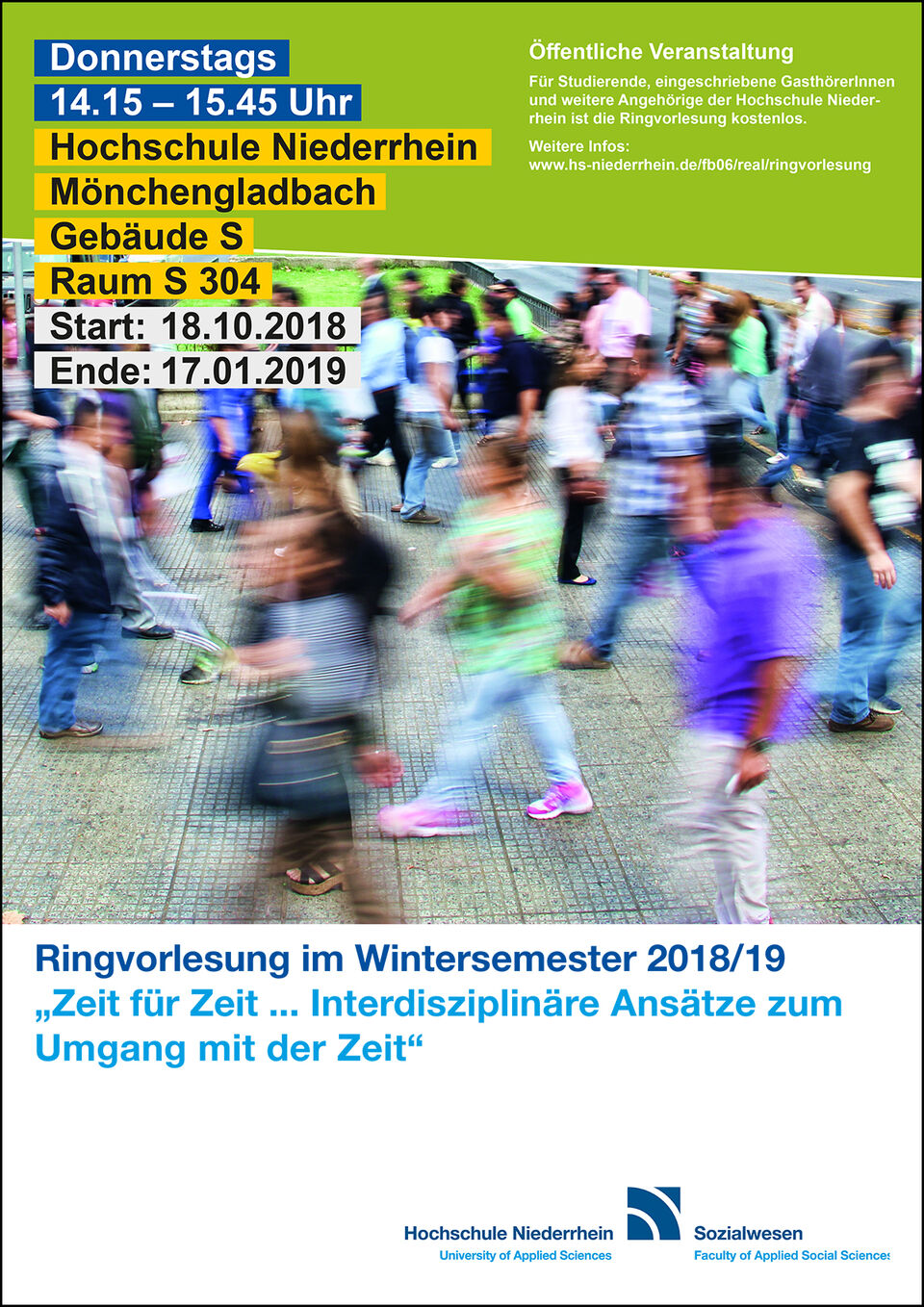
Time for time ... (2018/19)

Time for time ...
Interdisciplinary approaches to dealing with time

// Thursdays, 14.15 - 15.45
// Faculty of Applied Social Sciences
// Building S / Room S 304

Experience of time, sense of time, perception of time, idea of time, time consciousness, time rhythms, time pressure, timelessness, moment, eternity - when we think about time, we can think of an endless number of terms.

Time is an important topic in scientific disciplines. It is the subject of physics, biology, philosophy and theology, sociology, psychology, gerontology, literature and history. While philosophers enquire into the nature of time, psychologists investigate the perception and feeling of time. Other sciences, such as biology and physics, see time as a measurable quantity, linguists use time as a grammatical form and musicologists as an element that sets the beat.

The concept of time is characterised by different time perspectives: the past, the present and the future. With the increasing life expectancy in our society, we are gaining more time and so the question of how we can fill and organise this extra life remains. Is there enough time left or do we lack time? We simply cannot escape time; time is our most precious commodity. Time is irreversible. In this series of lectures, we want to get to the bottom of the phenomenon of time and examine the theories of the various sciences. We would be delighted if you would take time for time!


Thu, 18 October 2018 // 2.15 - 3.45 pm // S 304
Live Fast, Die Young?
Time culture from the beginnings to the present

Prof. em. Dr Hermann Strasser PhD
University of Duisburg-Essen, Institute of Sociology
Dipl.-Soz. Wiss. Martina Geisler
Managing Director of ProSeCo, Professional Seminars and Coaching, Consultant for Resilience, Burnout and Meditation

The expectations and demands placed on us humans are increasing massively. There is no upper limit, no enough! But life in the fast lane takes its toll. Stress is increasing, stress reactions are on the rise. We often only realise the importance of our lifetime when it seems to be at risk. Have we created a world for ourselves that we were not made for? The individual experience of time is embedded in the culture, the way of life that surrounds us.
A journey through time from the beginnings to the present day shows how differently time can be experienced and how important it is to establish forms of time that do not allow acceleration.


Thu, 25 Oct 2018 // 2.15 - 3.45 pm // S 304
Music and time

Prof. Dr Ulrich D. Einbrodt
The Hochschule Niederrhein, Faculty of Applied Social Sciences
Chair of Cultural Work with a Specialisation in Music

Time passes, but music remains. How does that happen? Music cannot exist without time. A piece of music begins, builds up, encompasses climaxes, comes to a conclusion. It lasts a few seconds, usually minutes, hours, or even many years. The two belong together. Inseparable. Or do they not? Professor Einbrodt invites you on a musical journey through time and a musical journey through time.


Thu, 08.11.2018 // 14.15 - 15.45 // S 304
Ageing and time

Prof. Dr Claudia Kaiser
The Hochschule Niederrhein, Faculty of Applied Social Sciences
Chair of Gerontology

As a dynamic process, ageing is inextricably linked to time. Every biography, every life course spans the past, present and future. Increasing life expectancy is also accompanied by an increase in individual lifespan. But do more years automatically give us more time? What does it mean when we have more "free time" when we retire? How is this extra time used? Is it true that the clocks tick differently, even faster, in old age? Or is it just a change in perception? What influence does the confrontation with the finite nature of life have on this? The lecture will explore these and other questions.


Thu, 15 Nov 2018 // 2.15 - 3.45 pm /// S 304
Narrated time - time of history(ies)

Prof. Dr Andris Breitling
The Hochschule Niederrhein, Faculty of Applied Social Sciences
Chair of Ethics, Social Philosophy, Cultural Theory

We encounter time on the one hand as "world time", i.e. as the time of objectively observable or measurable processes, and on the other hand as the subjectively experienced "time of the soul", in which past, present and future intertwine. Both appear connected in historical time as the simultaneously experienced and datable time of human action. According to the thesis of the French philosopher Paul Ricœur, this historical time, the time of history, can only be grasped in a diversion via a theory of narration, the representation of actions and events in stories. This thesis will be explained and discussed in the lecture. On the one hand, the focus will be on the organisation of temporal processes in historiography and, on the other, on imaginative variations of the human experience of time in fictional literature.


Thu, 22 Nov 2018 // 2.15 - 3.45 pm // S 304
Children of time: the '68 generation turns 50

Prof. em. Dr Klaus Hansen
Social scientist and writer
Former holder of the Chair of Political Science and Political Education in the Faculty of Social Sciences at Hochschule Niederrhein

It is claimed that the Federal Republic of Germany, now almost 70 years old, has produced two "political generations". The sixteen-year-old "flak helpers" of 1945 have become the "sceptical generation". The eighteen-year-old students of 1968 have become the "sixty-eight generation"
. Our main question will be: Did 1968 really produce a new generation? Today, 50 years on, this question should be answerable. Political generations are always only recognisable in retrospect. If we can answer the question in the affirmative, then we must also be able to identify typical generational dispositions that apply to a large number of German citizens. We will therefore look for patterns of thought, reaction and behaviour that characterise the sixty-eight type. All those present will then be able to check for themselves to what extent the "68 gene" is part of their personality - or not.


Thu, 29 Nov 2018 // 2.15 - 3.45 pm /// S 304
How long does a second last?

Prof. Dr Walter Ebner
The Hochschule Niederrhein, Faculty of Electrical Engineering and Computer Science
Chair of Physics and Computer Science

Time as a quantity of physics is measurable, with ever greater accuracy over the course of history. The "duration" of a second must therefore be revised again and again.
On closer inspection, however, the passage of time itself is subject to a wide variety of conditions and is by no means absolute, even in physics.
There are also questions: How is it that time always increases, i.e. that it has a certain direction? And when did time begin?


Thu, 06.12.2018 // 2.15 - 3.45 pm // S 304
At the heart of time - eternity in the moment

Dr theol. Wolfgang Siepen
Theologian, psychotherapist, meditation teacher

One of the outstanding characteristics of human beings is their relationship to "time". This can be experienced time and again in the feeling that the time given to us is racing by and that people are simultaneously looking to slow down and hold on to time.
Stretched out between the awareness of the moment and the sense of an eternity inherent in man, 'being in time' is a grandiose experience in which man can realise himself and the transcendent as an awareness of immersion in the flow of time. Such a profound experience can, of course, only be felt by being mindful of oneself and one's own time.


Thu, 13 Dec 2018 // 2.15 - 3.45 pm /// S 304
Doing Time - On experiencing and acting in time in contemporary society

Prof. Dr Nadine Schöneck-Voß
The Hochschule Niederrhein, Faculty of Applied Social Sciences
Chair of Sociology and Empirical Social Research

Our contemporary society is characterised by the experience of acceleration and the feeling of being driven - despite statistically increasing lifespans. Time stress is a very common phenomenon. Why is this the case? And why do women, who on average live longer than men, often suffer particularly from time stress? The lecture sheds light on these and other similar questions - both theoretically and empirically.


Thu, 03 Jan 2019 // 2.15 - 3.45 pm // S 304
Life on time - everyday time and life time in dealing with chronic illness

Dr Iris Schubert
The Hochschule Niederrhein, Faculty of Applied Social Sciences
Teacher for special purposes, specialism: Clinical Social Work

Chronic illness changes ... simply everything! Time, identity, relationship structures. The organisation of time becomes a primary concern. Dealing with chronic illness demands time from the affected system (the chronically ill person, relatives, those treating them) - and draws attention to the distinction between everyday time and life time. The central coping task in the context of everyday time is the permanent control of the latently threatening crisis: to prevent/prevent a medical crisis, to promote a gentle lifestyle. If the control is out of balance, the acute crisis exceeds the everyday framework with consequences for life. Chronically ill people also have to redesign their identity and biography as well as their role and position within existing relationships.


Thu, 10 Jan 2019 // 2.15 - 3.45 pm // S 304
Time from a neurological perspective: sleep and stress

Professor Carl-Albrecht Haensch, MD
Chief Physician, Specialist in Neurology, Sleep Medicine, Special Pain Therapy, Clinic for Neurology, St. Franziskus Hospital in Mönchengladbach

Sleep, the autonomic nervous system (ANS) and time are closely linked both functionally and anatomically. Sleep is associated with pronounced changes in the functions of the ANS, such as stress. Sleep directly influences the autonomic functions of respiration and circulation and modulates their interaction. For clinically active neurologists, disorders of the autonomic nervous system and sleep regulation are becoming increasingly important, with REM sleep behaviour disorders attracting widespread interest as an early sign of Parkinson's disease. In humans, the internal clock controls our sleep times and ensures that we not only remain adapted to the external light-dark cycle, but also that all internal biological processes remain in sync with each other. For many people, however, the sleep-wake rhythm is not aligned with the activity phases of our society.


Thu, 17 Jan 2019 // 2.15 - 3.45 pm // S 304
Timelessness in changing times using the example of Leibniz's reflections on the reunification of denominations

Prof. em. Dr Wilhelm Klüsche
Hochschule Niederrhein, Faculty of Applied Social Sciences
Former holder of the Chair of Clinical Psychology in the Faculty of Applied Social Sciences at Hochschule Niederrhein

If, despite changing circumstances, one searches for the unchanging in human existence, one quickly touches on the field of religion, because there one is confronted, among other things, with truth and its power of interpretation, with tolerance of different views, with ways of understanding, with forms of expression of transcendental needs. Leibniz's approaches to understanding between the denominations can be used to work out such timeless primal questions.

 

All lecture series since 1994

2024/25
Health and well-being in old age - interdisciplinary perspectives

2023/24
On the significance of spaces, places and regions

2022/23
On the art of letting go and the beauty of stopping
Interdisciplinary reflections

2021/22
The power of touch - between well-being, vulnerability and fear

2019/20
Alone, but not lonely!?
Interdisciplinary reflections

2018/19
Time for time ...
Interdisciplinary approaches to dealing with time

2017/18
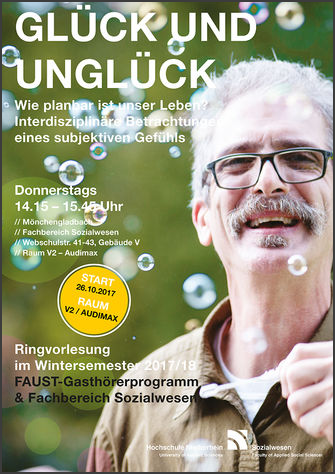
Happiness and unhappiness - how plannable is our life?
Interdisciplinary reflections on a subjective feeling

2015/16
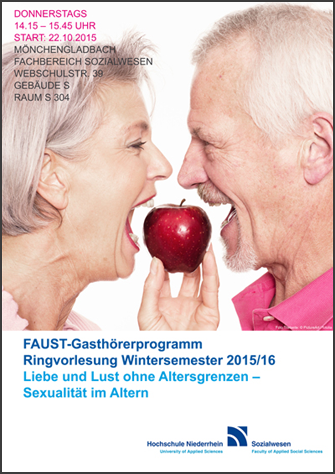
Love and lust without age limits -
Sexuality in old age

2014/15
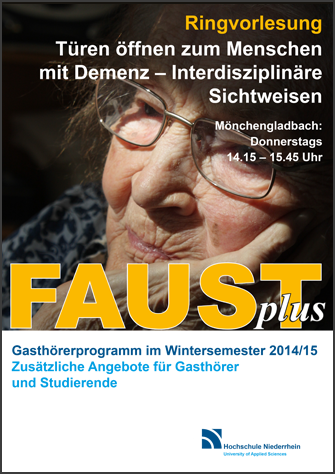
Opening doors to people with dementia -
Interdisciplinary perspectives

2013/14
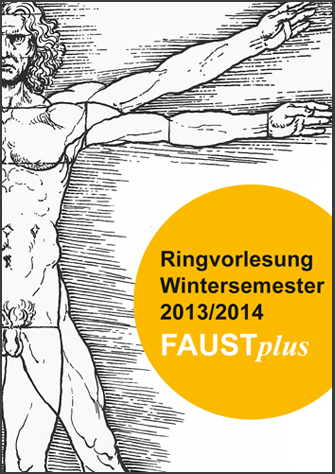
What keeps people healthy?
Physical, mental and social aspects of health

2012/13
"The goal-free path" -
Spirituality of ageing

2012
With each other - for each other.
Intergenerational solidarity between aspiration and reality

2011/12
Images of age(ing)

2011
Technical progress and new media

2010/11
Age and the future

2010
Giving shape to responsibility

2009
Giving shape to needs.
Interdisciplinary topics and working methods for socio-cultural transformation processes

2007
Rediscovering a sense of community -
the opportunities of dialogue between young and old

2006
Age(ing) has many faces

2004
Living old age consciously ... Ways and goals

2003
The living environments of people with dementia -
Backgrounds, problems and perspectives from research and everyday practice

2000
And tomorrow it will go on ... -
Development processes in old age

1994
Competence in old age between routine and new beginnings

Winter semester 2021/22
The power of touch -
between well-being,
vulnerability and fear

Alone but not lonely?

Winter semester 2019/20
Alone, but not lonely!
Interdisciplinary considerations

Time

Winter semester 2018/19
Time for time ...
Interdisciplinary approaches
to dealing with time

Lecture series

Winter semester 2017/18
Happiness and misfortune -
How plannable is our life?

Lecture series

Winter semester 2015/16
Love and lust
without age limits -
Sexuality in old age

Lecture series

Winter semester 2014/15
Opening doors to people
with dementia -
Interdisciplinary perspectives

Lecture series

Winter semester 2013/14
What keeps people healthy?
Physical, psychological
and social factors
of health

Publications

Articles and monographs - from 2024

2026

Oeben, Melanie; Krewer, Ann-Marie & Heß, Moritz (2026): What are baby boomers planning for retirement? In: ZWISCHENTÖNE, 53, 6-8.

Oeben, Melanie; Krewer, Ann-Marie & Heß, Moritz (2026): Perceptions and needs of the baby boomer generation in the post-employment phase - A qualitative study. In: ProAlter, 58(1), 47-50

2025

Ehlers, Anja; Berg, Pia-Saskia; Frewer-Graumann, Susanne & Hess, Moritz (2025): Sociotechnical systems in old age - A critical contribution to realising the possible. In: Heckes, Kolja T.; Lorke, Mariya; Siegler, Marcel and Wrona, Kamil J. (eds.): Sociotechnical transformations in social and Health Care: collaborative, diverse, barrier-free and socio-spatial. Beltz Juventa, 388-401.

Gerdes, Frederike; Naegele, Laura; Hess, Moritz & Ordemann, Jessica (2025): Ageism in German higher education. In: Educational Gerontology, 51(12), 1353-1360.

Grates, Miriam (2025). Impact of the COVID-19 pandemic on health-related digital inequalities. Journal of Gerontology and Geriatrics, 58, 477-482.

Grenz, Adele; Weinhardt, Michael; Hess, Moritz; van Hoof, Joost; Dikken, Jeroen & Boerner, Kathrin (2025): How age-friendly are cities and communities? German version of the Age-Friendly Cities and Communities Questionnaire (AFCCQ). In: Journal of Gerontology and Geriatrics, 58(8), 668-673.

Klingel, Markus; Garten, Claudius; Grates, Miriam; Quashie, Nekehia T., & Brandt, Martina (2025): Distancing and Changes in Intergenerational Support in Germany During the Beginning of the COVID-19 Pandemic. In: Journal of Intergenerational Relationships 23(4), 387-410.

Naegele, Laura; Schmitz, Wiebke; Staniczek, Selina & Hess, Moritz (2025):Continuing Vocational Educational Training, Self-Directed Ageism, and Extending Working Lives: Evidence from the German Ageing Survey. In: Cologne Journal of Sociology and Social Psychology [Online First].

Stiemke, Philipp; Pink, Sebastian & Hess, Moritz (2025): The voluntariness of retirement-transitions: A European cohort-study. In: Ageing & Society, 45(11), 2280 - 2295.

2024

Hess, Moritz; Zörlein, Nicolas; Grates, Miriam & Wanka, Anna (2024): Caring students. Challenges and burdens. Results of a survey. In: Journal for Social Reform, 70 (3), 249-270

Vanella, Patrizio; Wilke, Christina & Heß, Moritz (2024): Long-Term Care in Germany in the Context of the Demographic Transition-An Outlook for the Expenses of Long-Term Care Insurance through 2050. in: Econometrics, 12(4), 28.

Wanka, Anna; Lasser, Nathalie & Hess, Moritz (2024): The in/visibilisation of education and care: University staff's perceptions of, experiences with, and reaction to the needs of care-giving students. In: Access: Critical Explorations of Equity in Higher Education, 12(1), 48-60.

Articles and monographs - 2020 to 2023

2023

Grates, Miriam & Brandt, Martina (2023): (How) did self-rated health status shape Internet use among older adults during the COVID-19 pandemic in Germany? In: New Media & Society, 27(2), 1073-1092.

Hess, Moritz, Schmitz, Wiebke; Naegele, Laura & Stiemke, Philipp (2023): You will take care of me when I am old: Norms on children's caregiver obligations - An analysis with data from the European Values Study. In: Journal of Family Research, 35, 196-211

Wiegelmann, Henrik; Hess, Moritz; Domhoff, Dominik; Heinze, Franziska; Schmidt, Annika; Seibert, Kathrin; Stolle, Claudia; Preuß, Benedikt; Rothgang, Heinz & Wolf-Ostermann, Karin (2023): The situation of family carers under the age of 65 in the Corona pandemic - results of an online survey in Germany. In: Federal Health Gazette 66: 265-274.

2022

Knopf, Lea; Wazinski, Karla; Wanka, Anna & Hess, Moritz (2022): Caregiving students: A systematic literature review of an under-researched group. In: Journal of Further and Higher Education, 46(6): 822-835. (IF: 2.3)

Mäcken, Jana; Präg, Patrick, Hess, Moritz & Ellwardt, Lea (2022): Educational Inequalities in Labour Market Exit of Older Workers in 15 European Countries. In: Journal of Social Policy, 51(2): 435 - 459.

Stiemke, Philipp & Hess, Moritz (2022): Determinants of (in-)voluntary retirement - a systematic literature review. In: Journal of European Social Policy 32(3): 348-358. (IF: 3.06)

van Hoof, Joost; van den Hoven, Rudy F.M.; Hess, Moritz; van Staalduinend, Willeke H.; Hulsebosch-Janssene, Loes M.T. & Dikken, Jeroen (2022): How older people experience the age-friendliness of The Hague: A quantitative study. In: Cities, 124: 103568.

Wazinski, Karla; Knopf, Lea; Wanka, Anna & Hess, Moritz (2022): Invisible caregivers: The 'hidden lives' of German university students with care responsibilities. In: Journal for Higher Education Development, 17(4): 217-233.

2021

Naegele, Gerhard & Hess, Moritz (2021): Social Inequalities in the Late Employment Phase and at the Transition to Retirement. Results of the EXTEND project. Springer VS.

Schmidthuber, Lisa; Fechter, Charlotte; Schröder, Heike & Hess, Moritz (2021): Active ageing policies and delaying retirement: comparing work-retirement transitions in Austria and Germany. In: Journal of International and Comparative Social Welfare 37(2): 176 - 193.

2020

Ehlers, Anja; Heß, Moritz;Frewer-Graumann, Susanne; Olbermann, Elke & Stiemke, Philipp (2020): Digital participation and (digital) exclusion in old age. Expertise on the Eighth Ageing Report of the Federal Government. Edited by C. Hagen, C. Endter and F. Berner. Berlin: German Centre of Gerontology.

Hess, Moritz; De Tavernier, Wouter & Naegele, Laura (2020): Culture Matters - Norms, employment and informal care of older women in Europe. In: Social Progress, 69: 667-685.

Hess, Moritz; Naegele, Laura & Mäcken, Jana (2020): Attitudes towards working in retirement: a latent class analysis of older workers' motives. In: European Journal of Ageing 18: 357-368.

Publication series of REAL

Volume 5
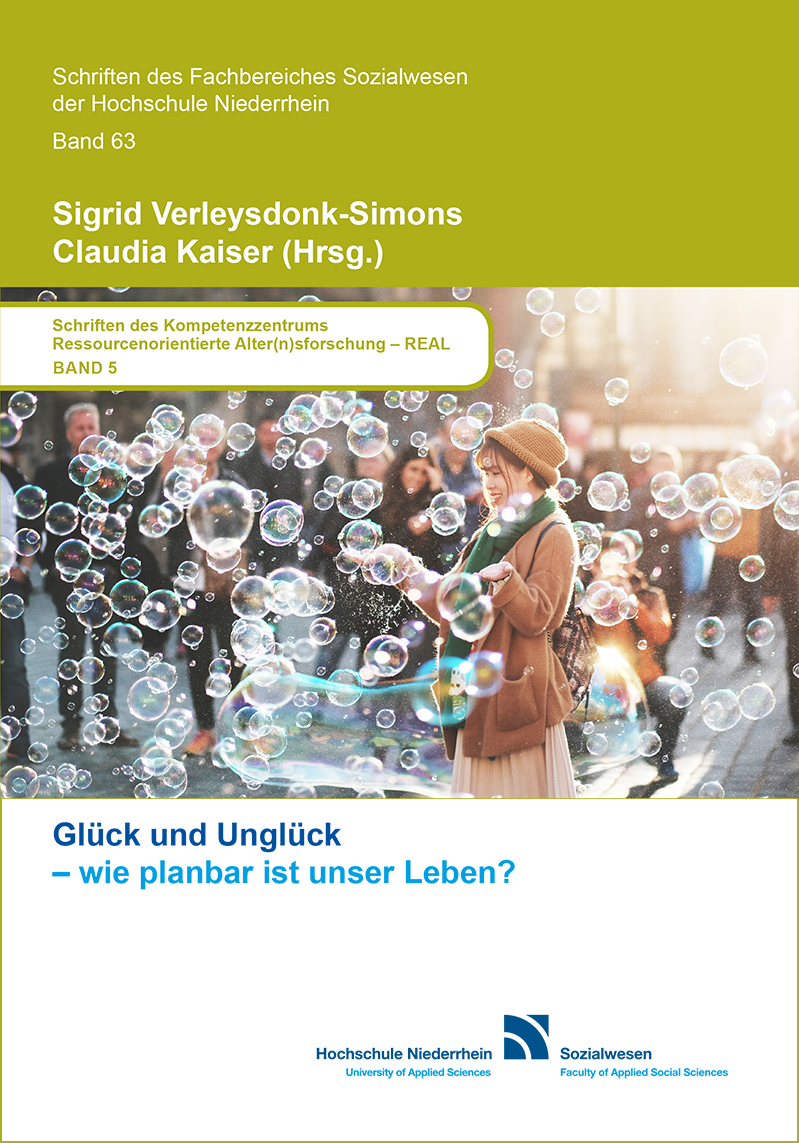
Happiness and unhappiness - how plannable is our life?
by Sigrid Verleysdonk-Simons & Claudia Kaiser
2020 | ISBN 978-3-933493-47-7 | 191 pages | €10.80

Volume 4
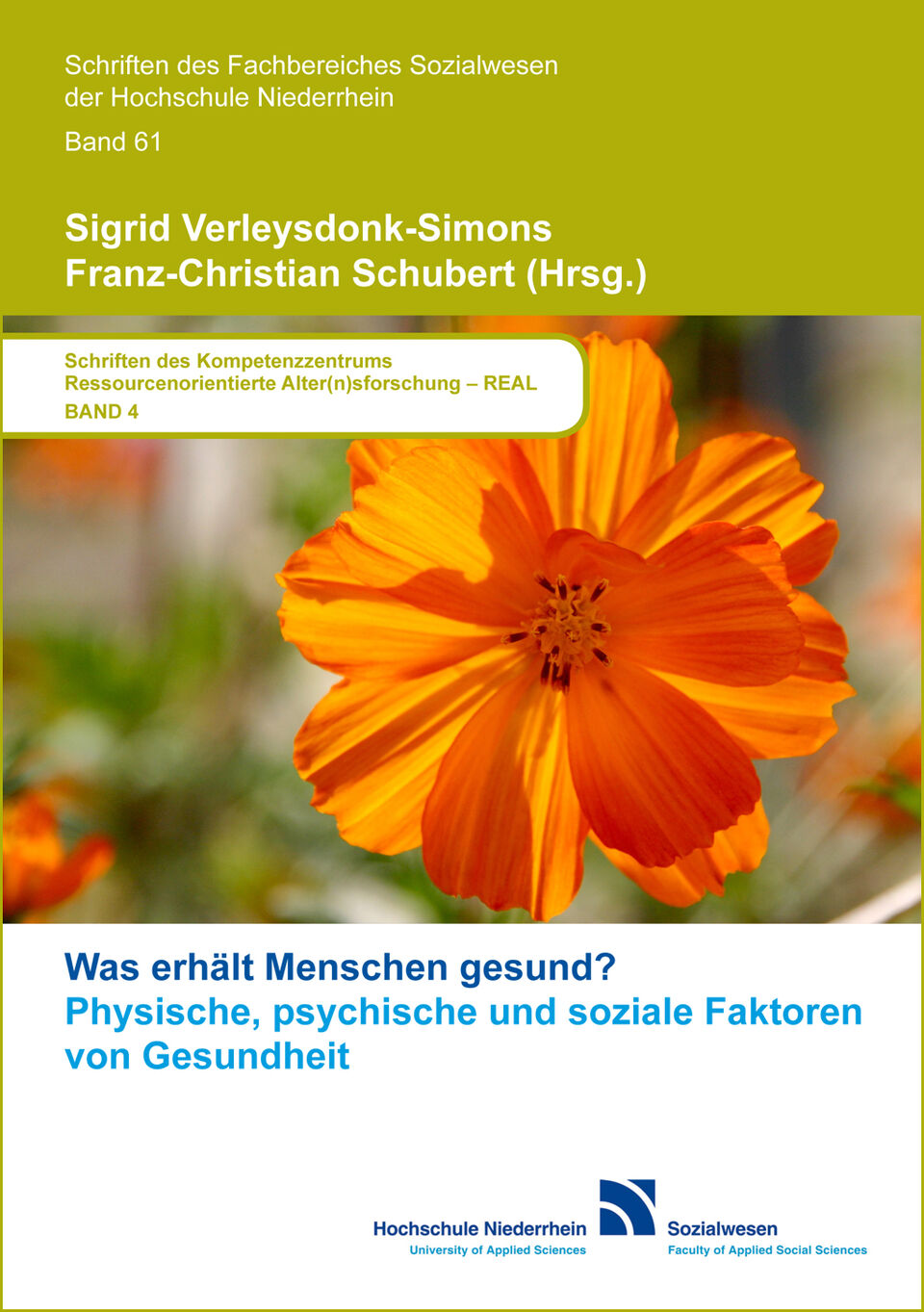
What keeps people healthy?
Physical, psychological and social factors of health
by Sigrid Verleysdonk-Simons & Franz-Christian Schubert (ed.)
2015 | ISBN 978-3-933493-42-2 | 184 pages | 10,- Euro

Volume 3
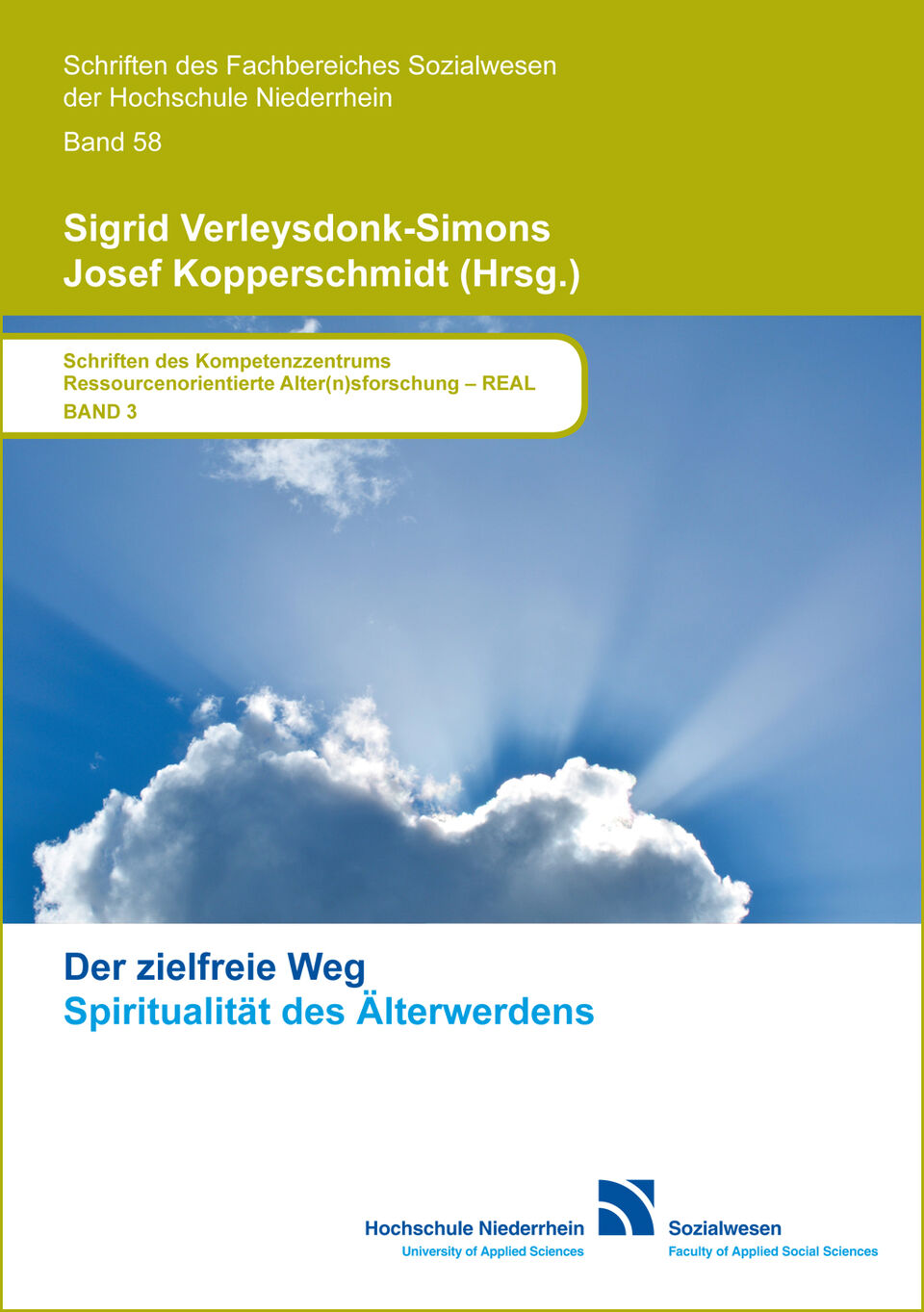
The goal-free path.
Spirituality of ageing
by Sigrid Verleysdonk-Simons & Josef Kopperschmidt (ed.)
2015 | ISBN 978-3933493-36-1 | 163 pages | 10,- Euro

Volume 2
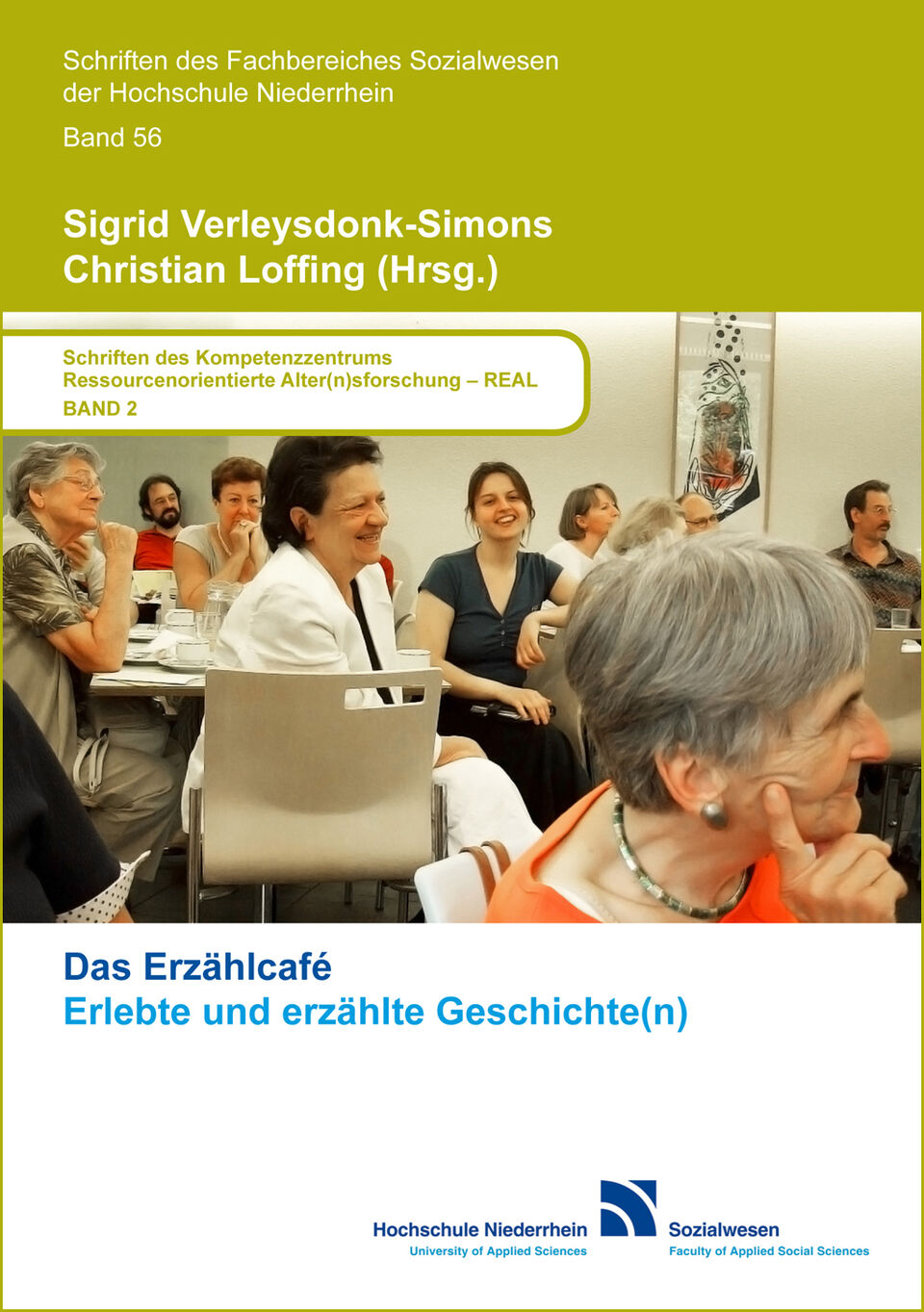
Das Erzählcafé
Erlebte und erzählte Geschichte(n)
by Sigrid Verleysdonk-Simons & Christian Loffing (ed.)
2012 | ISBN 987-3-933493-33-0 | 184 pages | 9.90 EUR

Volume 1
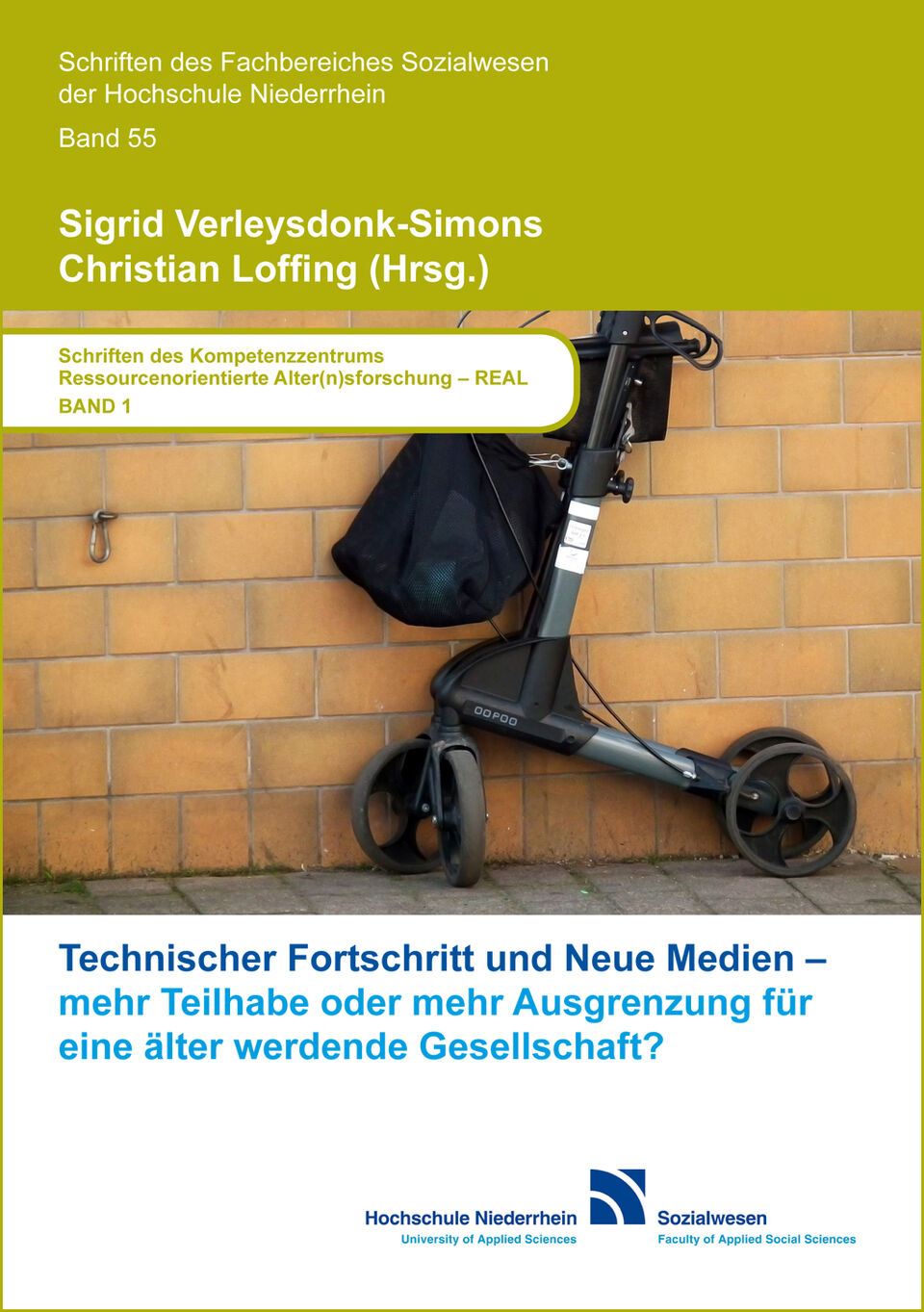
Technological progress and new media -
more participation or more exclusion for an ageing society?
by Sigrid Verleysdonk-Simons & Christian Loffing (ed.)
2012 | ISBN 987-3-933493-32-3 | 80 pages | 5.00 EUR

Publication series of the Faculty

The publications of the competence centre are published in the series of the Faculty of Applied Social Sciences at The Hochschule Niederrhein and are available directly from the faculty or from bookshops. From 2012 to 2020, the publications were published in a separate series under the title "Schriften des Kompetenzzentrums Ressourcenorientierte Alter(n)sforschung - REAL".

  • Volume 63 (2020)
    Happiness and unhappiness - how plannable is our life?
    by Sigrid Verleysdonk-Simons & Claudia Kaiser
  • Volume 61 (2015)
    What keeps people healthy? Physical, psychological and social factors of health
    by Sigrid Verleysdonk-Simons & Franz-Christian Schubert (eds.)
  • Volume 58 (2015)
    The goal-free path. Spirituality of ageing
    by Sigrid Verleysdonk-Simons & Josef Kopperschmidt (Eds.)
  • Volume 56 (2012)
    The storytelling café. Experienced and told stories
    by Sigrid Verleysdonk-Simons & Christian Loffing (Eds.)
  • Volume 55 (2012)
    Technological progress and new media - more participation or more exclusion for an ageing society?
    by Sigrid Verleysdonk-Simons & Christian Loffing (eds.)
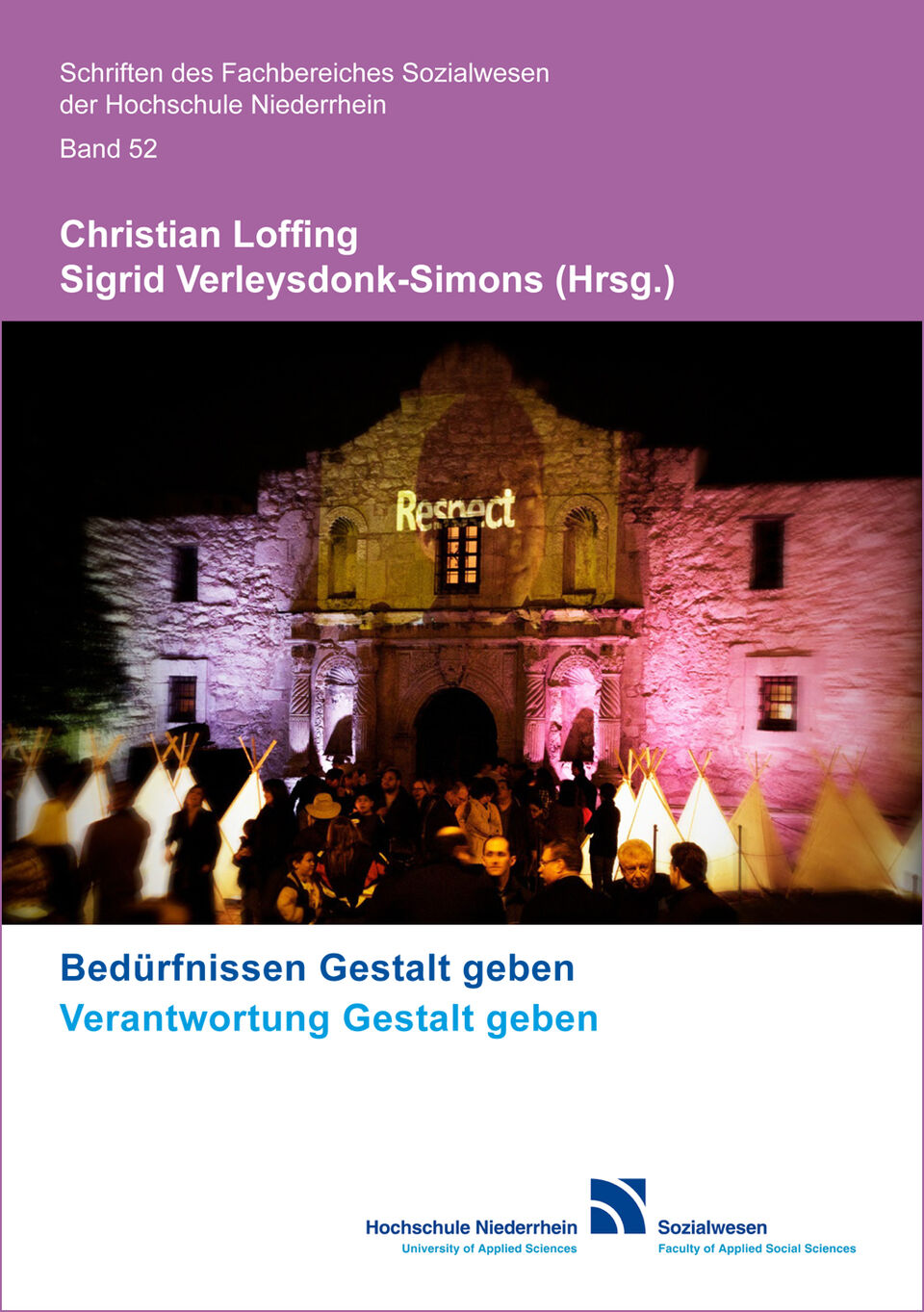
  • Volume 52 (2011)
    Giving shape to needs. Giving shape to responsibility
    by Christian Loffing & Sigrid Verleysdonk-Simons (eds.)
  • Volume 51 (2010)
    Vielfalt & Inklusion: Herausforderungen an die Praxis und die Ausbildung in der Sozialen Arbeit und der Kulturpädagogik
    by Sabine Krönchen (ed.)
  • Weg-Weisungen. On dealing with closeness and distance
    Engelbert Kerkhoff, Theodor M. Bardmann, Asgar Fabri (eds.)
  • The good Lord sees everything. A reading and picture book on time and educational sayings
    Engelbert Kerkhoff, Silvia Beck, Sigrid Verleysdonk-Simons (eds.)
    with illustrations by Anja Groten and Wienke Treblin
  • CityKirchenArbeit. Foundation courses, models and impulses for social and church work
    Engelbert Kerkhoff, Anke Dittrich, Stephan Dedring, Martina Baur-Schäfer (eds.)
    Tolerance between the worlds of young and old
    Engelbert Kerkhoff, Sebastian Erkens, Albert Verleysdonk (eds.)
  • Age: Individuality and Participation
    Engelbert Kerkhoff and Sigrid Simons (eds.)
  • Cutting in. Excerpt. New Old - New Media - New Challenges
    Nicole Gegner, Suela Sylla, Katrin Uecker, Engelbert Kerkhoff, Rolf Sachsse
  • Back - Mirror - View. Perspectives on ageing - not just for the elderly: Biography - Experience - Experience - Future
    Engelbert Kerkhoff and Katrin Rohmann (eds.)
  • Self-determined age(ing). Food for thought and perspectives from research, development projects and practical applications
    Engelbert Kerkhoff (ed.)
  • Impulses for cultural work with the elderly
    Engelbert Kerkhoff, Claudia Kewitz (eds.)
  • Expertise in old age between routine and new beginnings
    Engelbert Kerkhoff (ed.)

Volume 63

Happiness and unhappiness - how plannable is our life?
by Sigrid Verleysdonk-Simons & Claudia Kaiser
2020 | ISBN 978-3-933493-47-7 | 191 pages | 10.80 euros

b

What keeps people healthy?
Physical, psychological and
social factors of
health
by Sigrid Verleysdonk-Simons 
& Franz-Christian Schubert (ed.)
2015 | ISBN 987-3-933493-42-2
184 pages | 10,- Euro


b

Der zielfreie Weg
Spiritualität des Älterwerdens
by Sigrid Verleysdonk-Simons 
& Josef Kopperschmidt (ed.)
2015 | ISBN 978-3933493-36-1
163 pages | 10,- Euro


b

The storytelling café
Stories experienced and told

by Sigrid Verleysdonk-Simons 
& Christian Loffing (ed.)
2012 | ISBN 987-3-933493-33-0
184 pages | 9.90 EUR


b

Technological progress
and new media -
more participation or
more exclusion for
an ageing
society?
by Sigrid Verleysdonk-Simons
& Christian Loffing (ed.)
2012 | ISBN 987-3-933493-32-3
80 pages | EUR 5.00

b

Giving shape to needs
Giving shape to responsibility
by Christian Loffing &
Sigrid Verleysdonk-Simons (ed.)
2011 | ISBN 987-3-933493-30-9
335 pages | EUR 14.90


Expenditure 53 / February 2026

All expenditure since 2010

ZT all

ZWISCHENTÖNE
The generation magazine

Link & Downloads
All expenditure since 2010


Optimised screen display in Adobe Acrobat Reader: two-page view

Display ► Page display ► Activate "Two-page view" and "Show cover page in two-page view".

Intergenerational neighbourhood work

The community centre

The Belting-Treff is a community centre in the Venn-Beltinghoven district of Mönchengladbach. It has been run by the Competence Centre for Resource-Oriented Age(ing) Research (REAL) at The Hochschule Niederrhein in cooperation with WohnBau Mönchengladbach since 2007.

Theaim of the research and development project is to maintain and improve the quality of life in residential neighbourhoods. To this end, measures to promote intergenerational solidarity and intercultural exchange, to create help and support systems in the neighbourhood and to promote identification with the neighbourhood are being tested, implemented and continuously developed together with the residents.

Address
Bertolt-Brecht-Platz 12
41068 Mönchengladbach

Specialist articles on the bac

We in Beltinghoven (WiB e.V.)

Since December 2013, the activities of the Belting-Treff have also been supported by the non-profit organisation "Wir in Beltinghoven" (WiB e.V.). The association was founded by committed citizens to strengthen social interaction in Beltinghoven, promote dialogue between the generations and also provide support with everyday needs.

Get involved! The association is still looking for committed citizens who would like to play an active role, e.g. in the planning and organisation of events, or who would like to support us with membership fees or donations.
Contact:
Nicole Klösges
Phone: +49 (0)2161 186-5637
E-mail: nicole.kloesges@hs-niederrhein.de

Educational and cultural work in the region

The Mönchengladbacher Erzählcafé e.V.

The Mönchengladbacher Erzählcafé e.V. is a non-profit association that specialises in intergenerational educational and cultural work. The association originated in 1997 from a development project of the core research areas "Competence in old age between routine and new beginnings" at the Faculty of Applied Social Sciences at Hochschule Niederrhein (today "Competence Centre for Resource-Oriented Age(ing) Research (REAL)").

The active members include young and older volunteers. The aim is to promote, support and initiate cultural education work with and for older people in Mönchengladbach. The forum is the storytelling café. The events, which are currently organised once a month, usually take place in social facilities for the elderly.

The storytelling café events create cultural meeting spaces and offer opportunities for exchange and encounters. The focus is on intergenerational exchange, the integration of experiential knowledge, competences, skills and abilities.

Storytelling cafés are characterised by three essential elements: Conversation, informal education and socialising. In addition to an appealing atmosphere (music, coffee, pastries, room design) as a framework, topics from different cultural areas are addressed.

The topics are prepared free of charge by storytellers / initiators and presented at the storytelling café. There is a moderator who encourages dialogue between storytellers and visitors. The planning, organisation and implementation of the storytelling cafés is carried out by the association's active volunteers. Admission to the storytelling cafés is free of charge.

Link
► Homepage of the Mönchengladbach storytelling café

Contact / Chairwoman
Sigrid Verleysdonk-Simons. Dipl.-Geront., Dipl.-Soz.Arb.

E-mail: vorstand@erzaehlcafe.de

Consulting
Accessibility