How is digitalisation changing the economy in the Lower Rhine region - and what opportunities does this present for young people?
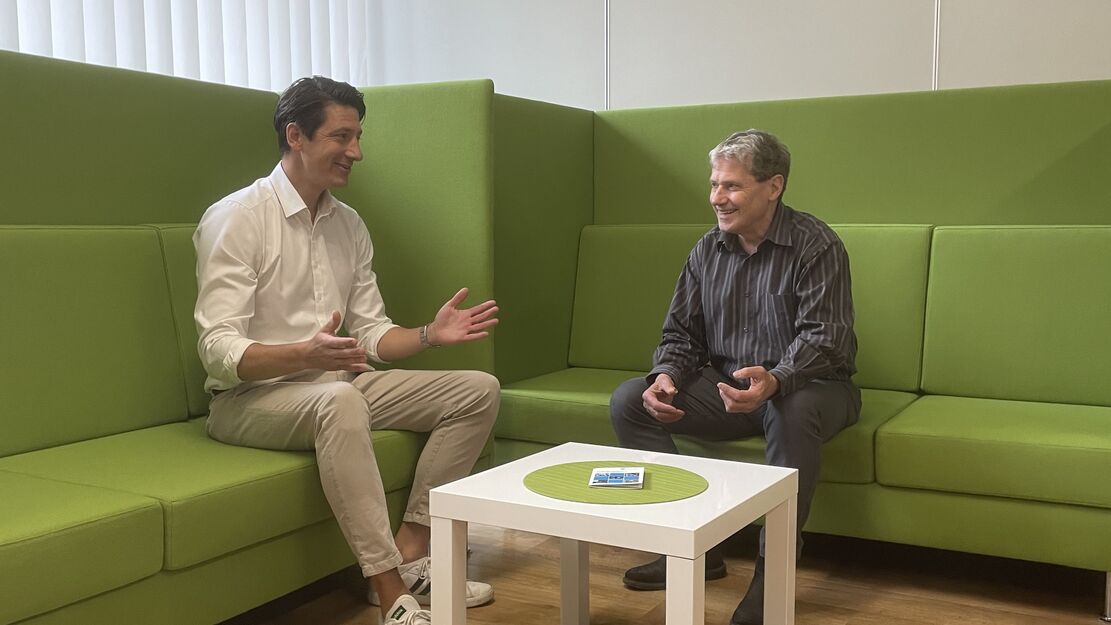
Prof. Dr René Treibert The Lower Rhine is a strong economic region with many small and medium-sized companies, but also with large industrial and service companies. All of these players are faced with the task of further digitalising their companies. Nothing less than the future competitiveness of the region in national and international comparison is at stake. This has resulted in a persistently high demand for well-trained specialists that needs to be met.
Professor Dr Boris A. Feige Correct, and we see this in all sectors and industries without exception. Health Care, public administration, retail, energy supply and mechanical engineering. Digitalisation is advancing everywhere. Qualified people are needed everywhere to design digital solutions in companies and, of course, to use them responsibly in the end.
What contribution does The Hochschule Niederrhein make to the Niederrhein region?
Feige We at The Hochschule Niederrhein see ourselves as a talent factory and therefore have a clear responsibility to train the specialists and managers of tomorrow. The majority of our students come from the region. You could perhaps sum it up like this: We train people from the Lower Rhine region in the Lower Rhine region for the Lower Rhine region.
Treibert Exactly, we don't train people for just any future at The Hochschule Niederrhein - as a university with around 13,000 students and almost 1,000 employees, we want to make a concrete contribution to digitalisation in the Niederrhein region. We do this through the apprenticeship of young people on our Bachelor's and Master's degree programmes in the fields of computer science, business informatics, medical informatics, cyber security management and digital forensics. This is where we train the digital experts that the regional economy so urgently needs.
How should we imagine such studies?
Feige We offer more than just grey theory. We are a university of applied sciences. This means that we offer a practical orientation and professional qualification. Our students learn on the basis of real issues, for example with the "problem-based learning" approach. Here, real problems from business practice are worked on in student groups. This makes for modern, practical orientation and skills-building teaching education and prepares students perfectly for their later career entry.
Can you give us a specific example?
Treibert Gladly, for example, in the Cyber Security Management degree programme we deal with the cyber attack on a large bakery on the Lower Rhine. Together with the students, we work out what needs to be done in such an acute crisis situation and what activities need to be carried out immediately by the affected company to avert danger. Such simulations are always very instructive for the students.
Feige The following collaboration between the university and the company was also exciting last semester: In the Business Information Systems degree programme, students tested the usability of Stadtwerke Krefeld's mobility app. The students investigated how local transport connections in the city of Krefeld can be searched for and, of course, found and displayed as intuitively as possible by users in the app. Or how the ticket purchase process can be made as simple as possible within the app. Aspects such as accessibility were also analysed. In other words, how people with impaired vision, for example, can make the best possible use of such an app. In the end, the results were presented to those responsible at Stadtwerke Krefeld. And the best thing is: some of the students' suggestions for improvement were then implemented directly by the team at Stadtwerke Krefeld.
What should interested young people know about computer science-related degree programmes?
Treibert That computer science and the associated degree programmes are not just for "technology and IT freaks". Our students have very different interests and skills when they start their studies. It is a widespread misconception that they need to be able to programme really well before they start their studies. Curiosity and a willingness to familiarise yourself with new topics are the most important things. Of course, a certain amount of perseverance and enjoyment are also always part of a course of studies lasting several years.
Feige Perhaps our programmes can be summarised like this: If you enjoy solving problems through software development and using software, the Computer Science degree programme is suitable. If you want to specialise in Health Care right from the start, you can begin your studies in Medical Informatics. If you want to use digital technologies in companies in a targeted manner, design efficient business processes and thus combine IT and management, the Business Information Systems degree programme is a good option. If you want to fight cybercrime and secure and analyse digital evidence, you will find your calling in studies in Digital Forensics. Those who want to protect companies from cyber attacks should opt for the Cyber Security Management studies programme.
A final tip for interested young people?
Treibert Take a look around. Be it on site in conversation with students and the student advisory service or digitally on our website. If you want to shape things, you'll find exactly the right place to start with us.
Feige And stay open to new things. The world of Computer Science and its associated degree programmes is more diverse than many people think and is waiting for bright young minds who want to make a difference.




 Our degree programmes
 Voices

 Research & cooperation for the region
 Advice and contact