

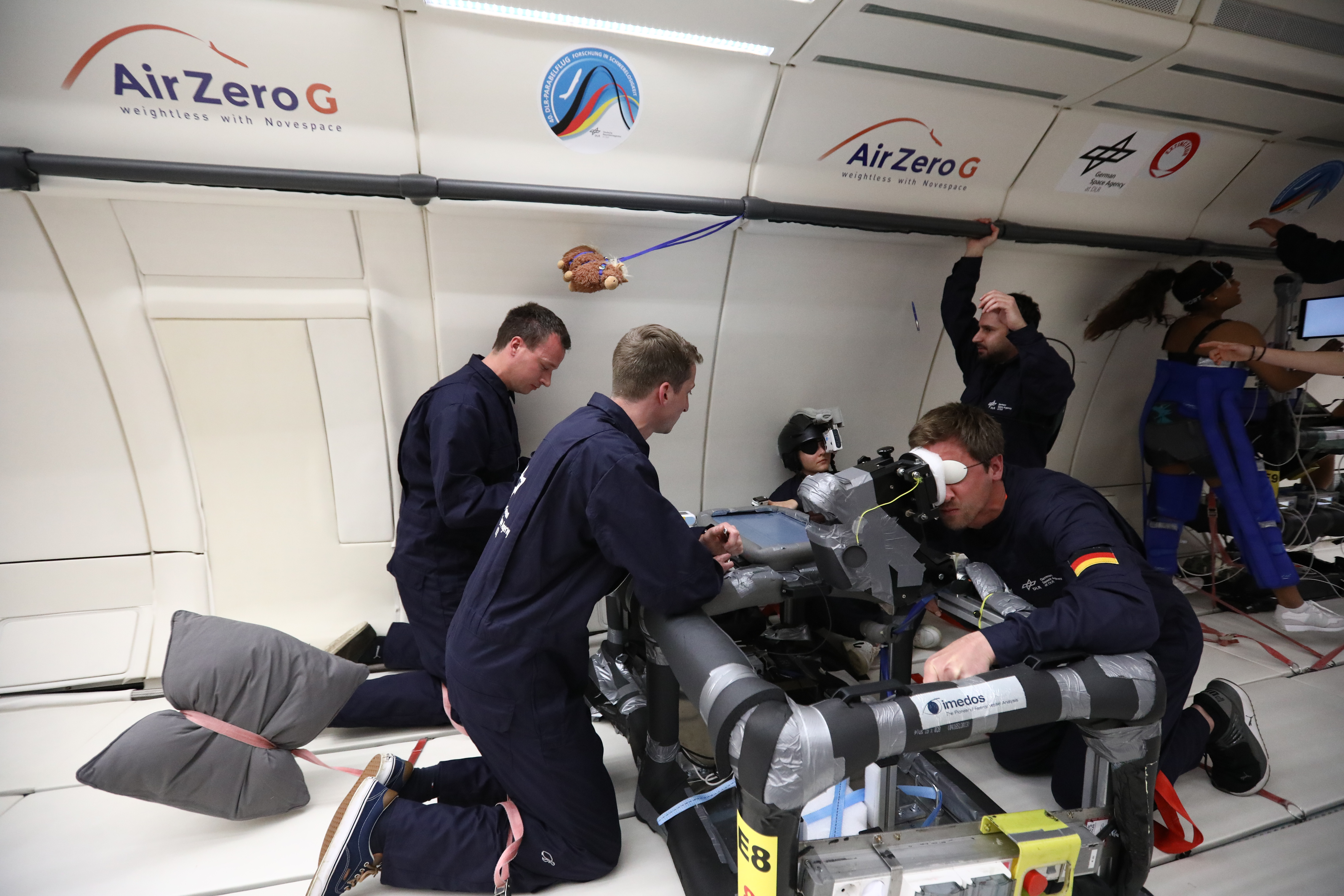
93 parabolic flights in 3 days for 22 seconds of weightlessness each - at the parabolic flight campaign of the German Aerospace Center (DLR) in Bordeaux, the participating teams went on a research mission to lofty heights. Dr. Lukas Streese was there with a team from the University Hospital Düsseldorf. In addition to his work at the hospital, Streese teaches at the Faculty of Health Care at the Hochschule Niederrhein. A prominent guest was also on board the converted former government aircraft: German astronaut Alexander Gerst.
DLR regularly conducts parabolic flight campaigns in which companies and institutions can apply with their projects. Lukas Streese was part of the 15-member team led by Prof. Christian Jung from the Cardiology Department of the University Hospital in Düsseldorf. The research plane flew 31 parabolas on three days for four hours each. These flights are the only opportunity for scientists to test their research questions on their own in weightlessness.
During the flights, the team measured the small blood vessels in the eye before, during and after weightlessness. The crew on board wanted to find out how the vessels at the back of the eye respond to weightlessness, which involves serious changes in pressure and flow. The vessels at the back of the eye are not just a local marker, but reflect the structure and function of the entire small blood vessels in the body. The eye is particularly well suited for measurement because the arterial and venous systems can be studied separately. The findings are not only of interest to the University Hospital Düsseldorf, but also to the German Aerospace Center: Astronauts have always complained about visual impairments after long stays in space. The cause of this has not yet been clearly explained.
Weightlessness is an extreme situation for the human body, which is sometimes subject to high gravitational forces that also affect the circulation of blood vessels. Whether the data obtained from the three-day experiment will provide insights into the problems faced by astronauts will be revealed by the ongoing evaluation at the university hospital.
To screen the vessels, photographs and video recordings are taken of the eye using high-resolution camera technology. The team relies on Streese's expertise for this technique. "I sit behind the camera, adjust the subjects at the right angle in front of the camera and see on the screen how the vessels in the eye change," says Dr. Lukas Streese, who has a lot of experience with the measurement technique.
During the experiment, there was no shortage of fun on board the aircraft: in the area separated by safety nets, the participants were able to experience weightlessness on their own bodies and float around.
Lukas Streese would like to incorporate his experiences and findings into his own lectures in the field of teaching Applied Therapy Sciences at the Faculty of Health Care, as these are also of interest to gerontology, nursing or midwifery.