

Challenge
How can AI be used meaningfully and responsibly in teaching education and learning?
Solution
Integrating AI and social robotics into the curriculum of a seminar on action concepts in social work enables students to gain practical experience in the design of these technologies at an early stage. The goal of the seminar is to provide students with in-depth preparation for the challenges and opportunities presented by AI systems and robotics. After three runs of the seminar integrating AI and robotics into the curriculum, an interdisciplinary collaboration with students in computer science took place. A central focus was on students acquiring basic competencies in dealing with AI and understanding the informatics processes behind it. At the same time, computer science students were given an understanding of the different approaches to AI and robotics. In addition, topics such as data literacy were covered. Through this transdisciplinary collaboration of different faculties, HSNR is able to offer students a comprehensive and versatile insight into AI systems and robotics.
Benefits
Integrating AI tools and robotics into courses creates a seminar that allows for individualized learning experiences and is tailored to the specific needs of the students. The use of AI-powered systems has the added benefit of motivating students through immediate feedback and rewards. Another benefit is that through collaboration between the social work and computer science faculties, the university can offer students a comprehensive and diverse look at AI systems and robotics. This better prepares students for the demands of the workplace and gives them a broader perspective on these technologies.
Details
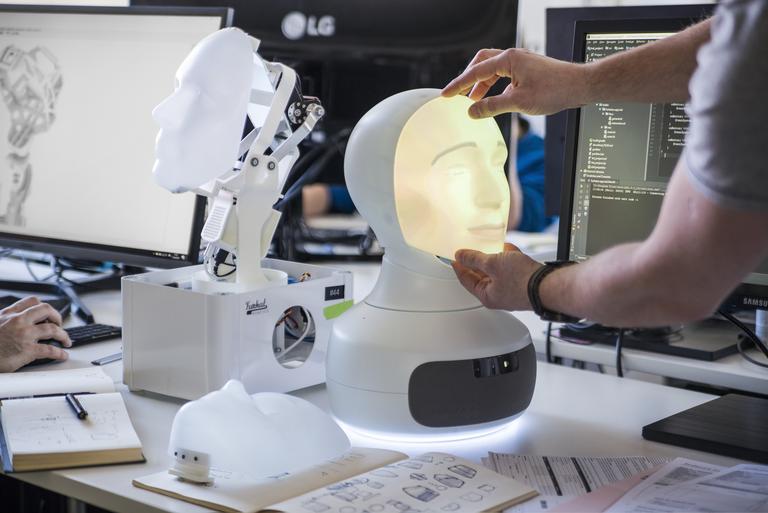
As part of the 4 SWS seminar "Social work action concepts incorporating robotics and AI" in the Bachelor's degree programme in social work, the humanoid robot "Furhat" was used by 30 social work students and five computer science students to simulate interactive role-playing games supported by AI. The students were given a social work action plan, which they had to work on together in groups. Based on this, they had to develop a client persona and a counselor persona. The client persona was used as a template for simulations in order to enable students to learn the respective concept of action as well as to have a guide to step into the role of professional counselors. The simulations were demonstrated in two classroom sessions. Computer scientists were temporarily involved in the planning groups and assisted with programming.
Through the use of Furhat, the students were able to develop a much greater interest in fundamental social work issues. They were more involved and were able to establish a deeper connection to the learning content.
Teaching/learning methods and/or digital media
In the seminar "Social work action concepts incorporating robotics and AI", various teaching and learning methods as well as digital media were used to provide students with an interactive and practical orientation learning experience.
One prominent method was the use of the humanoid robot "Furhat" to conduct interactive role plays. Students were able to simulate realistic scenarios, interact, and gain hands-on experience. This fostered their self-directed learning and ability to engage in tasks independently.
In addition, students worked in fixed collaborative groups. This fostered problem-based collaboration and allowed students to share ideas and work together to find solutions.
The use of digital media (asynchronous collaboration board) played an important role as it allowed students to learn independent of time and location. Access to online resources via Moodle allowed students to flexibly access information and research results, which promoted their flexibility and self-organization.
Overall, the interactive role plays with Furhat, independent programming of the robot, and use of digital media created a dynamic and engaging learning environment. The students were able to practically apply their theoretical knowledge, develop technical skills, and intensively engage with the topics of robotics and AI in social work. At the same time, their skills in self-directed learning, collaborative working, and time- and location-independent learning were fostered.
The portfolio method was used for the examination performance. Here, in the first part, the students were to reflect on their learning and the learning object according to Hilzensauer; in the second part, they were to write an essay on risks and opportunities of human-machine interaction in the social sector based on the competencies acquired in the seminar.
Stumbling blocks
The integration of AI into teaching education is a major challenge, as all participants have to deal with the underlying theoretical foundation courses in addition to the application issues, and sufficient time should be provided for this. AI-based systems may reflect biases and prejudices if they are based on incomplete or erroneous data. This also needs to be addressed in the collaborative groups. Self-directed learning can be problematic for students if students have little prior experience with agile working methods. Collaboration with other professions also requires lead time to accommodate different approaches.
Recommendation
Students should be given opportunities to acquire basic AI skills in their regular seminars. They should also be given a comprehensive and multi-perspective view of AI systems and robotics.
Transdisciplinary collaboration between different faculties can help prepare students for the challenges and opportunities of AI systems and robotics and equip them for the world of work.
Sufficient lead time should be planned.
Involved
Prof. Dr. Anne-Friederike Hübener, M.Sc., M.A.
Dr. Marc Heimann (graduate assistant)
Noemi Altendeitering (graduate assistant)
Annika Weisenburger (student assistant)
Tom Pätsch (graduate assistant)
Cooperation with FB03:
Prof. Dr. Christoph Quix
Pascal Quindeau (PhD student)
Links / Notes
Photo: Furhat Robotics
University Didactic NIU Supplement