

How is Heinsberg positioning itself for the future - especially in view of the planned phase-out of lignite-fired power generation? After all, the district and parts of the Aachen city region, Mönchengladbach and the northern Rhenish mining area are very agricultural and are considered structurally weak.
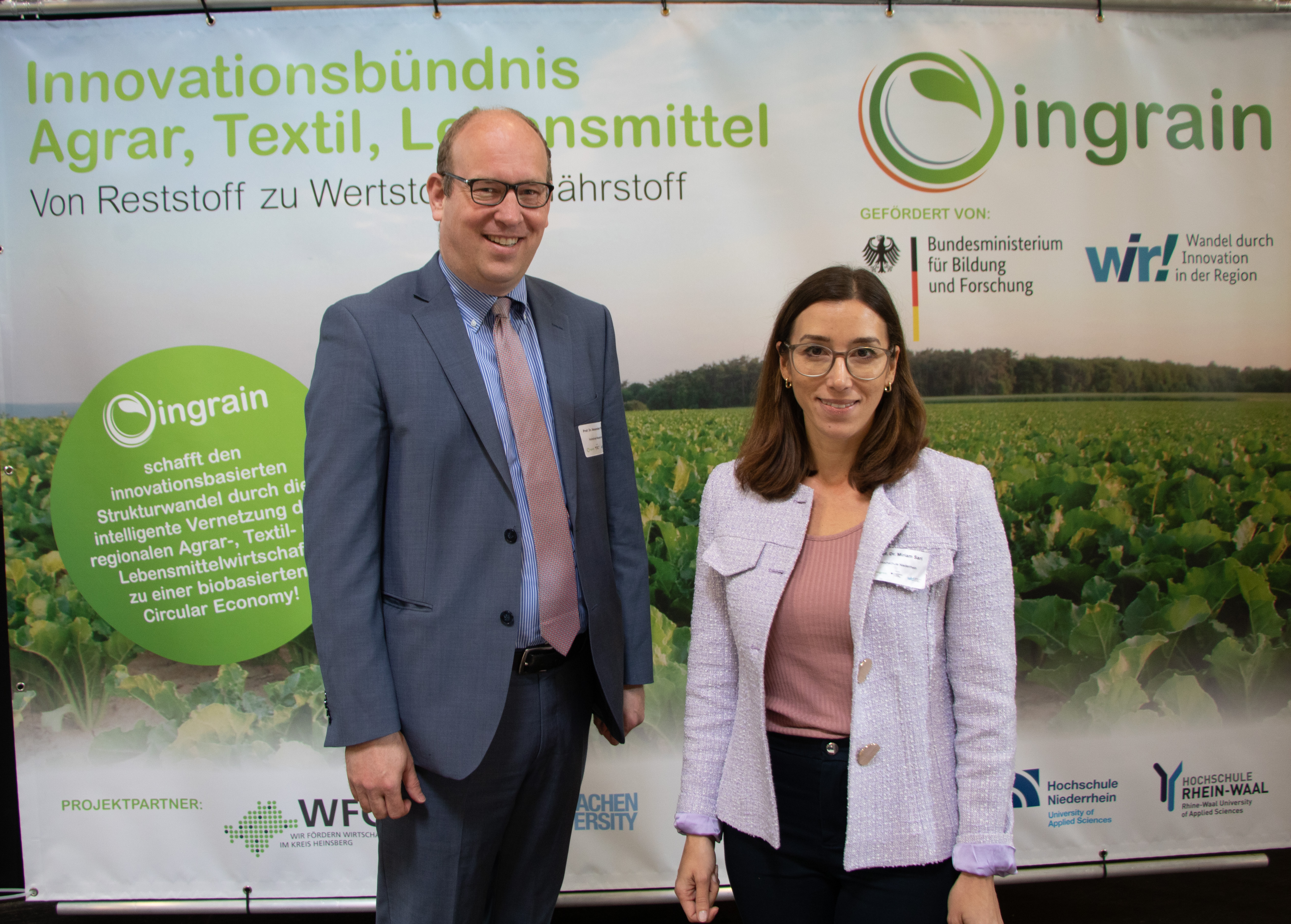
In order to give this region innovative strength, establish new technologies and create and secure jobs in the long term, the alliance "Ingrain - from residual material to recyclable material to nutrient" was founded. The Hochschule Niederrhein (HSNR) is also a member. It is one of 25 "WIR!" alliances throughout Germany that are being sponsored by the German Federal Ministry of Education and Research to the tune of millions of euros. Companies, universities, research facilities and other players are joining forces to prepare the region for the future after lignite mining.
As part of this cooperation, "Ingrain" aims to achieve a bio-based circular economy in concrete terms - and in doing so, to network the agricultural, textile and food industries in the region around Heinsberg. To this end, HSNR is contributing its food expertise, while RWTH Aachen University is focusing on textiles and sustainability and Rhine-Waal University of Applied Sciences (HSRW) on agribusiness. They want to develop value or nutrients from by-products and residual materials that arise during the processing of products in the respective industries.
Their starter project "TechEnt" shows how this can be done. Together, they are researching a substitute for peat used in mushroom and vegetable cultivation. Of the approximately 569,000 euros in funding, almost 188,000 euros will go to the HSNR. The Hochschule Niederrhein recently presented what this is all about at the Ingrain Alliance Day in Wegberg, which was organized by the Economic Development Corporation (WFG) for the Heinsberg district.
Peat serves as a covering layer on the mushrooms in mushroom cultivation. This is because it regulates the temperature on the surface of the mushrooms, keeping them cool and moist, as it can store water well.
Peat is formed in peatlands and, as a Co2 store, mitigates the greenhouse effect. Peatlands bind more carbon worldwide than all forests combined. This is an important reason to reduce the extraction of peat. It also destroys sensitive ecosystems. German mushroom cultivation requires 55,000 tons of peat every year.
This made it all the more important for the project team to find an alternative - from cellulosic residues/textile waste. This is because alternative growing substrates such as coconut fiber, mineral wool or perlite exist, but are not sustainable in terms of production, disposal or transport.
The alternative topsoil made from bio-based residues had to meet certain properties - including having a neutral pH, high air and water holding capacity, and being free of pathogens and pollutants.
Using this catalog of criteria from HSNR, the Institute of Textile Technology (ITA) at RWTH Aachen University found what it was looking for: Wheat pulp and staple fibers were identified as particularly suitable for mushroom cultivation, and nonwovens and spacer fabrics for tomatoes.
HSNR is concentrating on mushroom cultivation: two cultivation experiments in the laboratory will now show how the textile peat substitute affects the mushrooms. The first test run has already started at the university's own competence centre for applied mycology and environmental studies (KAMU) and will run until September. A second run will follow next year. There, the value-giving substances will also be investigated, for example the nutrient content and the polysaccharides.
At the Competence Center Microbiology and Biotechnology (CCMB) of the HSNR, the cultivated mushrooms will then be examined and evaluated microbiologically and in terms of food hygiene. "We would like to move away from laboratory-scale experiments and also go out into industry and cultivate on a larger area," says Prof. Dr. Miriam Sari. She heads the TechEnt project together with Prof. Dr. Dr. Alexander Prange, vice president of the Research and Transfer Department.
"The German government's new peat reduction strategy also shows how important and topical the issue is. The goal is ambitious, but if we can achieve even partial substitution using regional, biobased side streams, it would be a great success," Sari adds.
HSRW is testing how the textile substrate works for tomatoes. It and RWTH Aachen University are also handling sustainability considerations. "TechEnt" runs over a period of three years.