

Challenge
Prof. Dr. Regina Pohle-Fröhlich, module leader of the Operating Systems module, looks back:
The conversion of teaching to online teaching in the wake of the Corona pandemic also changed the teaching methods. Thus, in addition to the online lectures, I developed extensive self-study material with test questions and numerous sample programs, for which observation tasks were also formulated.
Despite these offerings, I felt that online learning fell short of teaching practical skills. I also found that the use of online testing methods encouraged "bulimic learning" even more than usual. Thus, I observed that most students had already forgotten the material of the module from the second semester by the beginning of the 3rd semester.
Solution
For this reason, I changed the examination form from a written examination to a portfolio examination. The developed group examination contains two parts: on the one hand the conversion of a task into a computer program and on the other hand the production of a video.
Advantages
I chose these two components of the group exam because learning success is achieved through steps such as self-exploration of the material, self-activity, and presentation.
Compared to written examinations, the students achieved better results. In their feedback, they emphasized the promotion of independent work, the high motivation through practical orientation and the formation of learning groups through the portfolio examination as positive aspects.
Details
The Operating Systems module in FB03 is a compulsory module in the 2nd semester with a number of hours of two SWS lecture, two SWS exercise and one SWS internship. On average, 120 to 150 students of the Faculty of Electrical Engineering and Computer Science participate in this module every year. In addition to the theoretical teaching of the foundation courses of operating systems, it is important to me that the students are able to practically apply what they have learned after successfully completing the module. In this way, we prepare them for professional practice at an early stage.
Teaching/learning methods or digital media
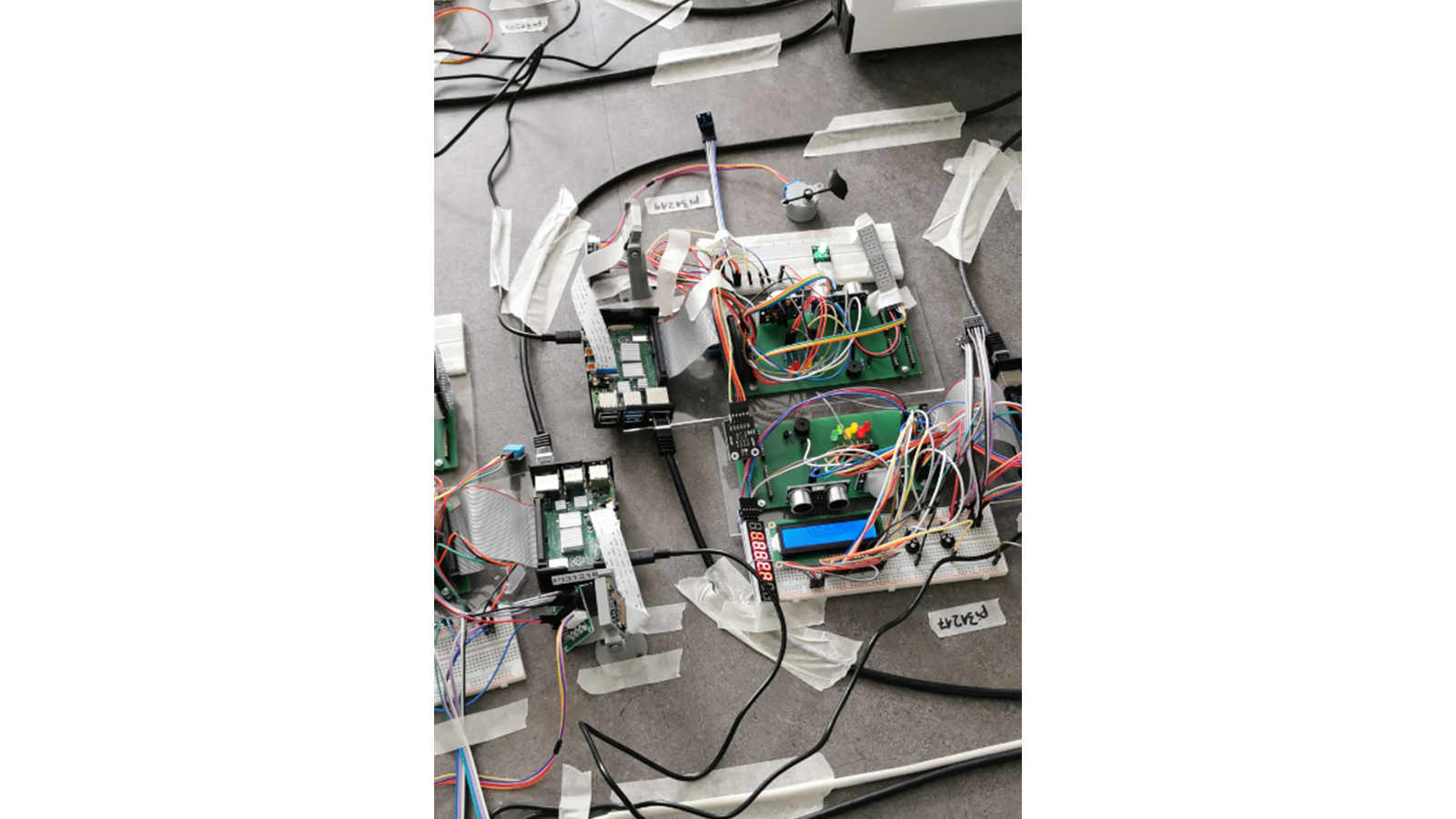
For the programming part of the group assignment, the project team first had to create all the technical requirements. This included adding more sensors (e.g., to measure temperature, air pressure, or brightness) and actuators (such as LCD display or LED matrix) to the existing hardware in order to be able to implement individual tasks for a large number of students. We then set up the hardware in the lab and provided remote access for the students. Among other things, the appropriate software requirements had to be created for the setup. The latter included configuring the network to access the hardware and distributing the access data. To allow students to see the successes of their programming outside the lab (e.g., LED lights coming on), the team mounted webcams above the hardware and made their displays available via stream on a website.
Now we generated individual programming tasks for each testing group. In the process, we took care to ensure that the individual groups interfered with each other as little as possible. With 20 setups available, three groups always worked on a Raspberry Pi ("mini-computer"). In order to achieve the greatest possible transparency for the students, we provided them with an evaluation scheme in advance. They also received, via Moodle, installation instructions for remote access, as well as instructions each on how to use the software libraries and how to create the video. In addition, there were several time slots where staff:in zoom sessions provided support with hardware setup. In addition, students were able to use the forum to get support in case of problems, such as programming errors. This required that someone from the project team read the forum regularly from 7 a.m. to 10 p.m.
Stumbling blocks
A disadvantage is the very large amount of work that had to be done by the entire project team in preparation and follow-up. In some cases, the team was able to reduce the effort by using the experience from the first run. However, new requirements also arose: For example, in the second run, the tasks had to be distributed randomly in order to prevent attempts at deception as a result of procured solutions from the higher semester during repeat examinations.
Involved
The team that dealt with the replacement of a written examination by a portfolio examination (group examination) in the module Operating Systems in FB03 consisted of the module supervisor Prof. Dr. Regina Pohle-Fröhlich, the academic staff M. Sc. C. Neumann, M. Sc. M. van Meegen, Dipl. Ing. A. Sprick, M. Sc. M. Notz and student assistants.